In the world of science, there are quite a few researchers who talk big. Only a few manage to turn their vision into an entire industry. Dr. Aubrey de Grey is one of them. A British biologist with a long beard who has been involved in longevity for decades, he was considered a fringe figure in science for years, until science itself turned in his direction. In a recent interview, he returned to his vision: a person who is today 50 years old or younger may live for hundreds of years, if research progresses at an accelerated pace. De Grey is a central figure in the longevity field, and also a polarizing and controversial figure.
Who is Aubrey de Grey?
De Grey grew up in British academia. He earned a BA in Computer Science from the University of Cambridge in 1985, and after years of independent work in biology, received a PhD in Biology from Cambridge in 2000, awarded based on his published work on the mitochondrial free radical theory of aging. In 2002, he published the theory that became a cornerstone of the field: SENS - Strategies for Engineered Negligible Senescence. Instead of seeing aging as a mysterious, irreversible process, he proposed an engineering framework: aging is the accumulation of 7 defined types of cellular damage. Repair the damage, and stop aging.
The Seven Types of Cellular Damage
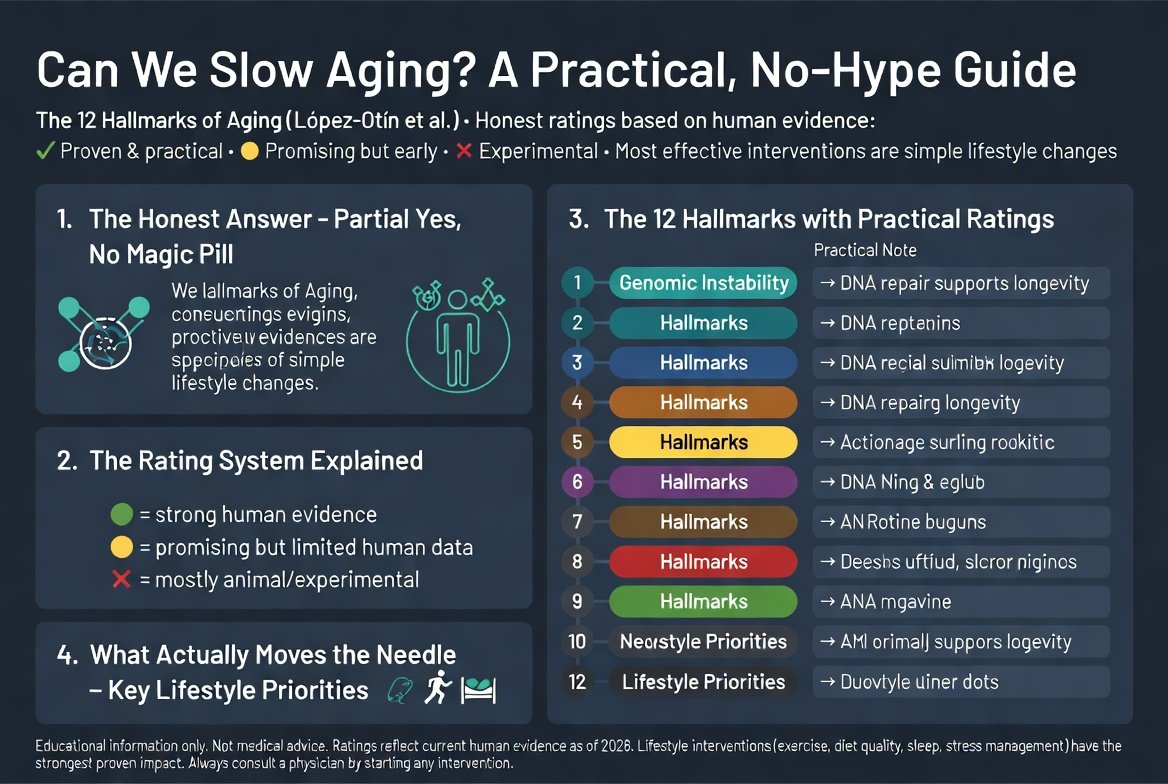
According to de Grey, everything we call "aging" results from a combination of seven cellular processes. Each requires its own solution:
- Cell Loss and Atrophy: Cells that die and are not replaced. The solution: stem cells and regenerative medicine.
- Zombie Cells - Senescence (Death-resistant cells): Cells that don't die when they should. The most well-known clinical example of senolytic drugs trying to eliminate them is the combination of dasatinib + quercetin, although other senolytic approaches exist.
- Accumulation of Intracellular Junk: Damaged proteins that cleaning enzymes cannot break down. The solution: bacterial enzymes capable of digesting them.
- Accumulation of Extracellular Junk: Like beta-amyloid in Alzheimer's. The solution: immunotherapy.
- Crosslinks: Connective tissue proteins that bind to each other, making skin and arteries stiff. The solution: AGE-breaking enzymes.
- Nuclear Mutations: Cancer. The solution: WILT, a method to shorten telomeres in all cells except stem cells.
- Mitochondrial Mutations: Damage to mitochondrial DNA. The solution: transferring these genes to the cell nucleus.
From SENS to the LEV Foundation
De Grey founded the SENS Research Foundation in 2009 and served as its Chief Science Officer. In August 2021, after about 12 years at the organization, he was ousted from his position by the SENS board following an internal investigation into complaints filed against him. This was a board-initiated termination, not a voluntary departure. A year later, de Grey founded a new organization, the LEV Foundation (Longevity Escape Velocity Foundation). The name reflects his core belief: there is a point after which the rate of medical progress outpaces the rate of aging itself, and each year of research adds more than one year of life. According to him, we may be approaching this point.
The Pivotal Experiment: 18-Month-Old Mice
At the center of LEV's work was an ambitious experiment, the first Robust Mouse Rejuvenation study (RMR1): taking mice in mid-life (treatment starting at 18 months of age, roughly equivalent to 60-year-old humans) and treating them with a combination of several interventions simultaneously. The hypothesis was that the combination of interventions would have a stronger effect than a single intervention. The study, largely completed, yielded a mixed and qualified result: the combination of damage repair with rapamycin showed cumulative benefit, extending average lifespan and creating what is called a "square" of the survival curve (more mice survived into old age). However, no dramatic extension of maximum lifespan was observed (the age of the oldest mice). The senolytic treatment arm showed no efficacy, and telomerase had different effects between males and females. That is, the result supports the idea of cumulative benefit, but is far from an unequivocal "breakthrough."
The 1000-Year Vision
De Grey's most famous statement, mainly associated with the 2004-2005 period (in his TED talk): "The first person to reach the age of 1000 has already been born." De Grey maintains his optimistic stance. His documented position is that there is about a 50% chance of reaching "biological escape velocity" within about 12 to 15 years from now, i.e., around 2035 to the end of the next decade. It is important to emphasize: this is de Grey's personal prediction, and it is controversial. Many researchers in the field believe it is overly optimistic given the complexity of human aging.
Critics and Controversy
De Grey is not without critics. Traditional gerontologists argue that the 7-damage theory is overly simplistic, and that aging involves systems more complex than the sum of their parts. Others point out that any success in the lab is far from humans. De Grey himself agrees there is a gap, but insists it is engineering, not biological: according to him, we know what the problems are, and now we need to translate this to the clinic.
What Does This Mean for Us?
Even if the 1000-year vision is distant, de Grey's approach has influenced the discourse around drugs already reaching the clinic: senolytic drugs, mTOR inhibitors (like rapamycin), NAD+ treatments, and combinations of senolytics and senomorphics. If you've ever wondered why all the newspaper headlines about anti-aging drugs have emerged in the last decade, a significant part of the explanation goes back to one man with a long beard who told everyone, about two decades ago, that all this is possible. Whether right or wrong, his influence on the field is clear.
References:
LEV Foundation
SENS Research Foundation

💬 Comments (0)
Be the first to comment on the article.