Liver diseases are a significant cause of death:
- They account for more than 50,000 deaths annually in the United States.
- They cause over one million hospitalizations each year.
- They cause more than 100,000 cases of end-stage liver failure each year.
Orthotopic liver transplantation (OLT) is a limited solution:
- It is currently the only curative treatment for patients with irreversible liver failure.
- It is limited by a small number of donors.
- It involves significant risks, such as infection, rejection, and death.
- It is very expensive.
Hepatocyte transplantation may be an alternative solution:
- This approach may provide effective treatment for patients who are not suitable for OLT.
- It may support declining liver function.
- It may increase functional liver mass.
Lymph nodes as an alternative site for hepatocyte transplantation:
- Previous research showed successful hepatocyte transplantation in mouse lymph nodes.
- A groundbreaking study examined the feasibility of this approach in a pig model of liver failure.
Research methods:
- 6 pigs underwent surgical induction of subacute liver failure. Liver injury was caused surgically: 3 pigs underwent right portal vein ligation (RPVL) and 3 pigs underwent a portacaval shunt, combined with resection of the left liver lobe.
- Autologous liver cells were isolated from the resected left liver lobe using a two-step collagenase perfusion (a standard procedure for hepatocyte isolation). The viability of the obtained cells exceeded 90%.
- The liver cells were injected directly into the mesenteric lymph nodes.
- All six pigs received hepatocyte transplantation. There was no control group.
- The animals were monitored for 30 to 60 days.
Research results:
- Hepatocyte transplantation into lymph nodes was safe and feasible.
- The liver cells successfully integrated into the lymph nodes.
- Functional ectopic liver tissue formed within the lymph nodes, with histological characteristics of normal liver tissue, including the formation of sinusoids and bile ducts.
- The transplanted liver cells created functional ectopic liver tissue, and the amount of tissue formed was proportional to the severity of the injury to the original liver.
- No serious side effects were observed.
Research conclusions:
- Hepatocyte transplantation into lymph nodes is a new and promising therapeutic approach for treating liver failure.
- This approach may provide a more effective and accessible solution for patients with end-stage liver disease.
Further research:
- Future studies will focus on:
- Developing more efficient transplantation techniques.
- Developing drugs and support for ectopic liver tissue.
- Examining the efficacy and safety of this approach in humans.
LyGenesis: An Innovative Solution for Mini-Livers, Human Trials.
LyGenesis is a biotechnology company developing a groundbreaking technology for growing "mini-livers" (ectopic organoids) in the lymph nodes of patients suffering from end-stage liver failure. This approach may provide an innovative solution to the problem of organ shortage for transplantation and save many lives.
LyGenesis technology:
- The company uses donated livers that are not suitable for standard transplantation.
- Liver cells are separated from the liver and processed in the lab.
- The liver cells are injected into the lymph nodes in the upper abdomen using an endoscopic ultrasound (EUS) approach.
- The lymph nodes provide a supportive environment for the growth of liver cells and serve as a living "bioreactor" in the body.
- Within a few months, functional "mini-livers" form within the lymph nodes.
Advantages of the LyGenesis approach:
- A solution to the problem of organ shortage for transplantation.
- More accessible treatment for patients suffering from liver failure.
- A relatively simple procedure compared to standard liver transplantation.
- Relatively low risk of rejection and infection.
- Potential to improve the quality of life and life expectancy of patients.
Clinical trials:
LyGenesis is conducting a Phase 2a clinical trial, the first-in-human trial of this treatment.
This is an open-label, dose-escalation trial examining the safety and efficacy of the treatment in 12 patients with end-stage liver disease.
The first patient in the trial received the treatment in 2024, and each participant will be closely monitored for one year.
According to estimates, preliminary results are expected to be published later.
It should be noted that LyGenesis plans to perform similar procedures for a variety of different organs, here is their progress: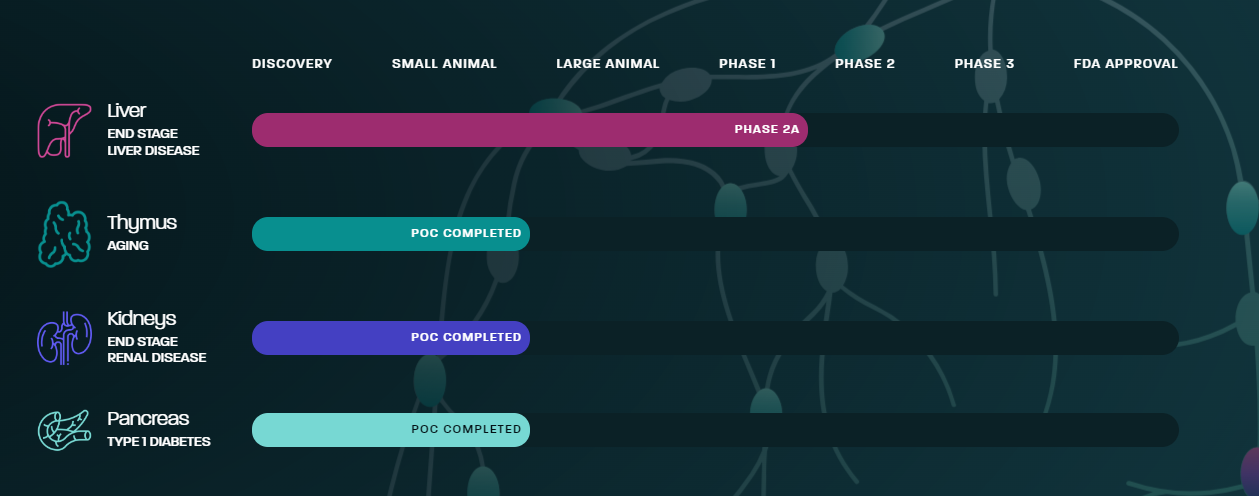
LyGenesis's technology for growing "mini-livers" in lymph nodes is an innovative and exciting solution to the problem of organ shortage for transplantation.
This approach may save many lives and improve the quality of life for patients suffering from end-stage liver failure.
.
References:
https://www.lygenesis.com/
https://journals.lww.com/lt/fulltext/2020/12000/development_of_ectopic_livers_by_hepatocyte.14.aspx
https://pubmed.ncbi.nlm.nih.gov/23000933/






💬 Comments (0)
Be the first to comment on the article.