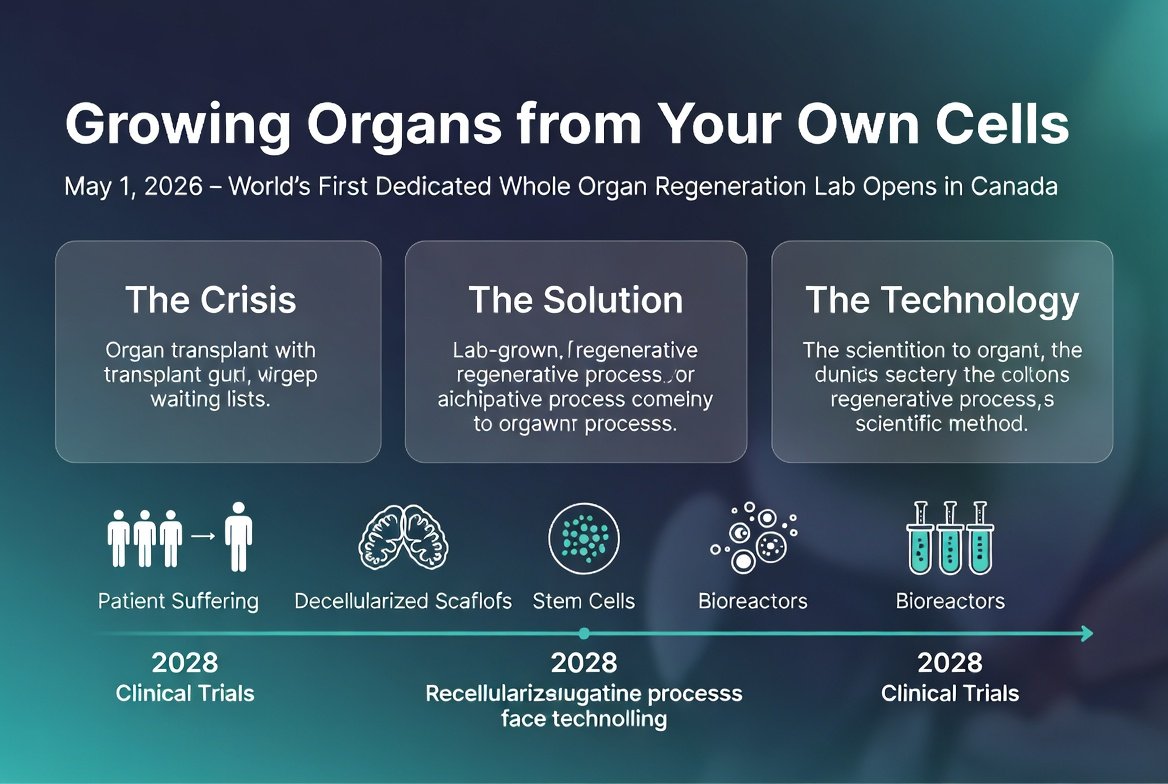
Imagine a donor organ that has been completely cleared of all cells. Only a scaffold of proteins, fats, and sugars remains, arranged exactly as they were in reality. Now imagine repopulating it with your own cells, and it becomes a foundation that can repair damaged tissue without being rejected by the immune system. This is not science fiction. This is decellularized extracellular matrix (dECM), a technology moving from the lab to the clinic. A review article in Bioengineering summarizes where we stand, in which fields there is already clinical use, and what to expect in the coming decade.
What is Extracellular Matrix?
In every organ in the body, cells are not just "cells." They sit on a complex scaffold of proteins (collagen, elastin, fibronectin), polysaccharides (glycosaminoglycans), and growth factors. This scaffold is called the Extracellular Matrix (ECM). It does not just "support" cells. It:
- Provides growth instructions: The structure of the ECM influences the nature of the cell that develops on it
- Controls function: A heart cell behaves differently from a kidney cell, partly because the ECM around it is different
- Holds growth factors: Molecules that guide regeneration are "stored" within the ECM
- Enables communication: Signals between cells pass through the ECM
The Idea: Remove the Cells, Keep the Scaffold
Researchers have shown that if you take a tissue or organ from a donor (animal or human) and perform decellularization (removal of all cells), only the ECM remains. A famous milestone in the field was published in 2008, when a group led by Harald Ott performed decellularization of a whole rat heart using a perfusion method, obtaining a whole heart scaffold with a preserved vascular network. The scaffold retains its structure, the blood vessel network remains intact, and some biological instructions are preserved. Only the cells themselves are gone.
Methods for decellularization:
- Physical: Acoustic waves, temperature changes, pressure
- Chemical: Mild detergents that break down cells without damaging proteins
- Enzymatic: Specific enzymes that break down cell structures
A combination of the three often yields the best result.
The Next Step: Repopulation
Once you have a clean scaffold, the next step is to return cells to it. The ideal approach:
- Take stem cells from the patient themselves (from blood, skin, bone marrow)
- Grow them in the lab in large numbers
- Seed them onto the scaffold, gently, in the right areas
- Culture in a bioreactor (a device that simulates body conditions)
- After weeks to months, the tissue begins to function
The main advantage: Potential for reduced immune rejection. When the cells come from the patient themselves, the chance that their body will recognize the scaffold as foreign is reduced.
Where Are We Now? Applications That Already Work
The review in Bioengineering focuses specifically on applications that have already been proven, rather than future promises. The documented achievements to date:
- Wound healing and skin restoration: This is the most mature clinical use. Commercial products based on dECM already exist for covering and healing wounds, including chronic wounds in diabetic patients and burns.
- Heart and blood vessel repair: dECM patches and scaffolds are being studied for restoring areas of the heart wall damaged after a heart attack, and for repairing blood vessels. At the research stage, with early encouraging results.
- Nerve restoration: Conductive tubes based on dECM are being tested to bridge gaps in damaged nerves and support nerve regeneration.
- Breast reconstruction: After mastectomy, dECM is used as a supportive scaffold in the reconstruction process.
The common denominator: In most cases, it involves tissue repair or providing a supportive scaffold, not growing a whole human organ from scratch.
What Else Is in Research?
Beyond the applications already in use, many research groups are working on expanding the technology. All of these are still in preclinical stages (cells and animals), not proven in humans:
- dECM-based heart scaffolds: Continuing the research line of Ott from 2008. The distant goal is heart patches and eventually more complex structures.
- Kidney scaffolds: Being worked on by several groups. A major challenge is repopulating the delicate vascular network of the kidney.
- Uterine tissue: There is a notable preclinical result here. In work by Hellstrom & Brannstrom, a uterine scaffold patch repopulated with stem cells was attached to the uterus of rats that had undergone partial resection, and it supported pregnancy at a rate similar to that of rats with a whole uterus. It is important to be precise: This is partial restoration of a damaged uterus in a rat, not a whole uterus created anew, and not in humans.
- Central nervous tissue: Further away. Being studied in models, with a theoretical horizon of supporting recovery after stroke.
The Limitations
The technology is far from solved:
- Production time: Building complex tissue requires weeks to months
- Cost: The processes are expensive, and most are still at the research stage rather than as a priced clinical procedure. Cost reduction is a condition for making them accessible
- Quality: Repopulation does not always succeed in mimicking the original tissue exactly
- Blood vessels: Repopulating a complete vascular network throughout its length is one of the hardest challenges
- Source and safety: When using tissues from an animal donor (e.g., pig), complete removal of cells and factors that cause rejection or viruses must be ensured
How Does This Fit into Anti-Aging?
In the context of aging, dECM offers two principal possibilities:
- Repair of damaged tissues: Skin, cartilage, and soft tissues. Instead of living with the damage, perhaps it could be repaired
- Scaffold for restoring failed tissues: A long-term direction, still mostly research-based, of providing a self-scaffold for damaged tissue instead of a transplant dependent on anti-rejection drugs
In an era where life expectancy is increasing, some of our tissues simply wear out. dECM offers an approach: not to stop aging, but to repair and replace worn-out parts. This is still largely a promise, not an available solution.
The Bottom Line
dECM technology is one of the most intriguing directions in reconstructive medicine. In the fields of wound healing, heart and nerve repair, and breast reconstruction, it has already moved from concept to clinical use or advanced clinical research. In more ambitious areas, like whole organs, we are still at the preclinical stage. The review in Bioengineering points to a clear trend: more applications, more approvals, and prices that will decrease over time. Anyone following advances in anti-aging should be familiar with this field, while also remembering that the big promises are still far from the clinic.

💬 Comments (0)
Be the first to comment on the article.