Sarcopenia - the gradual loss of muscle mass and strength with age - is one of the central issues of longevity. Muscle mass decreases by about 3 to 8 percent per decade starting at age 30, and the rate of decline accelerates further after age 60, so that over a lifetime a person may lose about a third of their muscle mass. Sarcopenia has a genetic component that science is only beginning to map, and most genetic research to date has been conducted in populations of European descent. A large Korean study attempts to close this gap.
Why is Ethnic Genetics Important?
Sarcopenia is a common phenomenon worldwide. Its prevalence varies greatly depending on diagnostic criteria and the population studied: among community-dwelling adults over 65, it ranges roughly between 5% and 13%, and increases significantly with age - according to the AWGS 2019 criteria (Asian Working Group for Sarcopenia), its prevalence in Asian men jumped from only 1.5% in those aged 60-69 to about 33% in those over 80.
Some of the differences between populations stem from diet and physical activity, but there is also a genetic layer. Here a fundamental problem arises: most genome-wide association studies (GWAS) on sarcopenia have been conducted in populations of European descent, and very little is known about the genetic factors in older adults in East Asia. A genetic variant common in one population can be rare in another, so findings from a European study do not necessarily translate directly to other populations.
The Study: GWAS on Nearly 7,000 Participants
In a study published in the journal Scientific Reports in 2022 (Jin et al.), researchers analyzed genetic data from 6,961 participants from two Korean populations: the VHSMC cohort (approximately 1,781 participants, mean age about 69) and the larger KARE cohort (approximately 5,180 participants, mean age about 63).
Instead of relying solely on a dichotomous diagnosis, the researchers examined quantitative measures of muscle and body composition:
- Lean Body Mass (LBM) - total body mass excluding fat.
- Appendicular Skeletal Muscle Mass (ASM) - muscle in the arms and legs, a key measure for sarcopenia.
- Skeletal Muscle Index (SMI).
The GWAS analysis compared the frequency of millions of genetic variants (SNPs) between participants with higher and lower muscle mass, to identify variants statistically associated with muscle measures.
Findings: New Genetic Variants
After stringent statistical corrections, the team identified several genetic regions with significant associations with muscle mass. The main genetic markers identified:
- Variant rs1187118 near the RPS10 and NUDT3 genes, associated with lean body mass (LBM).
- Variant rs3768582 in the region of the NCF2, SMG7, and ARPC5 genes, also associated with lean body mass.
- Variant rs6772958 near the GPD1L gene, associated with appendicular skeletal muscle mass (ASM).
The researchers found that these genes are differentially expressed in muscle tissue and linked them primarily to lipid and energy metabolism. That is, the idea emerging from the study is that part of the tendency to lose muscle with age is related to the metabolic regulation of muscle cells, not just to the structural proteins of the muscle itself. It is important to note that the well-known sports performance gene ACTN3 was not among the findings of this study; it has been studied in other contexts and is not one of the "new genes" that emerged here.
Why Does This Matter?
The value of the study lies mainly in expanding the genetic knowledge base on sarcopenia beyond populations of European descent:
- Population diversity in research is essential. Variant frequencies can vary between ethnic groups, so it is important to study diverse populations, not just those that participated in the initial studies.
- The link to metabolism opens research directions. If metabolic variants indeed affect muscle maintenance, there may be new biological pathways to understand the process.
- This is an early step, not a final conclusion. These are statistical associations that require confirmation in further studies; there is no ready-to-use genetic test or new treatment here.
What Can Actually Be Done About Sarcopenia?
While genetics is still in the mapping phase, the proven treatment for sarcopenia is well-known and does not depend on genetic testing. Evidence-based recommendations, in line with the AWGS 2019 guidelines, are:
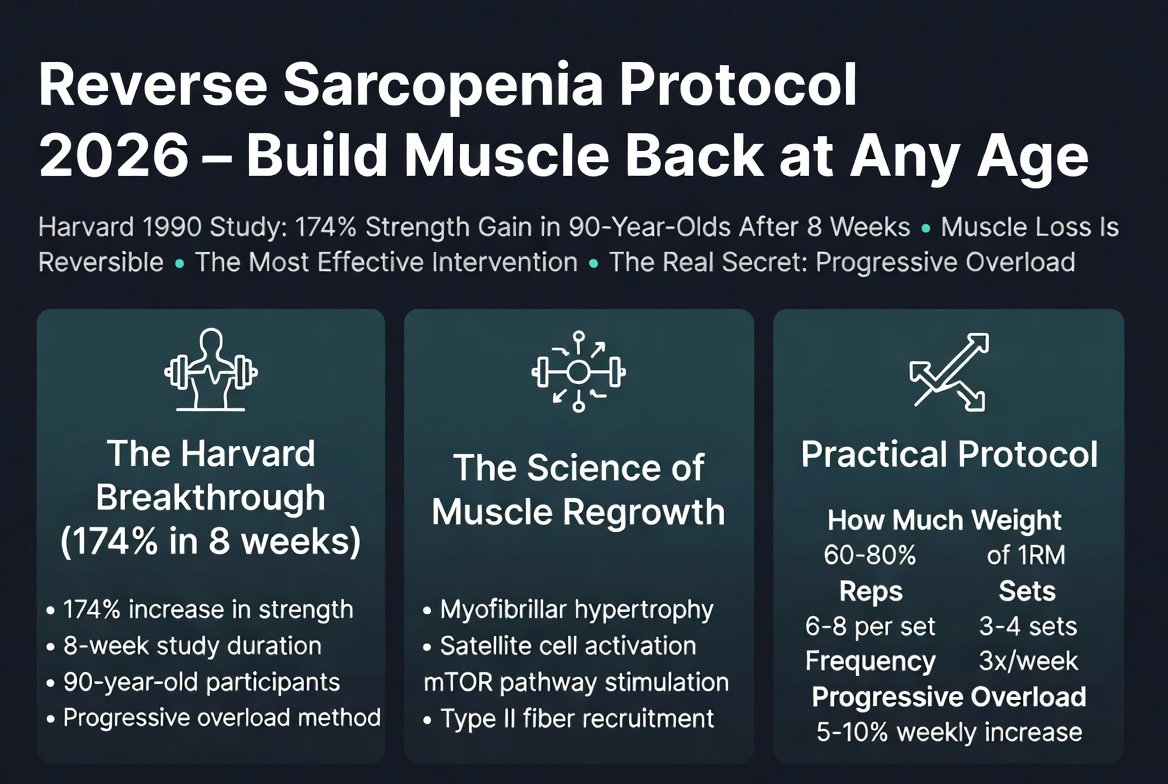
- Resistance (strength) training - the only factor repeatedly proven to increase muscle mass and strength even in old age.
- Adequate protein intake - for most older adults, a higher intake than for younger individuals is recommended, distributed throughout the day.
- General physical activity and avoidance of inactivity, which accelerates muscle loss.
It is important to note: interventions such as growth hormone supplements are not a recommended treatment for sarcopenia, are not supported by guidelines, and are not without risk. There is no need for SNP testing to know what to do - strength training and proper nutrition help everyone.
The Broader Message
The Korean study is an example of a broader principle in personalized medicine: genetics is not universal, and studies must include diverse populations. If science seeks to fulfill the promise of personalized medicine in the anti-aging era, it must work with different populations, not just those that participated in the initial studies. In the meantime, the foundation is clear: resistance training and a protein-rich diet are the proven way to maintain muscle with age.
References:
Jin H. et al. (2022). Unveiling genetic variants for age-related sarcopenia by conducting a genome-wide association study on Korean cohorts. Scientific Reports. DOI: 10.1038/s41598-022-07567-9

💬 Comments (0)
Be the first to comment on the article.