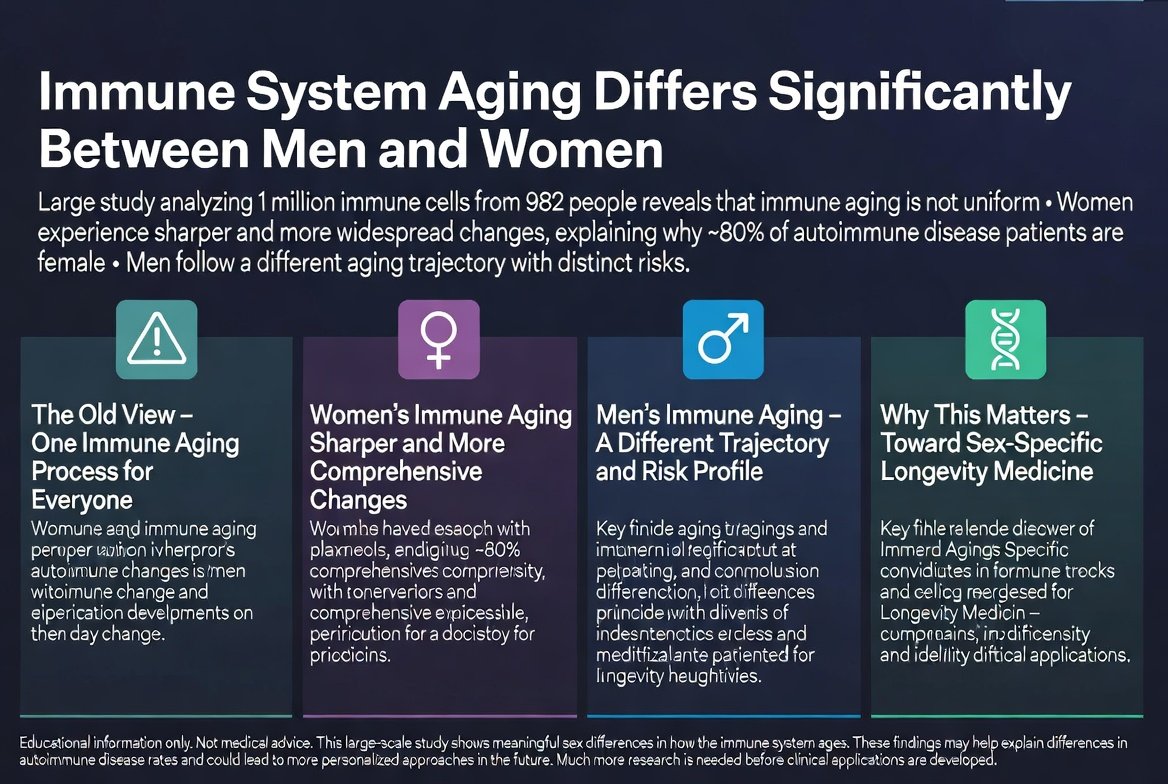
For years, aging medicine treated the immune system as a single system that deteriorates at a similar rate for everyone. A new groundbreaking study published in Nature Aging collapses this assumption. The study, led by Prof. Marta Mele from the Barcelona Supercomputing Center (BSC) and with lead researcher Maria Sopena-Rios, analyzed blood samples from 982 men and women of all ages, and found: The immune system of women ages dramatically differently, and generally, faster.
How was the study conducted?
The researchers used a technology called "single-cell RNA sequencing", which analyzes the gene expression of each cell individually. This way, they analyzed over a million cells and identified specific immune cell populations and the changes they underwent in each age group. Comparing women versus men at every age revealed distinct sex-specific patterns.
What happens in women?
The researchers identified three key changes that are more specific to women:
- Expansion of CD8+ Effector Memory T cells. These cells are the "killers" of the immune system, tasked with destroying infected cells. Their expansion in older age may explain chronic inflammatory phenomena in older women
- Expansion of inflammatory monocytes. Monocytes are blood cells specialized in inflammatory response. Low-grade chronic inflammation accompanying aging (inflammaging) is generally linked in the literature to heart disease and diabetes, although the study itself did not establish a direct link for this cell population
- Changes in CD4+ Central Memory T cells. These are memory cells responsible for a rapid immune response to known pathogens. The changes identified in the study were found in genetic loci linked to autoimmune diseases such as lupus, RA, and MS, diseases that are 4-9 times more common in women
What happens in men?
In some men, the researchers identified a different phenomenon: expansion of a specific B cell population linked to Chronic Lymphocytic Leukemia (CLL), a type of blood cancer. Specifically, a pattern characteristic of an asymptomatic precursor state (monoclonal B-cell lymphocytosis) was identified, meaning before the disease manifests clinically.
This finding is interesting: it suggests that in the future, it might be possible to detect early signs related to CLL in the blood of men, years before a possible diagnosis, although further research is needed to establish clinical use.
Why does this happen?
Not all factors are known. Possible mechanisms that the scientific literature raises as explanations for differences between sexes include:
- Hormones. Estrogen has a strong modulatory effect on the immune system. A drastic drop in estrogen at menopause changes the entire system
- Genetics of the X chromosome. The X chromosome contains several key immune genes. Women, with two copies, receive an "extra" that can be both protective and cause hypersensitivity
- Pregnancy and childbirth. Each pregnancy utilizes the immune system, and some speculate that cumulative effects occur over a lifetime
It is important to emphasize: these are general hypotheses from the literature, and the current study mapped the differences between sexes but did not prove which of these mechanisms is responsible for them.
Why does this matter for treatments?
The researchers' conclusion was general: the findings provide a high-resolution map of sex-specific immune aging, and lay the foundation for integrating biological sex into personalized medicine of aging. Beyond the scientific conclusion itself, several general lines of thought can be raised that warrant future investigation:
- Vaccines. It is possible that in the future, sex-adapted or age-adapted vaccination protocols will be considered, but this is a research direction and not a recommendation from this study
- Sex-specific understanding of inflammation. The differences in the inflammatory profile between women and men may in the future influence how immune health in older age is approached
- Early risk identification. The finding regarding men and B cells may in the future contribute to tools for early identification of blood cancer risk, subject to further clinical research
In any case, this study does not recommend any supplement, drug, hormonal treatment, or screening test. Any medical decision should be made with a doctor.
The bottom line
"Personal health" is not just about diet and physical activity. It is also about understanding that your body, at certain points in your life, behaves differently from someone else's body. This study is a big step towards truly personalized medicine, within a body that changes throughout life.



💬 Comments (0)
Be the first to comment on the article.