If you read the title and fear this is another guide telling you to stop enjoying food, we'll reassure you immediately: it's not. We don't believe in demonizing food, don't think "sugar is poison," and won't ask you to give up carbohydrates. Most foods in the world are perfectly fine, and some are even excellent for longevity. But there is a small, clear group of foods worth limiting, not because they are "forbidden," but because over the years they exact a real metabolic price.
The difference between a fear-mongering guide and a good guide is one word: why. Instead of "don't eat this," we'll try to explain exactly what happens in the body when you eat added sugar and refined carbohydrates, how it accumulates into insulin resistance, inflammation, and tissue aging, and at what point it turns from a theoretical problem into a real one. And along the way, we'll dismantle the most stubborn myth in the field, the one that says "you must eat sugar for your brain to work." It's simply not true, and we'll show exactly why.
What are the foods to limit?
Let's start with the list, then explain each one. These are the foods to limit, ordered by how significant they are:
- Added sugar: Not the natural sugar in a whole fruit, but the sugar added to products. Cakes, candies, sweet sauces, breakfast cereals, and most of all, sweetened beverages.
- Refined (simple) carbohydrates: White flour, white rice, white bread, regular pasta. These are grains from which the fiber and germ have been removed, leaving mostly starch that breaks down into sugar quickly.
- Sweetened beverages: Cola, sweetened juices, energy drinks, and even 100% natural fruit juice. They inject liquid sugar into the bloodstream without any fiber to slow it down. And yes, "diet" and "zero" drinks also belong in the category worth limiting; we'll explain why later.
- Ultra-processed food: Industrial products composed mainly of isolated substances, sugar, oils, salt, and additives. Packaged snacks, sausages, ready meals. We've written a separate guide on this and will link to it later.
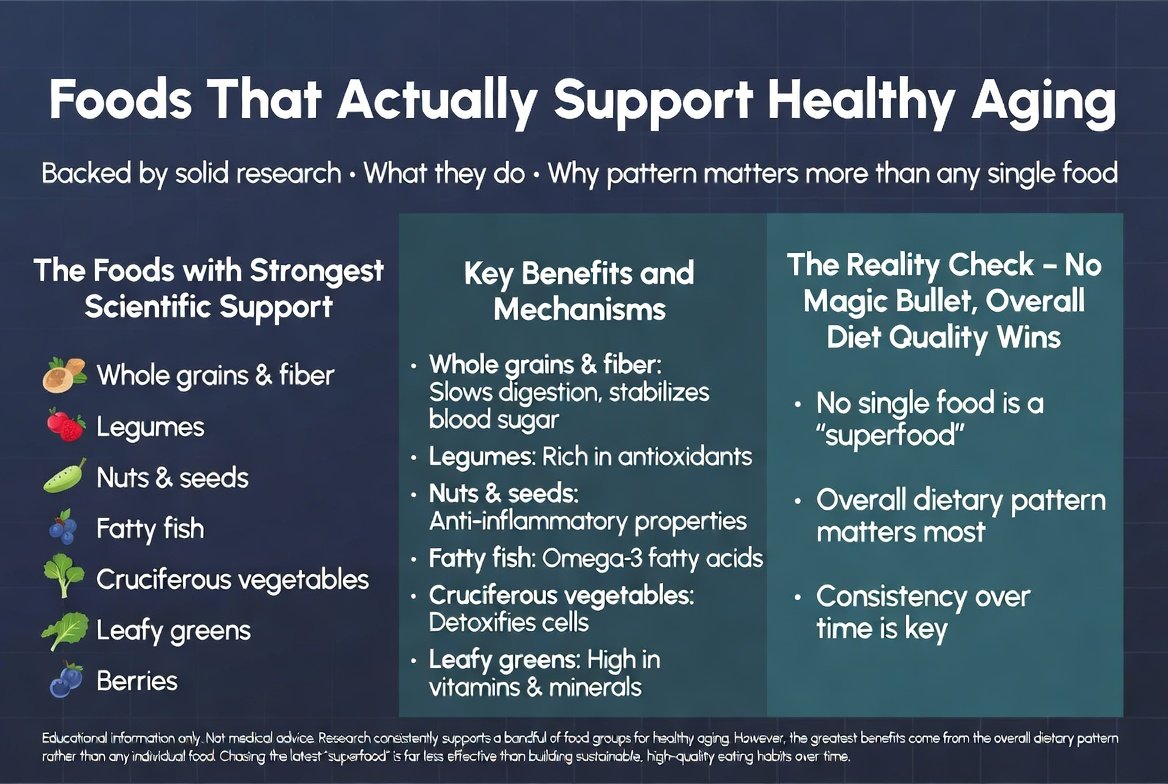
Notice what is not on the list: complex carbohydrates, whole grains, legumes, whole fruits, vegetables, fiber. These are not only "allowed," they are truly part of a healthy diet for longevity. The problem was never "carbohydrates." The problem is refined carbohydrates and added sugar that are absorbed too quickly. This is a critical distinction we'll return to.
The mechanism: Why a sharp sugar spike is the problem
To understand why specifically these foods make the list, you need to understand what happens in the body the moment you eat them. And this is the heart of the guide, because here lies the "why."
Stage 1: The spike
When you eat added sugar or a refined carbohydrate, there are no fibers and no structure to slow down absorption. The glucose flows into the blood quickly and at a high level. Your blood sugar level spikes sharply. With a sweetened drink, this happens fastest, because it's liquid sugar with no brake.
Stage 2: The insulin wave
The pancreas detects the spike and releases a large wave of insulin, the hormone whose job is to get the sugar out of the blood and into the cells, returning the level to normal. The sharper the spike, the larger the insulin wave. This is a normal, life-saving response, once in a while. The problem starts when it happens again and again, several times a day, day after day.
Stage 3: The crash and the recurring craving
After a large insulin wave, blood sugar often crashes below the starting point. The result is familiar to everyone: an hour after the croissant or cola, you're tired, foggy, and hungry again, looking for more sweets. This is an exhausting cycle that pushes you to eat more of the thing that caused the problem.
Stage 4: What accumulates over years
And here is the real story, because the warning is not about the single croissant. When the pattern of sharp spikes repeats itself over years, three types of damage accumulate:
- Insulin resistance: When cells are bombarded with insulin non-stop, they start to "tire" and respond less. The pancreas compensates by producing even more insulin, until the system begins to collapse. Insulin resistance is the cornerstone of metabolic syndrome, type 2 diabetes, and heart problems. It doesn't happen overnight; it builds silently over a decade.
- Chronic inflammation: Chronically high sugar and insulin levels fuel a quiet inflammatory state throughout the body, what scientists call "inflammaging," inflammation related to aging. Low-grade chronic inflammation is a common denominator of almost all age-related diseases.
- Glycation and AGEs: This is perhaps the least known and most important part. We'll explain it separately.
Glycation: How sugar literally ages tissues
When blood sugar levels are high for a long time, glucose molecules attach to proteins in the body in a process called glycation. The final products of this process are called AGEs (Advanced Glycation End products). Their small, perfect name in English, AGEs, sounds like the word "aging," and that's exactly what they do.
Here's how it works on the skin, the most tangible example: collagen and elastin are the proteins that keep skin flexible and young. When sugar binds to them, the collagen fibers cross-link in a disorganized way, becoming stiff, short, and brittle. The result is skin that loses elasticity, becomes rigid, and wrinkles faster. The exact same process also happens in blood vessels, the eye lens, and every other tissue. Glycation is one of the known causes of tissue aging, and it is directly accelerated by high blood sugar (and in the skin, also by sun exposure).
So when people talk about "sugar aging you," it's not a marketing metaphor. It's a real, measurable biochemical mechanism.
Bursting the myth: "You must eat sugar for your brain"
This is probably the most common myth that stops people from reducing sugar, and it's worth dismantling carefully and honestly, because it contains a kernel of truth mixed with a big mistake.
What's true: The brain does mainly run on glucose
This is the true part. The brain is a huge energy consumer, and it is indeed fueled mainly by glucose. Estimates are around 120 grams of glucose per day that the brain consumes, a huge portion of the body's energy budget. So far, whoever says "the brain needs glucose" is completely right.
What's not true: That you need to eat sugar to supply it
And here is the wrong logical leap. The fact that the brain uses glucose does not at all mean you need to eat sugar or refined carbohydrates to supply it. Why? Because your body is an excellent glucose producer on its own:
- Gluconeogenesis: The liver can produce glucose from scratch, from protein (amino acids), from glycerol (from fat), and from lactate. This is a basic, ongoing mechanism. Even if you don't eat a single gram of sugar, your liver will ensure your blood glucose level remains stable and your brain gets what it needs.
- Ketones: During fasting or low-carbohydrate diets, the brain partially switches to using ketones, an alternative energy source the body produces from fat. The brain actually likes them, and they supply a significant portion of its needs in such states.
The biological conclusion is clear: Added sugar in the diet is not necessary for the brain. Not a single gram. The glucose your brain needs is comfortably supplied from internal sources and from real food (complex carbohydrates, vegetables, fruits). Whoever sells you chocolate "because your brain needs it" is selling you wrong physiology. It's true that many people feel a craving for sugar when they are hungry or tired, but that's a behavioral and habitual craving, not a real metabolic need of the brain.
Important to emphasize: This is not a war on carbohydrates
At this point, it's easy to slide into extremism, so let's pause for balance. The problem is added sugar and refined carbohydrates, not carbohydrates in general. The difference is fundamental:
- Complex carbohydrates and whole grains (oats, quinoa, brown rice, whole wheat bread) come with fiber that slows down sugar absorption, so there's no sharp spike. They are excellent.
- Legumes (lentils, chickpeas, beans) are a fiber and protein bomb, and a hallmark of long-lived populations. Eat them without fear.
- Whole fruits contain natural sugar, true, but it's packaged with fiber, water, and antioxidants that completely moderate it. A whole apple is not a glass of apple juice. Eat the fruit, not the juice.
- Fiber in general is the hero of the story: it moderates any sugar rise, feeds good gut bacteria, and improves satiety.
In other words, your plate doesn't need to be low-carb. It needs to be low in added sugar and refined carbohydrates, and rich in fiber, complex carbohydrates, and protein. This distinction is worth much more than any fad diet.
The evidence: What the numbers say
All this mechanism doesn't remain theoretical. It appears in large human studies.
The controlled trial on ultra-processed food
The most important study in the field is a controlled trial by Kevin Hall and colleagues at the US National Institutes of Health, published in Cell Metabolism in 2019. 20 volunteers were hospitalized in a closed facility and received alternately two weeks of an ultra-processed diet and two weeks of an unprocessed diet, matched for calories, sugar, fat, and fiber. When eating ultra-processed, people ate an average of about 508 more calories per day and gained weight, without noticing. Same people, same offered calorie range, only the level of processing differed.
Sweetened beverages and diabetes
A classic meta-analysis by Malik and Hu, published in Diabetes Care in 2010, found that people who drank the most sweetened beverages (usually 1 to 2 servings per day) had a 26% higher risk of developing type 2 diabetes compared to those who drank little or none. Later reviews strengthened the link to heart disease and mortality as well. A liquid sweetened drink is probably the most "pure" form of the foods to limit, and therefore it's the first target.
And why are "zero" and "diet" also on the list?
Intuitively, a drink without sugar sounds like a solution. But artificial sweeteners maintain the habit of sweet taste, and some studies link their regular consumption to changes in the gut microbiome and disruption of sugar regulation, and they don't necessarily help with weight loss in the long term. They are less bad than a full-sugar drink, but they are not "healthy," so it's better to limit them too and aim for water. The gold standard for a drink is still the simplest: water, flavored water without sweeteners, unsweetened tea, and infusions.
Practical: How to identify hidden sugar and reduce without suffering
Now for the part you can implement today. Most of the added sugar we consume comes from places we don't suspect.
How to identify hidden sugar on the label
- Look for the "of which sugars" line in the nutrition table. A useful rule of thumb: more than 5g of sugar per 100g in a savory product (like sauce or bread) is a red flag.
- Sugar hides under many names in the ingredient list: high fructose corn syrup, dextrose, maltose, glucose syrup, concentrated cane juice, and dozens more. If several appear, there's a lot of sugar there.
- The surprising suspects: tomato and barbecue sauces, sweet soy sauce, granola, flavored yogurt, breakfast cereals, industrial sliced bread, and salad dressings. These are seemingly "savory" or "healthy" foods loaded with sugar.
How much is "too much"?
To give an anchor: The World Health Organization recommends limiting free sugars to below 10% of daily calories, and preferably below 5%, about 25 grams (about 6 teaspoons) per day. The American Heart Association recommends up to about 25 grams for women and 36 grams for men per day. To illustrate, one can of cola contains about 35 grams of sugar, meaning one drink already crosses the entire daily limit. This is exactly why sweetened beverages are the first target.
Smart swaps
- Sweetened drink or juice → water, flavored water, or soda with a slice of lemon. This is the single swap with the biggest impact. If it's hard, transition gradually.
- White bread and white rice → whole wheat bread, brown rice, quinoa, or legumes. Same role on the plate, much slower sugar absorption thanks to fiber.
- Sugary breakfast cereal → oatmeal with nuts and berries. Long-lasting satiety instead of a spike and crash.
- Processed candy → a whole fruit with a handful of nuts, or a square of 70% dark chocolate. Satisfies the craving, with fiber and fat that moderate it.
- Add protein, fat, and fiber to every meal. This is perhaps the most useful trick: the same amount of carbohydrate raises blood sugar much less when eaten together with protein, fat, or fiber. A nut next to the sugar, or protein before the carbohydrate, literally flattens the sugar curve.
Your palate adapts, and that plays the game
An encouraging point to end the practical part: your sweetness threshold changes. When you gradually reduce sugar over a few weeks, your palate gets used to it, and drinks and foods that once seemed "not sweet enough" start to taste perfect, while the old sweetened drink starts to feel unpleasantly sweet. The reduction becomes easier as you go, not harder.
The summary: Not fear, but understanding
If you take only three things from this guide: first, the foods to limit are mainly added sugar, refined carbohydrates, sweetened beverages, and ultra-processed food, and the reason is not a fad but a real mechanism of sugar and insulin spikes leading to insulin resistance, inflammation, and glycation that ages tissues. Second, you absolutely do not have to eat sugar for your brain: your liver produces the glucose it needs, and it's a behavioral need, not a metabolic one. And third, and most importantly, this is not a war on carbohydrates or a starvation diet, but a smart choice of slow, whole carbohydrates instead of fast, refined ones.
The big principle is simple: It's not the birthday cake that determines things, but the daily pattern over years. Whoever limits added sugar and refined carbohydrates in their routine can enjoy the occasional treat with a clear conscience. Want to turn these principles into a personal menu? Build nutrition principles for longevity that suit you. And if you love sweets, we have a separate guide showing how to enjoy desserts without the spikes, and many more practical guides for a healthy life.
For those who want to delve deeper into the industrial food side, we have a detailed guide on ultra-processed food and its impact on longevity, which complements this guide from the processing level angle.
The information in this guide is general and for lifestyle and informational purposes only, and does not constitute medical or nutritional advice and is not a substitute for consultation with a qualified doctor or dietitian, especially if you have diabetes, pre-diabetes, or a metabolic condition requiring monitoring. Do not change medications or therapeutic diets on your own.
References:
Hall KD et al., Cell Metabolism 2019, Ultra-Processed Diets Cause Excess Calorie Intake and Weight Gain
Malik VS et al., Diabetes Care 2010, Sugar-Sweetened Beverages and Risk of Metabolic Syndrome and Type 2 Diabetes
WHO 2015, Guideline: Sugars intake for adults and children

💬 Comments (0)
Be the first to comment on the article.