Our bodies are in a constant battle against aging, a gradual process that causes a decline in the function of many systems.
One of the key drivers of aging is the accumulation of senescent cells.
These are cells that have stopped dividing and function poorly, secreting inflammatory substances that damage healthy tissues.
Cellular aging in the gut
The gut is an organ of great importance to our health, with roles including absorbing nutrients, breaking down waste, and protecting against infections.
The intestinal lining constantly renews itself, with special stem cells creating new cells.
With age, this renewal process weakens, and senescent cells accumulate in the intestinal lining.
This accumulation impairs gut function, causes inflammation, and leads to phenomena like "leaky gut."
CAR T Cells
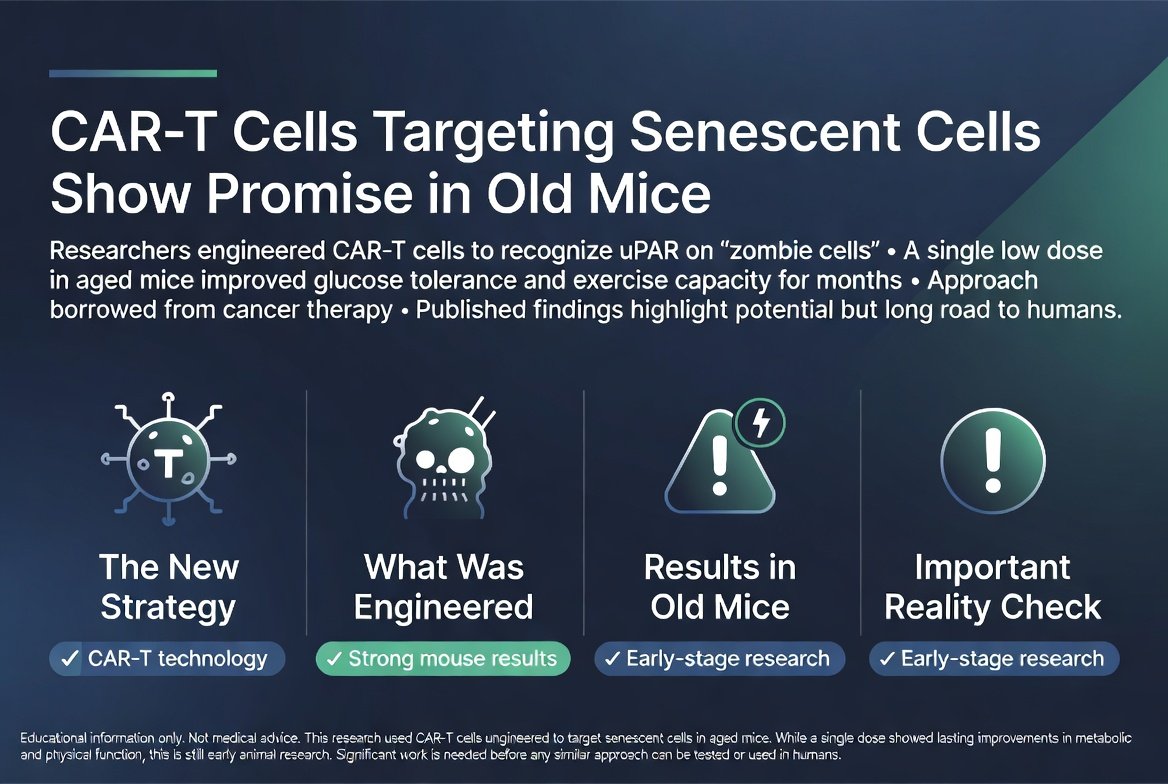
CAR T cells (Chimeric Antigen Receptor T cells) are immune system cells that have been genetically engineered.
This engineering allows them to identify and attack specific cells while sparing healthy cells.
CAR T cells have proven effective in treating various types of cancer and are now being explored as a potential treatment for aging-related diseases.
A new study, recently published, examined the use of CAR T cells against senescent cells in the gut.
The researchers used aged mice and injected them with CAR T cells designed specifically to target uPAR, a protein expressed on the surface of senescent cells.
Finding the Target
First, the researchers characterized the cellular markers of senescence in the gut.
They found that the most common marker of senescence, senescence-associated beta-galactosidase (SA-β-gal),
was significantly higher in the small intestines of 20-month-old mice compared to 3-month-old mice.
Subsequently, the scientists identified several additional senescence markers, including the cell surface protein uPAR.
Most cells expressing uPAR were of epithelial origin and also expressed SA-β-gal.
Using single-cell RNA sequencing on thousands of cells, the researchers showed that uPAR-expressing cells mainly consist of stem cells, epithelial cells (absorptive cells), and macrophages, and largely overlap with the senescent cell population.
Analysis of human samples from young and old individuals yielded a similar picture: an age-related increase in uPAR levels, which correlated with an increase in senescence markers.
The number of cells co-expressing uPAR and additional senescence markers also increased with age.
Back in mice, the researchers found that the senescent cell burden correlated with decreased gut function, increased intestinal permeability ("leaky gut"), and changes in microbiome composition.
Releasing the CAR T Cells!
In the next step, the scientists prepared CAR T cells targeting the uPAR protein and injected them into young and old mice at a dose previously found optimal in terms of senolytic potential (ability to eliminate senescent cells) and safety.
The CAR T cells were rapidly activated, showing they could recognize uPAR-expressing cells.
The treatment led to a significant reduction in SA-β-gal-positive cells, and more importantly, to functional improvement.
In particular, the treatment corrected age-related intestinal permeability ("leaky gut"), considered a major cause of inflammation.
Simultaneously, the number of dividing epithelial cells increased.
Treatment with CAR T cells also significantly reduced damage in two different models of gut injury in mice.
"In summary," the researchers wrote, "these results show that the accumulation of uPAR-positive senescent cells in aging and injured guts contributes to the decline in epithelial integrity and regenerative capacity."
Study Results
The results showed that CAR T cells successfully identified and eliminated senescent cells in the intestinal lining of the mice. As a result, several significant improvements were observed:
- Reduced inflammation: Levels of inflammatory cytokines, which are proteins that mediate inflammation, significantly decreased after CAR T cell treatment.
- Improved gut function: Absorption of nutrients and blocking of harmful bacteria improved after CAR T cell treatment.
- Rejuvenation of the intestinal lining: The number of stem cells in the intestinal lining increased after CAR T cell treatment, and their function improved.
- Reduced signs of aging: Mice treated with CAR T cells showed a decrease in senescent cell burden and improved regenerative capacity of the intestinal lining compared to untreated mice. It is important to note that the study did not examine lifespan or survival, but rather gut function, inflammation, and stem cell activity.
This study offers a new way to treat cellular aging in the gut and related phenomena.
In mice, CAR T cell treatment led to significant improvements in gut health, intestinal lining function, and reduced inflammation.
It should be emphasized that the study did not examine lifespan or survival, and all conclusions are valid for mice only at this stage.
Potential Implications
- Improved gut health: CAR T cell treatment may improve gut function, absorb nutrients more efficiently, and prevent infections.
- Slowing the aging process: CAR T cell treatment may reduce inflammation, improve tissue health, and contribute to a sense of youth and vitality.
- Improved quality of life and health: Reducing the senescent cell burden may contribute to healthier tissue function with age. The effect on lifespan has not yet been tested and requires further research.
.
References:
https://pubmed.ncbi.nlm.nih.gov/38529506/
https://www.ncbi.nlm.nih.gov/pmc/articles/PMC9775319/
https://www.nature.com/articles/s41580-020-00314-w
https://www.nature.com/articles/s41586-020-2403-9



💬 Comments (0)
Be the first to comment on the article.