Once every few years, an idea from the medical world crosses into the longevity realm and ignites the imagination. Hyperbaric oxygen chamber is a perfect example: an old technology used for decades to treat wounds and diving accidents suddenly made headlines as a 'biological time machine.' In 2020, an Israeli research team published impressive results, and within days, global headlines declared 'reversing aging.'
But there is a large gap between the sensational headline and what the study actually found. Hyperbaric oxygen is one of the most interesting and seemingly precise areas in the biohacking world, and precisely for that reason, it needs to be examined with open eyes. What does hyperbaric oxygen really do to the body? What has been proven, what is only hinted at, and why is the home chamber sold online not what was tested in the study? This is an informational article only, and we are covering the science, not selling devices.
What is Hyperbaric Oxygen?
Hyperbaric Oxygen Therapy, or HBOT for short, is simple in essence:
- The subject enters a sealed chamber with increased air pressure, typically 2 to 3 times normal atmospheric pressure.
- Inside the chamber, they breathe oxygen at a concentration of about 100%, compared to about 21% oxygen in normal air.
- The combination of high pressure and pure oxygen saturates the blood and tissues with a much larger amount of oxygen than normal, many times the concentration achievable through regular breathing.
- The excess oxygen reaches tissues with poor blood flow, where it can stimulate healing processes, the formation of new blood vessels, and increased cellular activity.
The unit for measuring pressure is called ATA (atmospheres absolute). At sea level, pressure is 1 ATA. Classic medical treatment uses 2 to 3 ATA. This number, as we will see later, is critical to understanding the whole story.
The Connection to Aging: A Surprising Mechanism
Why should oxygen under pressure affect aging? The answer lies in a phenomenon called the 'Hyperoxic-Hypoxic Paradox'.
Usually, we think more oxygen is always good, and less oxygen is bad. But the body reacts not only to the oxygen level itself, but to the sharp change in level. Researchers discovered that when the body is exposed to extreme excess oxygen and then brought back down, the body gets 'confused' and thinks it is experiencing a lack of oxygen.
This confusion activates biological pathways usually triggered during genuine oxygen distress: release of growth factors, formation of new blood vessels, mobilization of stem cells, and activation of cellular repair mechanisms. In short, it gives the body the benefits of oxygen distress without the damage. This is the central hypothesis underlying the use of hyperbaric oxygen against aging.
The two markers the researchers focused on are among the most central in the biology of aging:
- Telomeres: The protective caps at the ends of chromosomes, which shorten with each cell division and are considered a cellular 'biological clock.'
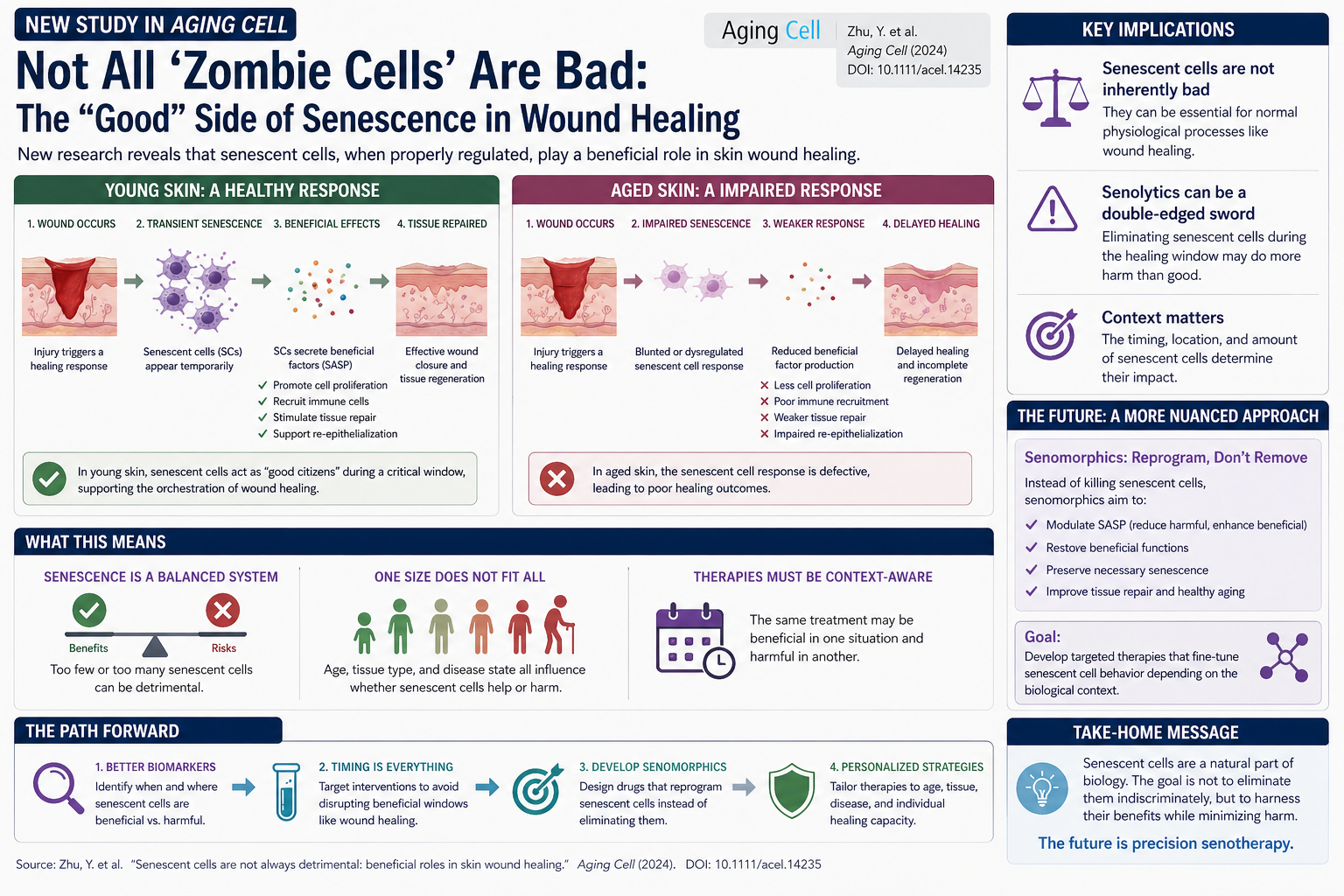
- Senescent cells (zombie cells): Cells that have stopped dividing but haven't died, accumulating with age and secreting inflammatory substances that damage surrounding tissues.
Current Evidence
Study 1: Telomeres and Senescent Cells, Hachmo et al. 2020
This is the study that ignited the whole story. It was published in November 2020 in the journal Aging (Albany NY), conducted at the Sagol Center for Hyperbaric Medicine at Shamir Medical Center and Tel Aviv University, led by the group of Prof. Shai Efrati.
The protocol: 35 healthy adults aged 64 and older (average age about 68) received 60 daily hyperbaric oxygen treatments over about 3 months, 5 days a week. Each session: 90 minutes of breathing 100% oxygen at 2 ATA, with short air breaks.
The results were dramatic on paper. Telomere length in white blood cells increased between 20% and about 38%, with the largest increase recorded in B cells, a jump of 37.63% at the end of treatment. T-helper cells showed an increase of about 29%, and NK and T-cytotoxic cells showed increases of about 20% to 24%.
At the same time, the number of senescent cells decreased: T-helper cells showed a decrease of about 37% at the end of treatment, and T-cytotoxic cells a decrease of about 11%. In simple terms, two key markers of cellular aging moved in the 'younger' direction.
And here we need to stop and be honest. This is a very small study, and without a control group. The researchers themselves note this as a major limitation: there was no control arm or sham group (placebo), the sample was small, the duration of the effect was not tested, and telomerase enzyme activity was not measured. That is, we have no comparison group to know for sure that the change was due to the treatment and not another factor. This is an intriguing and promising result, but it is far from proof.
Study 2: Cognitive Function, Hadanny and Efrati 2020
A companion study from the same group, also published in Aging (Albany NY) in 2020 led by Dr. Amir Hadanny and Prof. Efrati, examined the cognitive effect. Unlike the telomere study, this was a randomized controlled trial (RCT): 63 healthy adults over age 64, of whom 33 received hyperbaric treatment and 30 served as a control group.
The treated group showed significant improvement in attention, information processing speed, and executive functions, abilities that tend to decline with age. The improvement correlated with increased cerebral blood flow in specific areas. The fact that this is a controlled study gives it higher evidentiary weight than the first study, although it is also relatively small and not long-term.
Study 3: What Hyperbaric Oxygen is Actually Approved to Treat
It is important to put the cellular markers in perspective against what is already proven and medically approved. The professional organization for hyperbaric medicine (UHMS) recognizes about 14 approved indications, including:
- Non-healing wounds, such as diabetic foot ulcers.
- Decompression sickness (diving accidents) and air embolism.
- Carbon monoxide poisoning.
- Radiation tissue damage (after cancer treatment).
- Severe infections like gas gangrene and necrotizing fasciitis.
Aging is not on this list. The use against aging is experimental and not approved as a medical indication. This is a critical distinction: the same device, which saves lives for proven indications, is only at the research stage when it comes to slowing aging in healthy people.
The Most Important Point: The Home Chamber is Not What Was Tested
If there is one thing to take from this article, it is the following distinction. The Israeli study used medical-grade hyperbaric oxygen at 2 ATA, in a rigid chamber, with 100% oxygen, under medical supervision. This is a high, intensive, and controlled dose.
In contrast, the home 'soft' chambers sold online typically operate at a pressure of only about 1.3 to 1.5 ATA, and usually with regular air or an oxygen concentrator, not pure 100% oxygen. This is a much lower dose, fundamentally different.
The difference is not merely technical. There is almost no evidence that cheap home chambers replicate the study results. One cannot assume that buying a home chamber at 1.3 ATA will give the same effect measured at 2 ATA. In fact, soft chambers are officially approved for only one indication: acute mountain sickness. Anyone imagining they are 'lengthening telomeres at home' in a soft chamber is buying something that has not been tested for that at all. We do not recommend purchasing or using a home hyperbaric chamber for aging purposes.
Should You Rush to a Chamber? Risks and Costs
Even ignoring the gap between home and medical, hyperbaric oxygen is not without risk, and not without cost.
Side effects and risks include:
- Barotrauma: Injury to air-containing tissues due to pressure changes. The most common is in the ears and sinuses, but in rare cases also the lungs, and such lung injury can be dangerous.
- Temporary vision changes: Many patients in long series experience temporary worsening of nearsightedness (myopia), due to a temporary change in the eye's lens. This usually resolves after treatment ends.
- Oxygen toxicity: In rare cases, excess oxygen can cause seizures. The risk is low at pressures below 2 ATA, which is why medical supervision is important.
- Fire risk: An oxygen-rich environment is highly flammable, so strict safety rules apply.
- Claustrophobia: Simply being in a closed chamber can be difficult for some people.
Contraindications include conditions like untreated pneumothorax, certain lung diseases, and recent ear surgery. Anyone considering treatment must undergo medical screening and close supervision.
Cost and practicality: The tested protocol is 60 sessions of 90 minutes each, 5 days a week, for 3 months. This is a huge time investment and high cost. It is not something done 'casually,' but a serious commitment of entire months.
What to Take from the Research?
- Don't confuse signal with proof: The fact that cellular markers moved in a 'younger' direction is intriguing, but it doesn't mean you will live longer or healthier. It has not yet been proven that hyperbaric oxygen extends lifespan or healthspan in healthy people.
- If you have a proven medical indication (non-healing diabetic wound, radiation damage, etc.), talk to your doctor; there, hyperbaric oxygen is an established and real treatment.
- Don't buy a home chamber expecting an anti-aging effect: Soft chambers at 1.3 ATA are not what was tested, and there is no evidence they replicate the results.
- If you are curious about the field, consult a doctor, and know that this is an experimental intervention with real risks, high cost, and a heavy time commitment.
- Focus on what is proven: Sleep, nutrition, physical activity, and stress management remain the most powerful and proven tools for slowing aging, and they are accessible, safe, and cheap. You can check our biological age calculator to understand where to focus, and browse our biohacking tools for a comprehensive view of interventions.
The Broader Perspective
The hyperbaric oxygen story is an excellent example of how real and intriguing science becomes, on its way to a headline, something it is not. On one hand, there is a real and exciting signal: a tangible intervention moved aging markers in humans, not mice, and that is not trivial. On the other hand, it is a small, uncontrolled study that measured cellular markers, not longevity, and the leap from 'telomeres lengthened in blood cells' to 'we reversed aging' is a huge leap that science has not yet made.
And crucially, there is a vast gap between what was tested (medical oxygen at high pressure, under supervision) and what is sold (cheap home chambers at low pressure). The name is the same, the dose is completely different.
The lesson is not to dismiss the field. Hyperbaric oxygen is worth following, and it has interesting potential that larger, controlled studies will examine in the coming years. The lesson is to remember the basic rule of the longevity world: An impressive result in a headline is not a substitute for a controlled study, and certainly not a reason to buy a device. We cover the science honestly, we don't sell hyperbaric chambers. And when something is truly proven, we will know to say so clearly.
References:
Hachmo Y et al. - Hyperbaric oxygen therapy increases telomere length and decreases immunosenescence in isolated blood cells: a prospective trial. Aging (Albany NY), 2020
Hadanny A, Efrati S et al. - Cognitive enhancement of healthy older adults using hyperbaric oxygen: a randomized controlled trial. Aging (Albany NY), 2020
UHMS - Approved Indications for Hyperbaric Oxygen Therapy


💬 Comments (0)
Be the first to comment on the article.