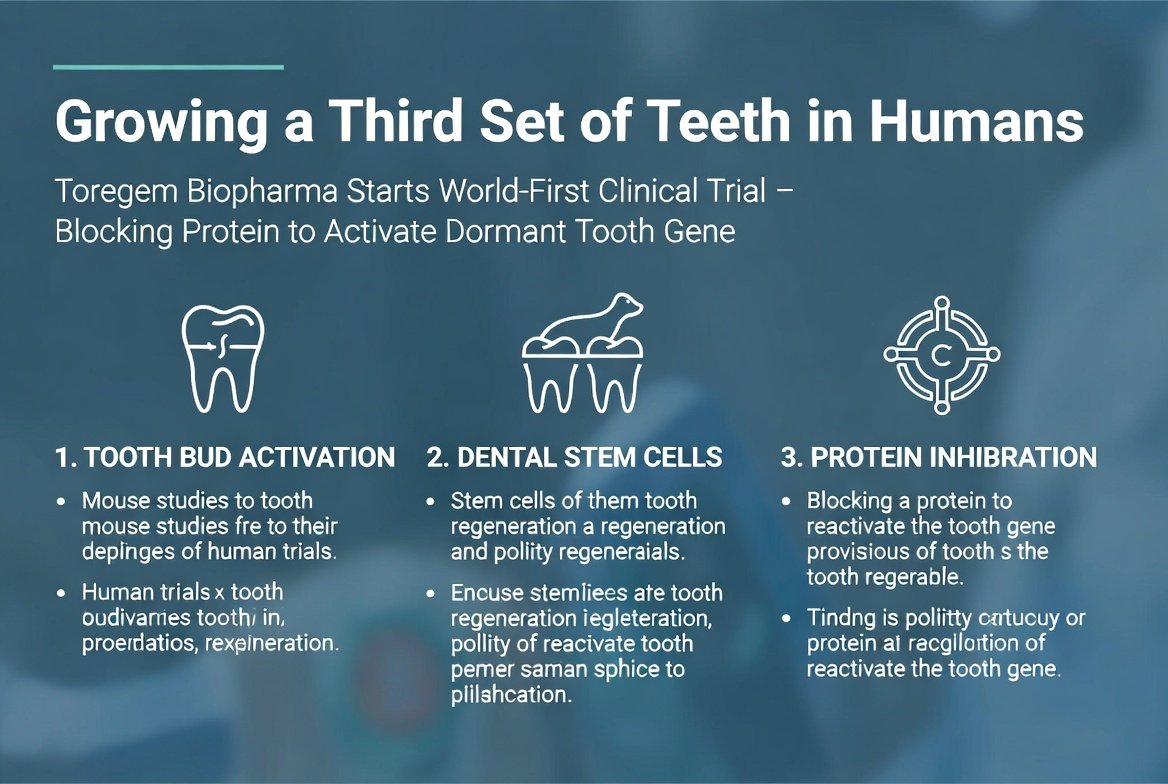
The tooth is an incredibly complex organ: hard tissue (enamel and dentin), living tissue (dental pulp with nerves and blood vessels), a periodontal ligament, and complete dependence on very precise development in childhood. When such an organ is lost, the solution of modern dentistry has been dentures, crowns, and implants. But what if we could simply grow a new one from stem cells? A scoping review published in April 2026 in the journal Cureus systematically maps, according to the PRISMA-ScR methodology, all the existing evidence in the field, and reaches a very cautious conclusion: the field is promising, but still almost entirely preclinical.
Why Tooth Regeneration Is a Big Dream
The standard implant—a titanium screw placed in the jaw with a porcelain crown—works well, but it has inherent limitations that the review notes as background:
- No living tissue: The implant does not feel pressure or heat and does not connect to the nerve, unlike a biological tooth with a living pulp.
- Does not restore biological function: Fillings, crowns, and implants restore lost structure, but do not restore the biological and functional characteristics of living tissue.
- Long-term maintenance: Artificial methods require maintenance and sometimes replacement.
A tooth that grows biologically could, in theory, solve these problems. The question is how far we really are from that, and this is exactly what this review attempts to answer.
What the Review Included (and How Cautious We Need to Be)
It is important to understand what a scoping review is: it does not measure "how well it works," but maps the scope, range, and nature of the existing literature. The researchers screened 1,080 records and filtered down to only 11 studies that met the criteria. The vast majority of these 11 are narrative reviews and theoretical articles, not original experiments. Only one original experimental study was included. A qualitative bias assessment they performed rated the studies at moderate to high risk of bias, and the review repeatedly emphasizes that the evidence is "fragmented and heterogeneous." This is not a list of successes, but a cautious map of a field in its infancy.
Types of Dental Stem Cells
The review mentions several sources of stem cells that can contribute to different parts of the tooth:
- DPSCs (Dental Pulp Stem Cells): Stem cells from the pulp of adult teeth. Multipotent, capable of forming dentin structures. One of the two most studied sources.
- SHED (Stem cells from Human Exfoliated Deciduous teeth): Stem cells from shed "baby teeth." Have strong proliferation and regeneration potential. The second most studied source.
- PDLSCs (Periodontal Ligament Stem Cells): From the periodontal ligament. Capable of differentiating into cementoblast-like cells and periodontal ligament cells.
- SCAP (Stem Cells from Apical Papilla): From the apical papilla at the root tip during development. Studied in the context of periodontal tissues.
- ESCs and iPSCs (Pluripotent stem cells, embryonic and induced): Have high differentiation potential toward odontogenic lineage, but their clinical application is limited due to ethical issues (ESC) and risk of tumorigenicity (both). Very few studies used them.
- Oral mesenchymal stem cells (oral MSCs): Another source mentioned in the mapping.
The two most frequently studied sources were DPSCs and SHED, which are also considered the most ethically justified. PDLSCs and SCAP were studied less, and pluripotent stem cells the least.
The Biological Scaffold
Stem cells alone will not form a tooth shape. They need a scaffold that mimics the three-dimensional structure of the extracellular matrix and guides them where to grow. The types of scaffolds documented in the review:
- Collagen scaffolds: Cell-friendly, found effective in combination with pro-angiogenic growth factors.
- Hydrogels: Along with collagen, these are the scaffolds that showed the most consistent results in the review.
- Chitosan-gelatin scaffolds: Natural materials used in dental tissue engineering.
- Nanofibrous and synthetic scaffolds: Additional engineered structures. Important note: studies that used a synthetic scaffold alone (without cells) were excluded from the review.
Growth Factors That Activate the Process
Cells on a scaffold still do not form a tooth. Chemical signals are needed to instruct them to divide, differentiate, and organize themselves. The growth factors and signaling molecules reported most frequently in the review are:
- VEGF (Vascular Endothelial Growth Factor): A critical pro-angiogenic factor. Creating a blood supply is one of the main barriers, so VEGF is central to the field.
- BMP-2 (Bone Morphogenetic Protein 2): Promotes mineralization and hard tissue formation.
- FGF-2 (Fibroblast Growth Factor 2): Promotes proliferation and blood vessel formation.
- TGF-β (Transforming Growth Factor beta): Involved in dentin formation and tissue interaction.
In the review, the combination of DPSCs or SHED with collagen or hydrogel scaffolds, together with pro-angiogenic factors, was the one that most consistently reported results of dentin-pulp complex regeneration, vascularization, and mineralization.
The Only Real Experiment: A Bioengineered Tooth in Mice (Oshima 2011)
Among the 11 studies, only one is an original experiment, not a review. This is the study by Oshima and colleagues published in PLoS One in 2011. The researchers took cells from an embryonic mouse tooth germ, reassembled them into a bioengineered tooth germ, and implanted it into mice. The bioengineered germ developed into a functional tooth unit: it integrated with the jawbone and periodontal ligament, and showed partial restoration of masticatory function. This is an important "proof of concept" for whole-organ engineering, but the review explicitly notes that this is an animal experiment only, with a small sample size, short follow-up, and no data on long-term stability, safety, or feasibility in humans.
It is important to emphasize what is not found in this review: it does not describe growing a whole human tooth from DPSCs and epithelial cells, it does not describe pulp regeneration in dogs using SCAP, and it does not describe separate periodontal ligament growth from PDLSCs as an independent experiment. The only original experiment is Oshima's bioengineered tooth germ in mice.
The Challenges Holding Back the Clinic
Why is this still not at your dentist? The review points to substantial uncertainties:
- Vascularization: Creating a functional blood vessel network within the regenerating tissue is a major barrier, hence the emphasis on VEGF.
- Innervation: Neural connection to the new tissue is still unresolved and only partially characterized.
- Functional integration and long-term stability: Data on long-term histological stability are lacking.
- Immune compatibility: An open issue in stem cell-based therapies.
- Heterogeneity: Large variability between cell sources, scaffolds, and signaling factors makes comparison and standardization difficult.
So What Is the Conclusion?
The conclusion of the review is cautious. On one hand, there is strong "proof of concept," including the demonstration of whole-organ engineering in mice. On the other hand, it is explicitly stated that "the existing evidence remains largely preclinical and heterogeneous," and that stem cell-based approaches "are still not mature for routine clinical application." The closest and most realistic application is not growing a whole tooth, but narrower areas where the risk to the patient is low: regenerative endodontics, vital pulp therapy, and immature permanent teeth. The review does not specify a timeline for human trials and does not point to specific teams expected to reach the clinic within a few years. The bottom line: the field is advancing from experimental feasibility toward early translational maturity, but well-designed human studies with long-term follow-up are still needed.


💬 Comments (0)
Be the first to comment on the article.