There is one molecule that your body produces and breaks down millions of times every second, in every cell, since the moment you were born. It's called alpha-ketoglutarate, and it's a central link in the Krebs cycle, the energy production engine of the mitochondria. It's not an exotic molecule, it's not a new wonder drug from a secret lab. It's a basic part of the biochemistry of life. So why are longevity researchers suddenly excited about it?
The reason is one discovery that still resonates in the field: in 2020, a study published in the prestigious journal Cell Metabolism showed that adding calcium alpha-ketoglutarate (Ca-AKG) to the diet of old mice extended their lifespan by an average of 12%, and increased healthspan by 41%. A year later came a small human study with an even more impressive number: an average decrease of 8 years in biological age. In this article, we'll do what marketing doesn't: separate the impressive data point from what it really means.
What is AKG?
Alpha-ketoglutarate, or AKG for short, is a small organic acid that serves as a central hub in metabolism. It's worth knowing through a few key points:
- It's a link in the Krebs cycle, the process where your cells convert food into energy (ATP). Without it, cellular energy production stops.
- It's a junction between carbohydrate metabolism and protein metabolism. AKG accepts and donates amine groups, making it essential for building and breaking down amino acids.
- It's a cofactor for enzymes that regulate the epigenetic age. Enzymes like dioxygenases, including TET and Jumonji, depend on AKG to edit DNA and histones. This is the direct link to epigenetic clocks.
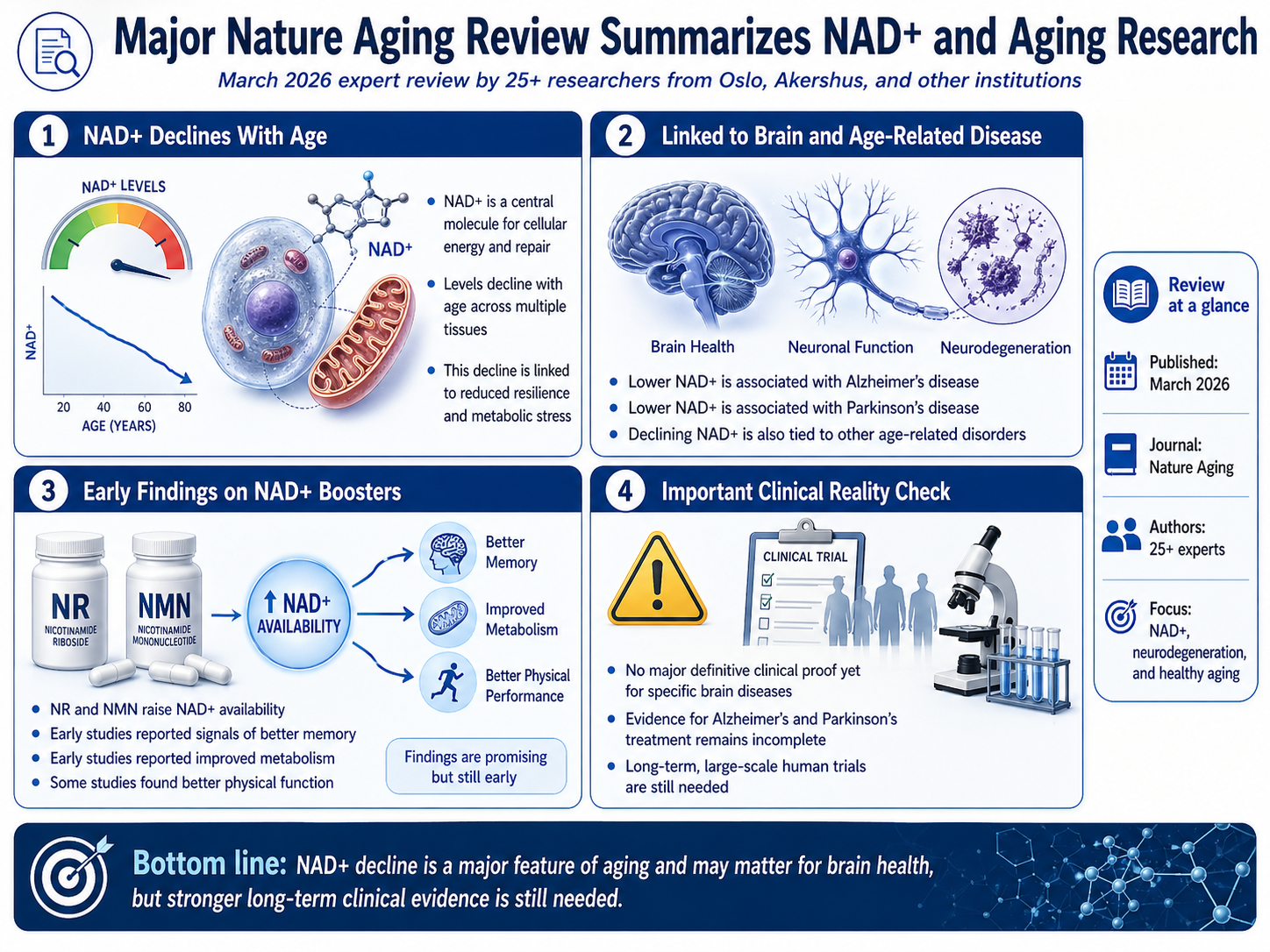
- Its levels decline with age. Measurements have shown up to a 10-fold decrease in blood AKG levels between ages 40 and 80. This decline is precisely the rationale behind the supplement.
The form sold as a supplement is usually calcium alpha-ketoglutarate (Ca-AKG), where the AKG molecule is bound to calcium for better stability. This is exactly the form tested in the major studies.
The Connection to Aging: A Three-Axis Mechanism
Why should a decline in a simple metabolite accelerate aging, and why should supplementing it slow it down? Researchers point to three main mechanisms working in parallel:
1. Suppression of chronic inflammation (inflammaging). This is the central mechanism identified in the mouse study. AKG lowered levels of systemic inflammatory cytokines, while simultaneously increasing production of IL-10, an important anti-inflammatory cytokine. Low-grade chronic inflammation is a hallmark of aging, and controlling it improves nearly every system in the body.
2. Epigenetic regulation. Since AKG fuels TET and Jumonji enzymes, normal levels help maintain a younger DNA methylation pattern. This is exactly what epigenetic clocks like those underlying the human study measure.
3. Mitochondrial support and mTOR regulation. As a central metabolite, AKG influences cell signaling around energy and amino acid availability, including a potential effect on the mTOR pathway, the same pathway whose inhibition is linked to lifespan extension in every organism tested.
Current Evidence
Study 1: Lifespan Extension in Mice, Cell Metabolism 2020
This is the study that sparked interest. The team, led by Azar Asadi Shahmirzadi and colleagues, gave calcium alpha-ketoglutarate to mice starting at 18 months of age, equivalent to late middle age in humans. Researchers tracked 31 frailty markers and a range of aging and inflammation biomarkers. The results:
- Approximately 12% increase in average lifespan across the population.
- In females, the effect was strongest: a 16.6% increase in median lifespan and a 19.7% increase in maximum lifespan. In males, the numbers were positive (9.6% and 12.8%) but not statistically significant.
- A 46% reduction in frailty in females and a 41% improvement in healthspan, meaning the mice not only lived longer but lived healthier, compressing the disease period to the end of life.
This is a strong, well-designed study, but it's important to remember: this is a mouse study. Impressive results in mice have often failed to translate to humans.
Study 2: Reduction in Biological Age in Humans, Aging 2021
The most prominent human study, led by Oleksandr Demidenko and colleagues, was a retrospective analysis of 42 people who took a commercial Ca-AKG-based formulation (with added vitamins) for an average of about 7 months. They were measured using a commercial DNA methylation clock. The result:
- An average decrease of 8 years in biological age, with very high statistical significance.
- The vast majority of participants showed some decrease, not just an extreme minority.
The 8-year figure sounds dramatic, but it requires great caution. This was a retrospective study, with no control group, on a very small sample of 42 people who had already chosen to buy the supplement. There is no random assignment and no comparison to placebo. Methylation clocks are also very noisy between measurements. In other words: it's an interesting hint, not proof.
What About Healthy Humans? Follow-up Studies
The field is aware of the limitations, so the ABLE study has been launched, a randomized controlled trial (RCT) examining the effect of Ca-AKG on biological age in middle-aged adults. This is exactly the type of study that's missing: randomized, placebo-controlled, and prospective. Until results from such studies are published and confirmed, the recommendation for AKG remains cautious. Additionally, there is growing research interest in the connection between AKG and bone health, immune function, and metabolism, but human data there is also early.
Should You Start Taking AKG?
That's the real question, and here we need to be most honest. Here's the full picture:
- The strong evidence is from mice. The 12% lifespan extension was measured in rodents, not humans. The history of the longevity field is full of compounds that shined in mice and failed in humans.
- The only human study is methodologically weak. 42 people, no control, retrospective, with a noisy epigenetic clock. That's not a basis for promises.
- The safety profile looks good. AKG is an endogenous molecule the body already produces, and the tested doses were well-tolerated. There are no reports of significant toxicity. This is its big advantage over more controversial supplements.
- The cost is reasonable. Unlike NMN and injectable peptides, Ca-AKG is a relatively cheap supplement. The common dosage in studies and on labels is about 1000 mg per day.
The bottom line: this is a supplement with a low-risk profile but limited human evidence. That's exactly why it's rated yellow here, not green. Those who still want to try can purchase AKG on iHerb, but always in consultation with a doctor, especially if you take regular medications.
What to Take Away from the Research?
- Don't treat the 8 years as a promise. The figure comes from a small retrospective study without a control. Treat it as a hypothesis that needs confirmation, not a fact.
- If you try it, start with 1000 mg per day of Ca-AKG, the dose matching the studies, and keep expectations modest.
- Strengthen those pathways naturally. Intermittent fasting, strength training, and aerobic activity naturally increase flow through the Krebs cycle and slow chronic inflammation, the same mechanisms attributed to AKG.
- Consult a doctor before starting, especially if you take medications, have kidney disease, or are under medical supervision.
- Build a personal plan based on your goals instead of chasing a single supplement. You can start with our personal supplement selector, which matches evidence-rated supplements to your goals.
The Broader Perspective
The story of AKG is a perfect case study in how to read longevity news. There's a compelling biological mechanism, an impressive data point from mice, and an interesting hint from humans, but still no strong human proof. This gap between promise and evidence is exactly where marketing enters and logic exits.
AKG may well turn out to be a valuable longevity supplement, and its favorable safety profile makes it a reasonable candidate for cautious experimentation. But the rule remains: no single molecule beats lifestyle. Sleep, nutrition, movement, and stress management still provide more health years than any pill in a bottle. A supplement is, at best, the cherry, not the cake.
References:
Shahmirzadi A. A. et al., Alpha-Ketoglutarate, an Endogenous Metabolite, Extends Lifespan and Compresses Morbidity in Aging Mice, Cell Metabolism, 2020
Demidenko O. et al., Rejuvant, a potential life-extending compound formulation with alpha-ketoglutarate and vitamins, conferred an average 8 year reduction in biological aging, Aging (Albany NY), 2021

💬 Comments (0)
Be the first to comment on the article.