If you walk into a family doctor's clinic today and ask what measures should be checked to predict the risk of stroke or early death, you will most likely hear: blood pressure, cholesterol, sugar. A classic list. But what if we told you that a simpler measure, requiring no blood tests and no month-long wait, might be stronger in predicting risk than any of these measures?
This is exactly what a wave of studies published in recent years shows, the latest of which was released this week: Muscle function, especially hand grip strength and walking speed, predicts the risk of stroke and death with surprising power. The muscle, it turns out, is not just a lever for lifting baskets from the kitchen. It is an active endocrine organ, activating molecules that affect every system in the body, and a decline in its function is one of the earliest warnings the body sends us.
What Exactly is Muscle Function?
It is important to distinguish between two concepts that are often mixed up:
- Muscle Mass: How many kilograms of muscle tissue are in the body. Measured by DEXA, BIA, or circumferences.
- Muscle Function: How much force the muscle can produce, how fast, and for how long. Measured by grip strength, walking speed, and time to stand from a chair or the floor.
This is the difference between a large engine and a powerful engine. You can have reasonable muscle mass but poor function, and you can be lean but with excellent function. Recent studies show that function is stronger than mass in predicting health outcomes. This is also an important conceptual shift: not to chase numbers on the scale but to observe capability.
Three Tests You Can Do at Home
- Hand Grip Strength: A hand dynamometer costs $15-30 on Amazon. Warning threshold: below 26 kg in men and 16 kg in women over age 60.
- Sitting-Rising Test: Sit on the floor with legs crossed, stand up without using hands, knees, or walls. Maximum 10 points. Below 8 points at ages 50-80, mortality risk is 2-5 times higher in the next decade.
- Walking Speed: 4 meters at a natural pace. Less than 0.8 meters per second is a clear warning sign.
The Link to Stroke and Mortality: A Surprising Mechanism
Why is a weak muscle specifically linked to stroke? The first logical answer is correlation: weak people move less, eat less well, and therefore are sicker. But the new studies control for all these variables and still find a strong link. That is, muscle strength itself, independently, predicts risk. Why?
The muscle is an endocrine organ. Every time we activate a muscle, it secretes signaling molecules called myokines. These include IL-6 (in low doses, pro-healthy), irisin, BDNF (also known as brain-derived neurotrophic factor), and dozens of other molecules. They travel through the blood and affect:
- Glucose Clearance: An active muscle absorbs sugar from the blood without insulin mediation. Strong muscle = lower risk of diabetes = less blood vessel damage.
- Endothelial Function: The lining of blood vessels remains flexible and can dilate when needed, so blood pressure is more stable.
- Chronic Inflammation: An active muscle lowers inflammation markers like CRP. Chronic inflammation is a central driver of atherosclerosis.
- Brain Protection: Myokines, mainly BDNF and cathepsin B, cross the blood-brain barrier and promote the production of new neurons and the maintenance of existing ones.
In other words: A strong muscle sends protective signals to the entire body. A weak muscle = fewer signals = more inflammation, more sugar in circulation, more blood vessel damage, less brain protection. When this system erodes over decades, the risk of stroke and death increases.
Current Evidence
Study 1: UK Biobank, Stroke Journal, 2026
The publication that sparked the current wave, a study by Tang and colleagues published in the journal Stroke of the American Heart Association (also reported via HealthDay news agency), examined 482,699 participants from the UK Biobank, aged 37 to 73, with a median follow-up of about 14 years. During the period, 11,814 stroke cases were recorded, including 9,449 ischemic strokes and 2,029 hemorrhagic strokes.
Findings: People with low muscle strength had a 30% higher risk of any stroke, a 31% higher risk of ischemic stroke, and a 41% higher risk of hemorrhagic stroke. Slow walking, compared to brisk walking, was associated with a 64% higher risk of stroke. Importantly, the association remained significant even after adjusting for age, sex, BMI, smoking, blood pressure, cholesterol, and general physical activity.
And no less troubling: Among those who had already had a stroke, muscle loss predicted a higher mortality risk, about 25% higher in cases of probable sarcopenia and up to about 46% higher in confirmed sarcopenia. That is, the muscle affects both the chance of having a stroke and the chance of surviving it.
Study 2: UK Biobank, BMJ 2018
An earlier study by Celis-Morales and colleagues, on about half a million Britons, found that grip strength is inversely and consistently associated with all-cause mortality and cardiovascular disease mortality. Each 5 kg decrease in grip strength was associated with about a 16-20% increase in all-cause mortality and about a 19-22% increase in cardiovascular disease mortality. The association with cancer overall was weaker and not consistent across all subtypes. The graphs were continuous, meaning the lower the grip strength, the higher the risk, with no clear threshold below which the association disappears.
Study 3: PURE, Global, Lancet 2015
A multinational study in 17 countries, on about 140,000 participants, showed that poor grip strength was a better predictor of mortality than systolic blood pressure. Each 5 kg decrease in grip strength was associated with about a 16% increase in all-cause mortality, about a 17% increase in cardiac mortality, and about a 9% increase in stroke risk. This was one of the results that shocked the cardiology community, because it showed that a simple, inexpensive measure outperforms a standard clinical measure.
What About Dementia and Alzheimer's?
The story doesn't end with stroke. The same mechanisms that protect blood vessels also protect the brain. Studies show that low grip strength is associated with a higher risk of dementia, in a wide range of about 50% to 72% in some analyses. The presumed reason: BDNF secreted during muscle activity promotes neurogenesis in the hippocampus, the first area affected in Alzheimer's.
There is also a link in Parkinson's. Patients who preserve muscle mass and function tend to show a better functional course. And in osteoporosis: a strong muscle pulls on the bone, encourages mineralization, and helps prevent fractures.
To summarize: Good muscle function is a broad umbrella that protects the brain, heart, bone, and metabolic system simultaneously. It is hard to find another single intervention with such a range of protection.
Is the Link Really Causal? The Critique
Cautious researchers remind us that correlation is not causation. It is possible that physically weak people are also generally sicker, and therefore die earlier. But there are several lines of evidence that strengthen the hypothesis that the link is indeed causal:
- Intervention Studies: When resistance training is started in older adults, inflammation markers tend to decrease, insulin sensitivity improves, and in some studies, blood pressure also improves within weeks. This is mechanistic proof.
- Mendelian Randomization Studies: Genetic analyses using genetic variants associated with muscle strength suggest that a genetic predisposition to strong muscle is linked to better health outcomes. This brings the evidence closer to causality.
- Dose-Response: The better the function, the better the outcomes, continuously. This is also a strengthening sign of causality.
The downside: We still don't know the exact threshold above which every improvement is additive, and where the benefit begins to plateau. Probably, in very weak people, even a small improvement is dramatic, and in strong people, the marginal benefit of more strength is smaller.
What to Take from the Research? An Action Plan
- Buy a dynamometer and test yourself once a quarter. The price is low, the data is valuable. Recording over 5 years is worth gold, because you measure your own rate.
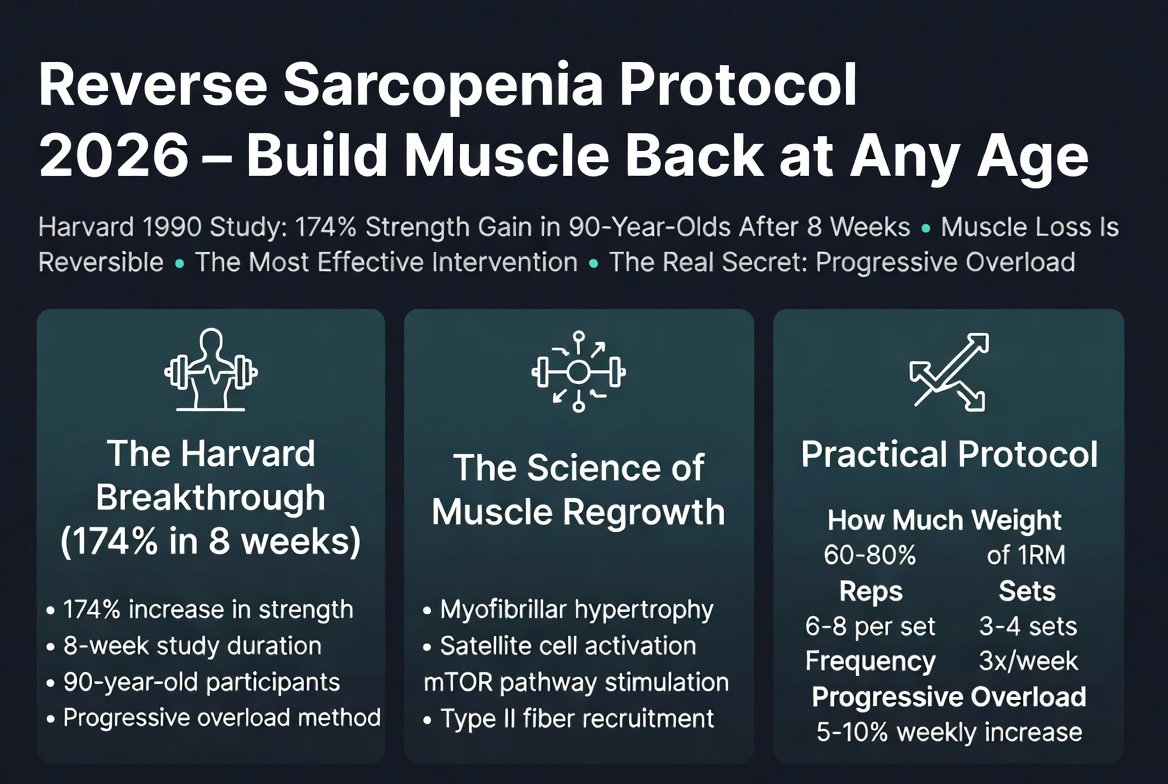
- Resistance training 2-3 times a week, with an emphasis on compound exercises: squats, deadlifts, overhead presses, pull-ups. 3 sets of 6-12 reps, with a load that feels heavy in the last reps.
- Eat about 1.6 grams of protein per kg of body weight per day, divided into 3-4 meals. Muscle protein synthesis is optimal with 25-35 grams per meal.
- Creatine monohydrate 3-5 grams per day. The research evidence is strong, the price is low, no side effects beyond a small temporary increase in muscle water weight.
- Daily brisk walking for 30 minutes, minimum, as a complement to resistance training. Blood flow helps create myokines and clear metabolites.
- If you are over 60 and have never exercised: Start with bodyweight only. Squats, chair squats, planks. 6 weeks, and you will feel the difference. Then add weights.
The Broader Perspective
The story of the muscle is part of a larger story about what it means to be healthy in advanced age. Health is not the absence of disease, but functional capacity. A 75-year-old who can get up from the floor, carry groceries, and climb 4 floors without shortness of breath is healthy, even if they have a few diagnoses. A 60-year-old who struggles to stand from a chair is at risk, even if their tests look normal.
The main message from the combination of new evidence is that the muscle is medicine. It is not a supplement or a bonus. It is a vital organ that requires active maintenance, like any other organ. The only difference is that we cannot directly influence the heart, but we can train the muscle at any age. And this is an opportunity not to be missed.
In a world where we spend billions on drugs that treat diseases after they appear, we have here a cheap, accessible intervention backed by hundreds of thousands of cases: Good muscle function is lifespan. Three times a week, half an hour. This is perhaps the most worthwhile investment you will ever make.
References:
Sarcopenia, Grip Strength, Walking Pace, and New-Onset Stroke Risk: A UK Biobank Study (Stroke, 2026)
Prognostic value of grip strength: PURE study (Lancet 2015)
Associations of grip strength with cardiovascular and cancer outcomes and all-cause mortality (BMJ 2018)


💬 Comments (0)
Be the first to comment on the article.