For centuries, the aspiration to turn an old cell into a young one was considered science fiction. But in 2006, a Japanese researcher named Shinya Yamanaka found four genes that do exactly that. In 2012, he received the Nobel Prize in Medicine for the discovery. Now, after 20 years of research, this technology is facing clinical trials in humans for the first time. Here is the simple explanation of the technology that could change medicine.
What is a cell anyway?
The human body is built from 37 trillion cells. Each one carries the same DNA - the same book of 3 billion letters. But each cell type has a "role": a heart cell contracts, a nerve cell transmits signals, a skin cell protects. How do they know what to be?
The answer: Epigenetics. The layer above DNA. In each cell, only some genes are activated. The rest are tagged and silenced. A heart cell activates genes for heart function and silences the rest of the body. A nerve cell activates nerve genes.
With age, epigenetics becomes messy. Genes that should be active are silenced. Genes that should be quiet are awakened. The cell has lost its "identity," and with it, its function.
Yamanaka's discovery: Four genes that change everything
Shinya Yamanaka from Kyoto University asked a simple question: Can you take an adult cell and return it to a stem cell state? In a stem cell state, the cell can become any type of cell in the body. It is young.
He found the answer: Only four genes are enough. They are named after him "Yamanaka factors":
- Oct4: The master controller of stem cells
- Sox2: Its partner
- Klf4: Controls maintenance and division
- c-Myc: Promotes cell growth
When all four are introduced into an adult cell, it loses its identity and returns itself to a stem cell state. Yamanaka won the Nobel in 2012.
The problem: c-Myc is dangerous
Yamanaka's approach was brilliant, but it has a problem. c-Myc is an oncogene - a gene that can cause cancer. When activated fully, the cell can become cancerous.
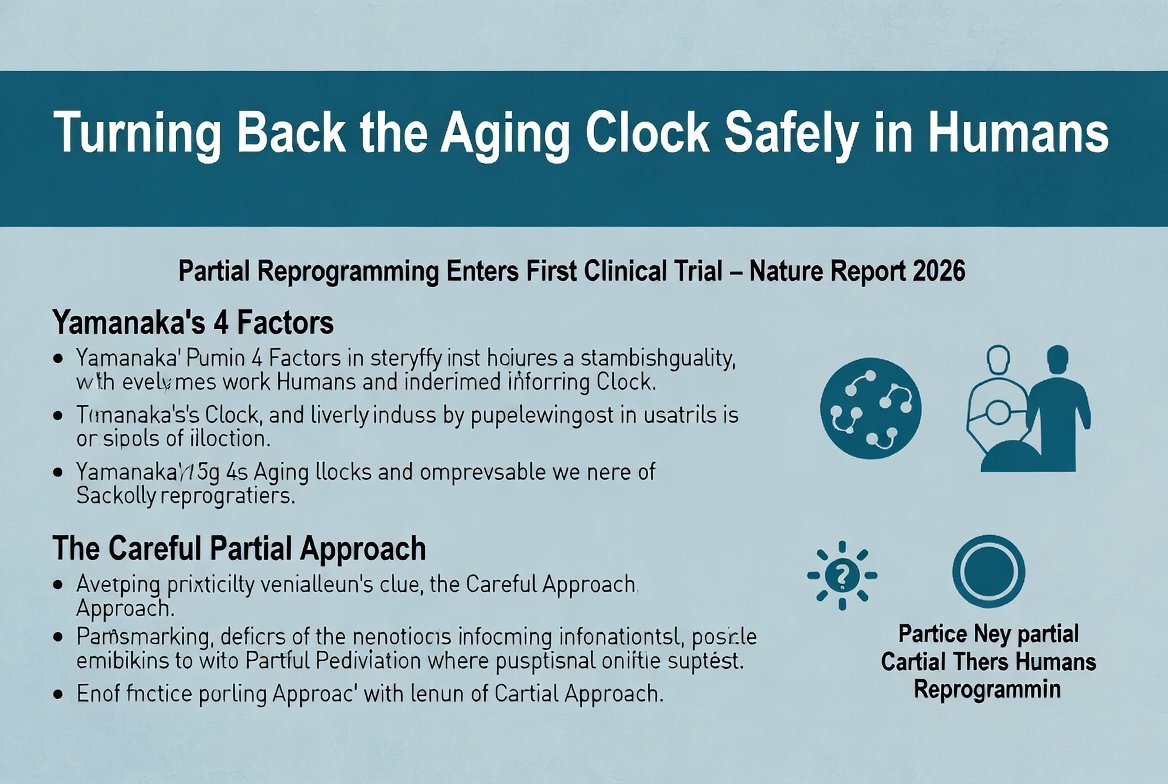
Subsequent researchers led by Juan Carlos Izpisua Belmonte at the Salk Institute proposed a solution: partial reprogramming. Instead of leaving the genes active for a long time, they are activated for only a few days, then turned off. This is enough to refresh the cell, but not enough for it to lose its identity.
Additionally, various researchers discovered that it is possible to use only three genes (OSK, without c-Myc) and achieve the same effect without the risk of cancer.
The Rejuvenate Bio experiment: 109% lifespan extension
In 2024, the company Rejuvenate Bio, led by researcher Noah Davidson, published an important study in Cellular Reprogramming. They used an AAV virus to introduce OSK (the three genes without c-Myc) into very old mice - 124 weeks (equivalent to a human about 77 years old).
The results:
- 109% lifespan extension over the control group
- Significant improvement in physical fitness: stronger muscle, increased walking speed
- Improvement in immune system function
- Restoration of methylation patterns like those of young mice
- No signs of cancer or significant side effects
In simple words: the researchers injected very old mice and expected them to die soon, and instead saw them thriving.
Different approaches: Not just genetics
While the classic approach uses viruses to introduce the genes, researchers have developed alternatives:
- Temporary RNA: Instead of permanent DNA, inject RNA that disappears after a few days. Safer but works for less time
- Chemical cocktails: In 2023, a team from Harvard discovered six combinations of chemicals that can induce reprogramming without genes at all. A promising discovery for low-cost treatment
- Small molecules: Drugs that affect the pathways that Yamanaka factors activate, without mimicking them directly
The leading companies
Three main companies are active in the field:
- Altos Labs: $3 billion raised from Bezos. Broad research on reprogramming throughout the body.
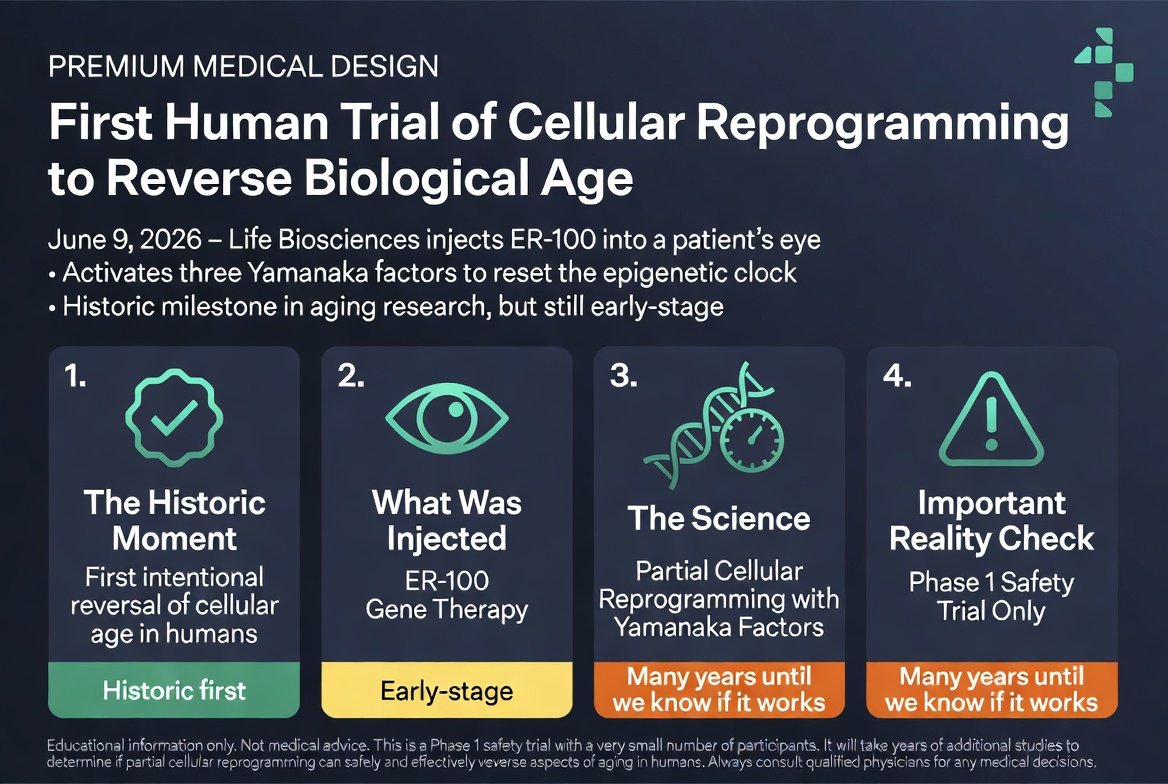
- Life Biosciences: First human clinical trial (FDA approval in January 2026). Initially focusing on the eyes.
- Rejuvenate Bio: Started with dogs, now moving to heart treatments.
The first human trial
In January 2026, Life Biosciences received FDA approval for the first human trial of partial reprogramming. The trial:
- Target group: Patients with glaucoma and NAION (acute optic nerve injury)
- Approach: Injection of AAV with 3 Yamanaka factors into the eye
- Progress: About 18 participants in the first phase (12 glaucoma patients initially, then 6 NAION patients). If safe, expand
- Results: Expected in 2026-2027
Why the eyes? Because it is a closed, accessible, and clean place - if something goes wrong, it won't spread throughout the body.
What does this mean for you?
This technology will not be available to the general public before 2030-2035 at least. But this is the first step. Even if you are not the first to use it, you will be when it becomes available. In the meantime:
- Maintain a healthy lifestyle - extends the time until the technology is available
- Follow research news - to know when trials begin
- If you have a relevant disease (glaucoma, progeria) - there is now an option to participate in a clinical trial
The bottom line
Partial reprogramming is one of the greatest promises of aging research. For 20 years it was a theoretical idea. In 2026 it becomes clinical. If the trials succeed, we will see within a decade drugs that reverse biological age. It is real, and it is truly beginning.

💬 Comments (0)
Be the first to comment on the article.