When discussing nutrition that extends life, the conversation almost always drifts to the same topics: how much protein, which fat, whether carbohydrates are bad. But there is one component that large studies, on millions of people, repeatedly link to lower mortality, fewer heart diseases, less diabetes, and less colon cancer, and it is actually the least sexy of all. Dietary fiber. No one gets excited about it, no one sells it in a shiny capsule, and precisely because of that, most of us eat much less of it than we should.
The most troubling statistic: while recommendations speak of 25 to 38 grams per day, most adults eat about only 15 grams, some much less. About 90 to 97 percent of the population does not reach the recommended amount. This is one of the largest and quietest nutritional gaps, and also one of the easiest to close.
What is Dietary Fiber?
Dietary fiber is the part of plant-based food that our body cannot break down and digest on its own. Unlike protein, fat, or sugar, it passes through the digestive system almost intact, and precisely because of that, it does its job. Here is the main point in brief:
- It is not absorbed as calories in the usual sense, so it fills the stomach without adding energy.
- It slows down the absorption of sugar from the meal, preventing sharp spikes in blood sugar.
- It binds to cholesterol and bile acids in the intestine and helps eliminate them from the body.
- It is the fuel for good gut bacteria, which produce beneficial substances from it.
- It is found only in plant-based food: vegetables, legumes, whole grains, fruits, nuts, and seeds. Animal-based food contains no fiber at all.
Soluble vs. Insoluble: Why It Matters
Not all fibers are the same, and the two main types do different things in the body. It is worth knowing both, because a good diet includes both.
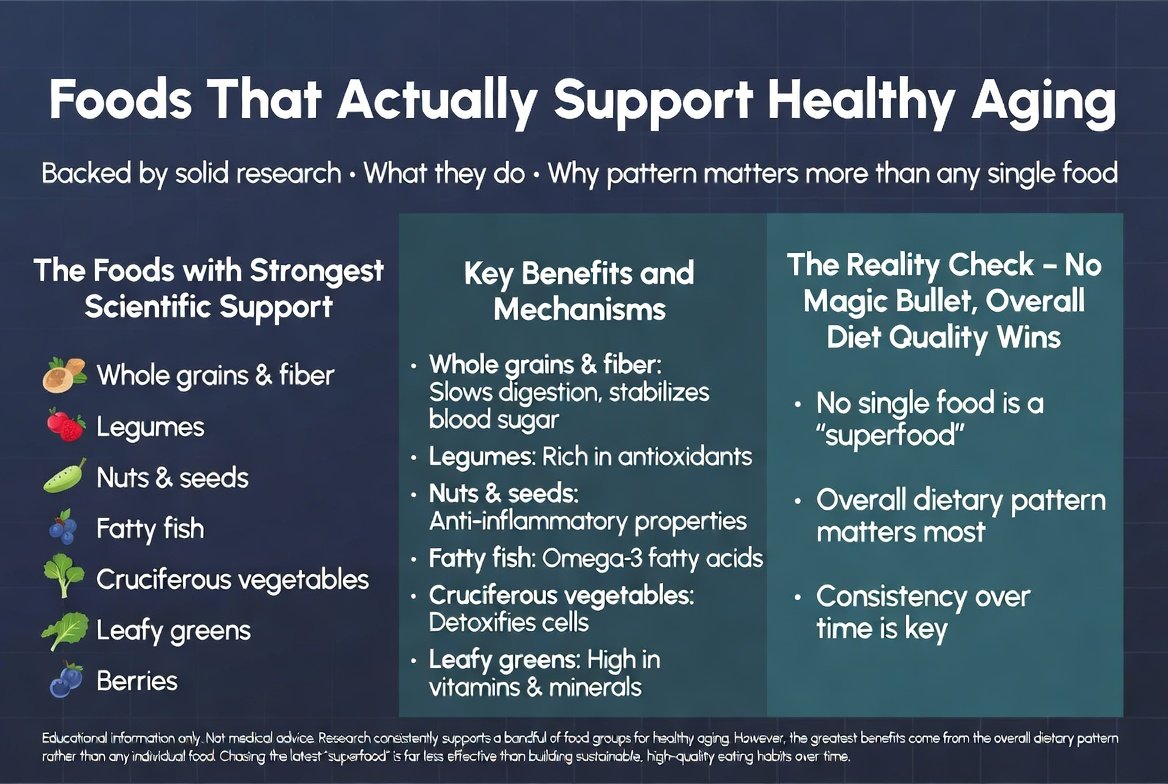
Soluble fiber dissolves in water and turns into a thick gel in the digestive system. This gel is what slows down sugar absorption and helps lower cholesterol. You will find them mainly in oats, legumes (lentils, chickpeas, beans), apples, citrus fruits, carrots, and flaxseeds. These are the fibers most linked to heart health and blood sugar balance.
Insoluble fiber does not dissolve in water, but adds bulk and speeds up the passage of food through the intestine. These are the ones that prevent constipation and maintain a healthy gut. You will find them mainly in skins of fruits and vegetables, whole grains, wheat bran, nuts, and seeds. Most natural foods contain a mixture of both types, so the best approach is simply to eat a wide variety of plant-based foods, rather than chasing a specific type.
The Evidence: What Science Really Says
This is not a field of general advice or gut feeling. The link between fiber and health is one of the most established and consistent in all of nutrition science, based on some of the largest studies ever conducted.
Study 1: The Lancet Mega-Review from 2019
This is the flagship work in the field. A team led by Andrew Reynolds from the University of Otago in New Zealand published in 2019 in The Lancet a series of systematic reviews and meta-analyses, which compiled 185 prospective studies and 58 clinical trials, with about 135 million person-years of follow-up. The conclusion was unequivocal: comparing the highest fiber consumers to the lowest, a 15 to 30 percent reduction in all-cause mortality and cardiovascular disease mortality was observed, as well as a similar reduction in the incidence of coronary heart disease, stroke, type 2 diabetes, and colorectal cancer. The researchers found that the greatest protection is achieved when daily fiber intake ranges between 25 and 29 grams, and that even higher intake may add further benefit.
Study 2: NIH-AARP, Hundreds of Thousands of Americans
In a study published by Yikyung Park and colleagues in 2011 in the Archives of Internal Medicine, hundreds of thousands of American adults were followed for about nine years, during which more than 31,000 deaths were recorded. The finding: those who consumed the highest amount of fiber, about 30 grams per day for men and 25 grams for women, showed a significantly lower risk of death from heart disease, infectious diseases, and respiratory diseases. This is one of the strongest confirmations that fiber not only improves blood tests but is linked to the final outcome that truly matters: how many years one lives.
Study 3: Meta-Analysis in BMJ on Heart Disease
A meta-analysis published by Diane Threapleton and colleagues in 2013 in the BMJ compiled 22 cohort studies. The precise quantitative finding: for every additional 7 grams of fiber per day, the risk of cardiovascular disease and coronary heart disease decreased by about 9 percent (hazard ratio of 0.91). Seven grams is not much: one serving of legumes, or replacing white bread with whole wheat bread plus a fruit. The relationship was continuous, meaning every small addition contributed.
The Connection to the Microbiome: In Brief
Part of the benefit of fiber goes through gut bacteria. They break down certain fibers and produce short-chain fatty acids from them, which affect inflammation, the immune system, and metabolism. This is a vast field in itself, and in separate articles we expand on the connection between the microbiome and aging. Here we will suffice with one point: to nourish a healthy microbiome, you need a variety of plant-based foods, and this is another reason to get fiber from real food rather than from a single supplement.
So How Many Grams Do You Really Need?
The accepted recommendations (according to US health bodies) are approximately:
- Men up to age 50: about 38 grams per day.
- Women up to age 50: about 25 grams per day.
- Men over 50: about 30 grams per day.
- Women over 50: about 21 grams per day.
A convenient direction to remember is the broad target of 25 to 35 grams per day, which aligns well with the 25 to 29 gram point where maximum protection was measured in the Lancet review. The problem: the actual average intake is about 15 grams, less than half the target. That is, most people need to roughly double their fiber intake.
Should You Just Take a Fiber Supplement?
This is the obvious question, and the cautious answer is: a supplement is a partial solution, not a substitute. The fiber in the large studies almost always came from whole foods: legumes, vegetables, fruits, and whole grains, which also contain vitamins, minerals, antioxidants, and plant compounds that work together. A single fiber supplement does not bring this entire package, and it is difficult to know if the benefit measured in the studies comes from the fiber alone or from the whole food.
A fiber supplement (like psyllium) can be a useful aid in certain situations, for example for someone who struggles to reach the amount from food, or for balancing sugar and cholesterol, and on this we have a separate guide. But if you are healthy, the goal should be to close the gap through the plate, not through the bottle. Another important point: it is advisable to increase fiber intake gradually and drink plenty of water. A sudden jump from 15 to 35 grams in one day can cause bloating and gas, so it is better to add 5 grams at a time over a week or two.
How to Add Fiber Without a Revolution
The good news: closing the gap does not require a complicated diet, but rather a few simple swaps that add up quickly. Here is a practical plan:
- Add legumes at least once a day. Half a cup of lentils, chickpeas, or beans adds 6 to 8 grams of fiber. This is the single swap with the greatest impact.
- Replace processed grains with whole grains. Whole wheat bread instead of white, brown rice instead of white, oatmeal for breakfast. Each such swap adds 2 to 4 grams.
- Eat the fruit, don't drink it. A whole apple with the skin gives about 4 grams of fiber, while apple juice gives almost zero. The skin and pulp are the fiber.
- Fill half your plate with vegetables. Cooked and raw vegetables, with the skin when possible. Broccoli, carrots, sweet potatoes, and zucchini are excellent sources.
- Sprinkle seeds and nuts. A tablespoon of ground flaxseeds or chia seeds on yogurt or salad adds soluble fiber and healthy fat.
Just the first two swaps, legumes once a day and whole grains, can already add 10 to 12 grams per day and close a significant part of the gap. Want to build a personalized menu around these principles? You can build personal nutrition principles and see exactly where your plate is losing fiber.
The Broader Perspective
The story of fiber is a reminder of a fundamental principle in longevity: the truly powerful interventions are often the most boring. There is no magic molecule here, no shiny capsule, just more vegetables, more legumes, more whole grains. But precisely this simple habit is consistently linked, across millions of people and decades, to fewer heart diseases, less diabetes, less colon cancer, and longer lives.
The gap between 15 and 35 grams sounds small, but it is one of the most impactful nutritional gaps you can close, and it is entirely within your control. Every meal is a new opportunity to add a few more grams. The varied plate is still the best supplement there is.
References:
Reynolds A et al., The Lancet 2019, Carbohydrate quality and human health
Park Y et al., Arch Intern Med 2011, Dietary fiber intake and mortality (NIH-AARP)
Threapleton DE et al., BMJ 2013, Dietary fibre intake and risk of cardiovascular disease


💬 Comments (0)
Be the first to comment on the article.