One of the most intriguing promises in aging research is simple to describe: a small blood draw that tells you how many zombie cells are in your body. Zombie cells, or by their official name senescent cells, are cells that have stopped dividing but refuse to die, secreting an inflammatory cocktail that poisons the surrounding tissue. If we could measure their burden with a single number, we could know when to intervene, which drug to give, and whether it worked.
That is the dream. The reality, as of today, is far from it. There is currently no validated clinical blood test that measures zombie cell burden in the human body. What does exist is a series of promising research tools, some at the mouse-only stage, that still need years of work before anyone can get them at an HMO. This article separates what the headlines say from what the science actually shows.
The headline that sparked the latest wave came from Mayo Clinic in May 2026, reporting on DNA molecules that identify zombie cells. This is real and interesting work, but it is not a blood test, it has not been tested on human cells, and it is an early-stage research reagent, not a medical product. Let's see exactly what was discovered, and what else is missing.
First: What Are Zombie Cells
The phenomenon of cellular senescence was first discovered in 1961 by Leonard Hayflick, who showed that human cells in culture divide a limited number of times and then stop. Only in recent decades have we understood how significant these arrested cells are for aging.
- They don't die, but they don't function: They remain in the tissue, consume energy, and stop at an intermediate stage between life and death.
- They secrete the SASP: A combination of inflammatory cytokines (like IL-6 and IL-8), enzymes that break down tissue, and abnormal growth factors. The SASP is what makes them harmful.
- They affect their neighbors: The SASP can push healthy cells around them toward senescence as well, a process called paracrine senescence.
- They accumulate with age, and are linked in studies to many age-related diseases, including osteoarthritis, fibrosis, type 2 diabetes, and neurodegenerative diseases.
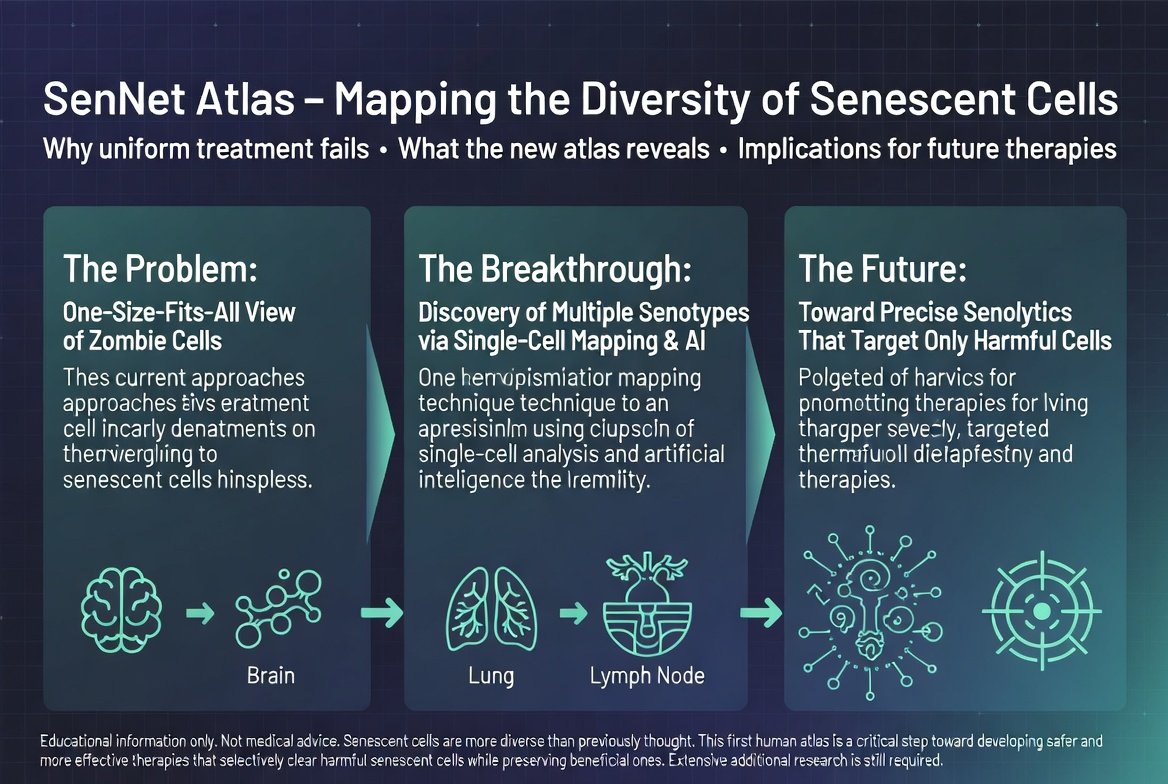
It is important to know that not every zombie cell is bad. Cellular senescence plays a beneficial role in wound healing, embryonic development, and in halting cells that could become cancerous. This is one reason why precise measurement and treatment are so complex: you don't want to eliminate everything, only what is harmful.
How Are Zombie Cells Identified Today, and Why Is It Not Enough
The fundamental problem, which the researchers themselves admit, is that there is no single universal marker that characterizes every zombie cell. In the lab, a combination of indirect markers is used:
- Increased expression of p16INK4a and p21: Genes that halt the cell cycle, and their high expression is considered one of the main signs.
- Activity of the enzyme beta-galactosidase (SA-beta-gal): A classic stain that marks senescent cells in culture and tissue.
- SASP markers: Measuring the inflammatory cytokines the cells secrete.
The problem: All these markers are usually measured in a tissue biopsy, not in a blood test. They are also not entirely specific; the same genes and markers can appear in other contexts. Therefore, a 'single number that measures zombie burden in the blood' does not yet exist as a validated clinical test. Anyone promising you otherwise, you should ask them which controlled human study they are basing it on.
What the Mayo Clinic Actually Discovered
This is the part where precision is needed. The team from the Mayo Clinic, led by Keenan Pearson and James Maher, published a study in September 2025 in the journal Aging Cell on a new method to mark senescent cells. They used aptamers: short pieces of synthetic DNA that fold into three-dimensional shapes and can bind to specific proteins, similar to antibodies but cheaper and more flexible.
From a random library of trillions of DNA sequences, the researchers screened and identified aptamers that selectively bind to senescent cells. The target the aptamers identified is a variant of a protein called fibronectin on the cell surface. This is a significant conceptual achievement, because it shows it is possible to distinguish a senescent cell from a healthy one using a simple DNA tool.
But here are the caveats that headlines usually omit, and that the researchers themselves emphasize:
- This was done on mouse cells, not human cells. The researchers explicitly state that further studies will be needed to find aptamers that identify senescent cells in humans, and that this could take years.
- This is an identification reagent, not a blood test. The aptamer binds to the cell; it does not measure free DNA in the bloodstream, and there is no 'zombie burden score' derived from a blood draw.
- This is not a drug. There is no treatment here that kills zombie cells, only a tool to identify them, and for now in mice.
- The role of this fibronectin in senescence is still not understood, as the researchers themselves note.
In other words: this is a real research breakthrough in identification tools, but it is at the beginning of the road. The distance between 'an aptamer that binds to a senescent mouse cell in a dish' and 'a blood test available in a clinic that measures your zombies' is a distance of years, if not more.
Why a Blood Test for Zombies Is Such a Difficult Problem
Even if we assume that one day a human aptamer, or another signature in the blood, is found, there are real obstacles that explain why this hasn't happened yet:
- There is no single universal marker. Senescent cells differ from each other between tissues and cell types, and a marker that works for one does not necessarily work for another.
- A weak signal in a large noise. Every day, billions of healthy cells die in the body and release their contents into the blood. Identifying the specific contribution of zombie cells within this noise is a huge technical challenge.
- Broad human validation is needed. For a test to become clinical, it must be shown that the number in the blood truly correlates with the zombie cell burden in the tissue, across thousands of people and different ages and conditions. Such work has not yet been published.
- Human vs. mouse. Many impressive findings in mice simply do not replicate in humans. This is a warning that repeats again and again in this field.
What Does Work: The Treatments, Also Mostly in Mice
If identification is not yet mature, what about treatment? Here there is stronger evidence, but again, the vast majority is in animals. These are the real milestones in the field of senolytics (drugs that selectively kill zombie cells):
- Baker et al., 2016 (Nature): Using a genetic system (INK-ATTAC) that removes cells expressing p16, the team showed that clearing zombie cells from naturally aging mice extended their median lifespan by about 24% to 27%, depending on genetic background.
- Zhu et al., 2015 (Aging Cell): The study that first introduced the concept of senolytic drugs, and identified the combination of dasatinib + quercetin (D+Q) as one that selectively eliminates zombie cells. Here there were no lifespan data yet.
- Xu et al., 2018 (Nature Medicine): Oral administration of D+Q to old mice increased their survival after the start of treatment by about 36%, and improved physical function. This is the study that established the link between clearing zombie cells and extending healthspan in mice.
Note what is missing here: There is still no convincing proof that senolytics extend human lifespan or prevent age-related diseases in humans. Early clinical trials in humans are underway (for example, in pulmonary fibrosis and metabolic diseases), but the results are preliminary and mixed. Here too, the gap between mouse and human is the story.
And What About the 'Aging Clocks' Already Being Sold?
There are currently commercial tests that promise a 'biological age', most based on epigenetic methylation clocks (like GrimAge and PhenoAge). It is important to distinguish: These are not tests for zombie cell burden. They measure general methylation patterns on DNA and try to estimate biological age or risk. They are a more established research tool than a 'zombie index', but they too remain mostly in the research domain, with an ongoing debate about how useful they are for personal decisions.
The key point: No commercial test today directly and validly measures your zombie cell burden. If someone markets a private 'zombie cell test' to you, you should carefully check which controlled human study it relies on, because currently there is none.
What Is Worth Doing Now
- Don't look for a blood test for zombies; it does not yet exist as a reliable clinical test. Don't pay thousands of shekels for a product that claims to measure this, because it has no human validation.
- Beware of commercial bioage tests that promise more than the science supports. Distinguish between controlled academic research (like that of the Mayo Clinic) and marketing that uses headlines without mentioning that the research is in mice and at an early stage.
- Focus on what has already been proven to benefit aging: regular physical activity, quality sleep, a whole-food Mediterranean-style diet, and avoiding smoking. These are the interventions with the strongest evidence base, without needing any expensive test.
- If you have an advanced age-related disease and are in the US, ask your doctor about clinical trials in the field of senolytics. A trial is the right way to be exposed to new technology, with medical supervision, and not through a supplement bought on your own.
- Remember that quercetin and fisetin are sold as supplements, but there is no quality evidence that supplement doses eliminate zombie cells in humans. Most senolytic data are in mice and at pharmaceutical doses, not in a supplement capsule.
- Follow the field without getting carried away. Institutions like the Mayo Clinic and the Buck Institute lead the research. When a validated human test is published, it will come from them, and not from an advertisement.
The Broader Perspective
It is easy to get excited, and that is understandable. The idea of zombie cells as a major driver of aging is one of the most powerful and exciting frameworks in aging science, and the work on aptamers that identify them is truly promising. But healthy excitement also requires honesty about the stage we are at.
As of today, the picture is this: The treatments (senolytics) have proven themselves mainly in mice, with early and mixed human evidence. The identification tools (like the Mayo Clinic aptamers) are a conceptual breakthrough, but at the mouse stage, and have not yet bound to human cells. And a simple blood test that gives a personal 'zombie index' is, for now, an aspiration, not a product.
The history of medicine teaches that good measurement tools indeed change entire fields, just as the cholesterol test changed cardiology. It is very possible that measuring zombie cell burden will do the same for aging. But that will happen when there are controlled human studies showing the test is reliable and that it leads to a treatment decision that improves outcomes. Until then, the healthiest thing you can do is distinguish between the dream and the reality, and not pay for the former as if it were the latter.
References:
Pearson et al., Aging Cell 2025 - DNA Aptamers as Senescent Cell-Specific Reagents
Baker et al., Nature 2011/2016 - Clearance of p16Ink4a Senescent Cells
Xu et al., Nature Medicine 2018 - Senolytics Improve Physical Function and Increase Lifespan



💬 Comments (0)
Be the first to comment on the article.