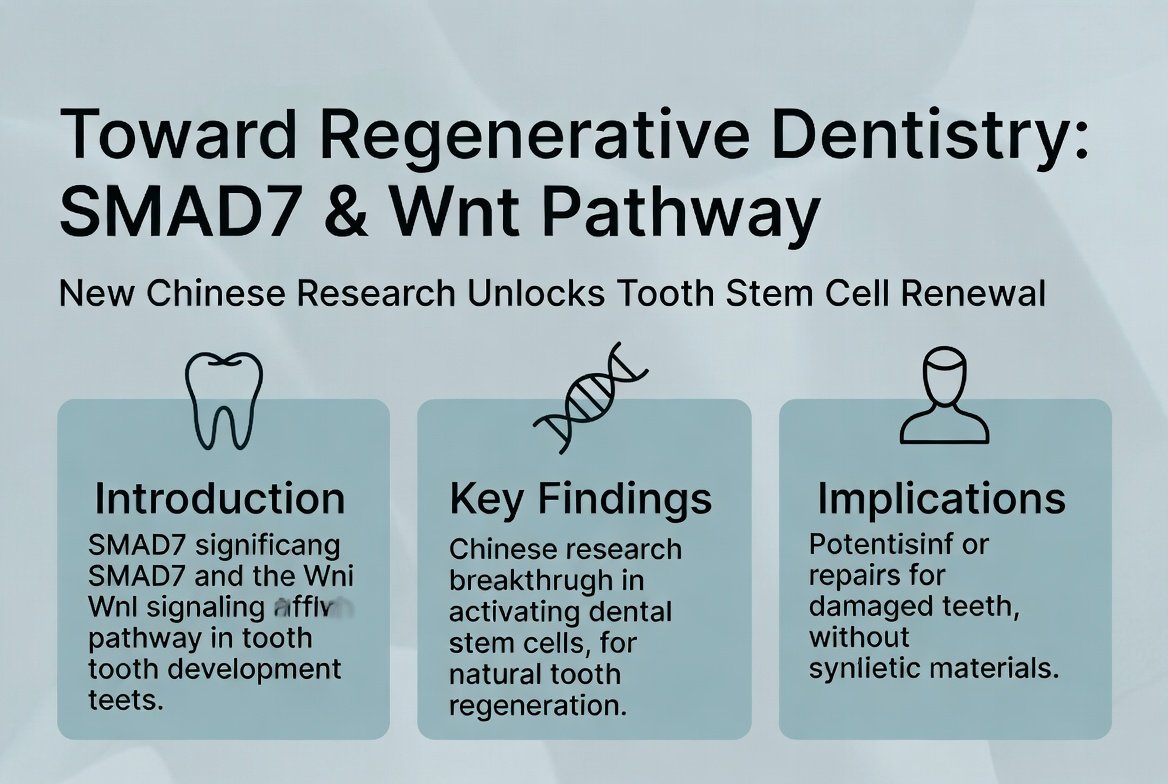
A tooth is composed of three layers: enamel (outer), dentin (middle), and dental pulp (inner). Enamel is the hardest substance in the human body and protects the tooth from external damage. But it has one bad property: after teeth develop in childhood, enamel cannot regenerate. Any damage is permanent. That's why we have fillings, crowns, and implants. However, new research published in the International Journal of Oral Science (Nature group) by the University of Washington presents a breakthrough: an AI-designed protein capable of causing enamel cells to mature in the lab and produce real enamel-like material.
Why is enamel so difficult to mimic?
Ameloblast cells are the cells that produce enamel. They are active only in childhood, during tooth development. Afterward, they die or fade away. For years, scientists tried to "revive" them in the lab, but without success: the cells did not mature to the right stage, and certainly could not produce hard enamel.
The main reason: ameloblast cells require a specific signal from other cells in the tooth. This signal passes through a pathway called Notch, and is usually provided by neighboring cells in the tooth. Without it, ameloblast cells do not know they need to mature.
The solution: A protein designed by AI
The University of Washington team, through the Institute for Stem Cell & Regenerative Medicine (ISCRM) and led by researcher Anjali Patni, managed to solve the problem with a new approach: they computationally designed a protein that directly activates the Notch pathway. This is an excellent example of how AI is changing biology.
The protein, called C3-DLL4 (a computationally designed soluble agonist for the Notch pathway), bypasses the need for a signal from neighboring cells. It directly activates the pathway in ameloblast cells, causing them to mature to an advanced stage of enamel production, identified among other things by the marker WDR72.
The mouse experiment: Creating enamel-like material in a living body
The team did not stop at the lab. They implanted the mature ameloblast cells under the kidney capsule of mice, a small pouch that allows the cells to continue maturing into tooth-like material. After a few weeks, the cells formed a calcified material similar to enamel. This is the first demonstration that enamel-like material is formed in living tissue using this approach.
Where is this going?
It is important to put things in perspective: this is research at a very early preclinical stage, still far from clinical use in humans. The researchers describe several challenges that need to be solved before treatment can even be considered:
- Integration with dentin. Enamel alone is not enough. The inner layer of the tooth is also needed. The next step: creating a more complex organoid
- Implantation in more complex models. Currently, this is under the kidney capsule. It needs to be shown to work in a jaw-like environment
- Safety tests. Mainly concern about cancer, as stem cells can become uncontrolled
In other words, we are at the beginning of the road. This is a proof of concept in a lab model, not an existing treatment, and not regrown human teeth. Any assessment of a timeline for clinical availability would be pure speculation at this stage.
What could this mean for dentistry?
If the approach succeeds in maturing in the future, it could theoretically offer an alternative to some existing treatments: producing enamel-like material instead of fillings, regenerating tooth tissue, and perhaps in the distant future, a biological alternative to implants. But all of these are future scenarios, not promises.
Additionally, the research sheds light on genetic diseases of enamel. The researchers found that the DLX3 gene is critical for the development of ameloblast cells: in its absence, the cells could not mature properly even when the Notch pathway was activated. Mutations in this gene have been linked to increased susceptibility to cavities and enamel diseases such as amelogenesis imperfecta, a genetic condition that causes defective enamel from birth. Understanding this mechanism is an important research value in itself, even without immediate clinical application.
The bottom line
For years, dentistry was considered a "boring field" of minimal innovation. This research changes the picture, at least on the research level. By combining AI, cell biology, and protein design, scientists have shown for the first time a way to cause human enamel cells to mature and produce enamel-like material. The path to clinical use is still long, but the question is no longer just "if" but "when": will a filling one day be a thing of the past, and will the tooth repair itself?



💬 Comments (0)
Be the first to comment on the article.