The longevity technology market in 2026 is booming. Every other day, a new product appears promising to predict, measure, or track your biological age. At CES 2026 in Las Vegas, the halls were filled with companies offering "longevity as a product line." A new study published in Nature Communications provides impressive scientific validation: A consumer wristwatch can estimate biological age with surprisingly good accuracy. This is what the new technology looks like and the possibilities it will open for the average older adult.
The Big Story: Biomarker Monitoring Enters the Home
In the past, if you wanted to measure your biological age, you would go to a lab and pay hundreds to thousands of dollars. In 2026, some of this capability is moving to the home and the watch on your wrist.
The new devices fall into several categories:
Smart Watches
The stars of 2026 are the smart watches already on your wrist: the Apple Watch and advanced Garmin watches. They use PPG sensors (an optical sensor that reads the pulse wave from the wrist) and other sensors to detect:
- Heart Rate Variability (HRV) - a predictor of autonomic aging
- Sleep Architecture - quality and duration of deep sleep
- Estimated VO2 Max from walking and running pace
- Thermal regulation and resting heart rate
- Steps and daily activity
The study in Nature Communications showed that from the optical pulse wave (PPG) read by a smart watch, an artificial intelligence algorithm managed to estimate chronological age with an average error of only about 2.4 years in healthy individuals, an accuracy the researchers describe as "similar to or better than expensive clinical tests." It doesn't replace a blood test, but it is impressive for a device already on the wrist.
Smart Scales
Company Withings introduced the Body Scan 2, a device called a "home longevity station." It's not a mirror, but an advanced smart scale that combines bioelectrical impedance measurement (bioimpedance) and ECG, and includes:
- Estimation of up to 60 biomarkers in a single measurement
- Body composition (muscle, fat, water, bone mass)
- 4-limb ECG
- Cardiovascular health indices
- Metabolic age assessment
- Vascular health assessment
Measurement time: about 90 seconds. Price: about $600 (launch in Q2 2026). The concept is considered revolutionary: metrics that required a clinic visit become a home routine of less than two minutes.
Epigenetic Tests and Home Blood Tests
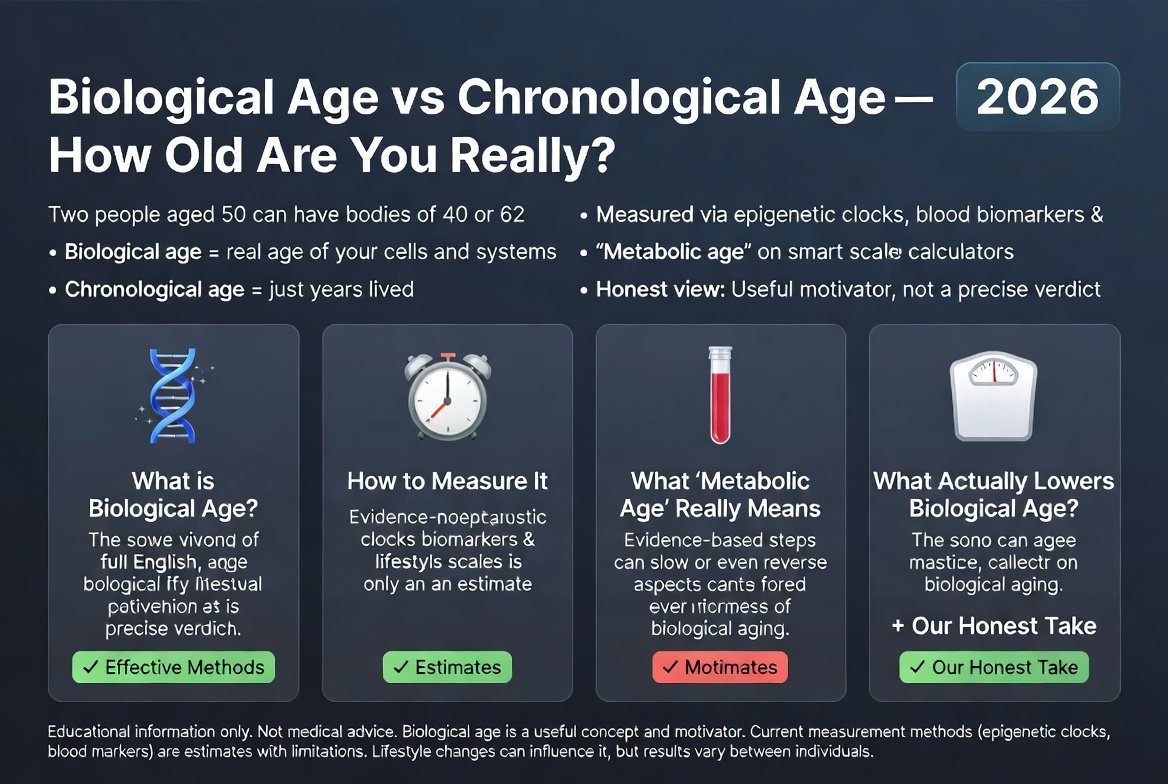
Here it is important to distinguish between two completely different approaches. Company TruDiagnostic offers a home epigenetic test: a DNA methylation test (from a blood sample or cheek swab), which is translated into an "epigenetic clock." In contrast, company InsideTracker is not an epigenetic test at all, but is based on regular blood markers (cholesterol, glucose, vitamins, inflammation, etc.). Both send a kit home and return results within weeks.
The TruDiagnostic epigenetic test can provide:
- Biological age according to methylation clocks like GrimAge
- Aging rate (DunedinPACE)
- Biological age report by different body systems (within a metric like SymphonyAge, which estimates about 11 body systems, including brain, heart, liver, and immune system) - from the same blood sample
Prices typically range from $200 to $500 per test, and there are subscription plans with repeat tests. It's important to remember: this is an estimate, not a medical diagnosis.
24-Hour Blood Pressure Monitoring
Companies offer cuffs that measure your blood pressure several times over 24 hours. The reason: blood pressure varies throughout the day, and a single clinic measurement does not provide a complete picture. 24-hour monitoring predicts the risk of a cardiac event better than a single measurement.
The Research Behind It: A Wristwatch Estimates Biological Age
The study published in Nature Communications (Miller, Futoma, Abbasporazad et al., 2025) is a true breakthrough. The researchers:
- Used data from the Apple Heart and Movement Study, a massive study with about 213,593 Apple Watch participants and over 149 million participant-days of data
- Built an "aging clock" (termed PpgAge) based on the optical pulse wave (PPG) shape read from the watch
- Showed that the model estimates chronological age with an average error of about 2.4 years in healthy individuals
- Discovered that a high gap between estimated and actual age is associated with higher rates of heart disease, heart failure, and diabetes, and that more deep sleep was linked to a younger "biological age"
The implication: If you have a smart watch, you may already have the basis for a biological age meter. The sensor exists; what needs to develop is the software and clinical validation. However, the study emphasizes that this is a population-level estimate, not a substitute for medical tests.
Where is the Technology Going in 2027-2030?
Experts in the field predict:
- Organ-specific tests: Separate age assessment for kidneys, heart, and brain. This could provide much more accuracy and guidance.
- Integration with personal AI: A system that learns your personal patterns over years and alerts you to changes early.
- Connection to home screens: A mirror in the bathroom that not only reflects but serves as a monitoring platform.
- Shower technologies: Patents already exist for showers that measure components in sweat (glucose, electrolytes, etc.).
- Integration with nutrition: A watch that knows what you ate and recommends what to eat at the next meal.
The Dangers
The technology is not without problems:
- Privacy: All your health data flows to companies. Who reads it? Who sells it?
- Health anxiety: Constant monitoring can create anxiety. A healthy person might feel "sick" because of a number on a screen.
- Algorithmic biases: Some studies are based on specific populations, and accuracy may be lower for other groups.
- Exploiting fear: Companies profiting from a "high biological age" might highlight alarming results.
Who Should Invest?
If you are serious about anti-aging and have a budget, a logical order of priorities:
- A quality smart watch ($300-600) - daily value, you probably already wear one
- An epigenetic test or blood test once a year ($200-500) - tracking progress
- A smart scale ($200-600) - for tracking body composition
- 24-hour blood pressure monitoring (if there is risk or heart issues)
Total: about $700-1,500 to start, and about $300 per year for maintenance. Not cheap, but less than the cost of two to three months of expensive supplements. And of course, the free habits (sleep, movement, nutrition) are still the foundation.
The Bottom Line
Longevity technology in 2026 is moving from "expensive lab tests" to "devices at home." This is not just convenience, but the ability for continuous monitoring that was previously impossible. The question is no longer just "is my body aging fast," but "is my trend improving." We are moving from point-of-care medicine to continuous medicine. But remember: all these numbers are estimates that help track trends, not a substitute for a doctor's diagnosis.


💬 Comments (0)
Be the first to comment on the article.