In the world of anti-aging, the strongest currency is measurable results. You can publish articles about a supplement that is supposed to 'slow aging,' but if you can't measure whether it actually works, it's just a promise. In recent years, biological measures have been developed that attempt to estimate a person's biological age, as opposed to their chronological age, to see if lifestyle leaves a quantifiable mark.
A new study from the University of Sydney, published in May 2026 in the journal Aging Cell, examined exactly this: whether a four-week dietary change alone could move the biological age clock in older adults. The results are interesting, but it's important to understand them precisely, without embellishment. The surprising point: the diet that showed the strongest improvement was not a vegetarian or low-carb diet, but rather a high-carbohydrate diet.
What is biological age, and why try to measure it
Biological age differs from chronological age:
- Chronological age, how many years have passed since you were born. Unchangeable.
- Biological age, an estimate of the health status and resilience of the body's systems. Varies from person to person at the same chronological age, and is influenced by lifestyle.
There are several ways to estimate biological age. Epigenetic clocks (like Horvath, PhenoAge, and GrimAge) are based on DNA methylation patterns, and the GrimAge clock is considered a good predictor of mortality and age-related diseases in large population groups. Another method, used in the current study, is a composite index based on clinical biomarkers from blood tests and physiological measures, not methylation. It is important to emphasize: the Sydney study did not use an epigenetic clock like GrimAge. It calculated biological age using a completely different method.
How biological age was measured in this study
The researchers used the Klemera-Doubal (KDM) method, a composite index built from about 20 clinical biomarkers, including blood pressure and blood levels of insulin, cholesterol, and CRP (C-reactive protein, an inflammation marker). From these biomarkers, a single 'biological age' is calculated, and then the difference between it and chronological age is calculated (called δAge in the study). A decrease in δAge means the person's biomarker profile 'looks' younger.
The KDM method has been linked in large cohort studies to morbidity and mortality, so it serves as a useful estimate of physiological state. But it is a measure of a biomarker profile at a given moment, not direct proof that 'aging' itself has been halted.
What exactly was tested: Four diets, not a 'methylation diet'
The study analyzed data from a randomized controlled dietary trial (Nutrition for Healthy Living) with a 2x2 design. It included 104 older adults aged 65 to 75. Each participant was randomly assigned to one of four diets, all providing about 14% of energy from protein, but differing along two axes:
- Protein source: Omnivorous diet (half the protein from animal sources) vs. semi-vegetarian diet (about 70% of protein from plant sources).
- Macronutrient composition: High-fat and low-carbohydrate vs. low-fat and high-carbohydrate (about 53% of energy from carbohydrates).
This created four groups:
- OHF, Omnivorous High-Fat.
- OHC, Omnivorous High-Carbohydrate.
- VHF, Semi-Vegetarian High-Fat.
- VHC, Semi-Vegetarian High-Carbohydrate.
Biological age (δAge) was measured before the diet and after four weeks.
The results: The high-carbohydrate diet stood out
This is the part that surprised even some readers:
- The OHF group, whose diet was closest to the participants' usual diet, showed no significant change in δAge.
- The OHC group (the high-carbohydrate omnivorous diet) showed a significant decrease in δAge compared to OHF, and this was the result measured with the highest level of statistical confidence.
- The VHF and VHC groups showed similar decreases in δAge compared to OHF, but not always reaching statistical significance.
The main takeaway from the numbers: Three diets that differed from the participants' usual diet improved the biomarker profile, and the clearest improvement was observed in the high-carbohydrate omnivorous diet. This contradicts the common intuition that 'fewer carbohydrates' or 'more plant-based' is always better. Incidentally, the researchers note that the study does not measure precise years of 'age reversal' and does not include such year numbers as an official result.
The most important warning from the researchers
Here we need to slow down. The researchers themselves were careful to qualify the finding, and this must not be skipped:
They explicitly wrote that caution should be exercised in interpreting the change as evidence of 'biological age reversal', because the observed change may reflect a rapid physiological responsiveness to the dietary input, rather than a true change in the aging trajectory. In simple terms: the body may simply have responded quickly to the change in the menu (for example, in blood sugar, blood lipids, or inflammation), rather than something in the fundamental rate of aging actually changing.
Additionally, and no less important, the study had no follow-up after the end of the four weeks. That is, there is no data on what happens to the result afterward, whether it is maintained, disappears, or changes. The researchers say that long-term studies are needed to test whether dietary changes indeed reduce the risk of age-related diseases over time. Until then, in the words of one researcher, it is too early to definitively determine that a specific dietary change will extend lifespan.
So what can be taken from this anyway
Even without inflating the finding, there is a positive and evidence-based message here: An older adult's biomarker profile can respond to a dietary change within weeks, and this is measurable. This supports the general idea that diet affects metabolic health measures even at ages 65 to 75, not just in younger people.
What would be good to do with this, as general and healthy advice (and not as a 'proven age-reversal protocol'):
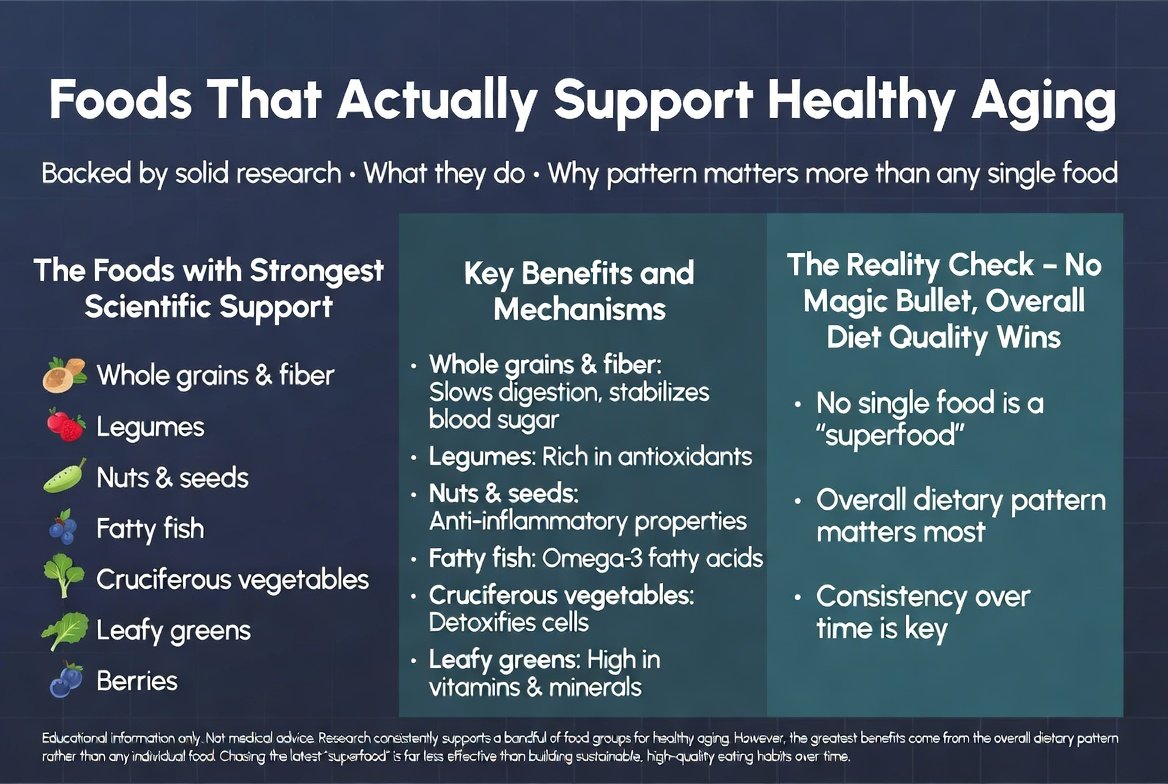
- Eat a wide variety of whole foods, vegetables, legumes, whole grains, fruits, and healthy fats. The high-carbohydrate diet in the study was based on good quality carbohydrates, not sugar and white flour.
- Don't be afraid of quality carbohydrates, the finding reminds us that a low-fat, high-carbohydrate dietary pattern (in the Mediterranean family) is completely legitimate for older adults.
- Maintain adequate protein intake, all diets in the study provided protein, and protein is especially important for preserving muscle mass with age.
- Measure basic health indicators, blood pressure, blood sugar, cholesterol, and CRP, with your doctor. These are the same biomarkers from which the index is built, and they are accessible in a standard blood test.
The message is not 'discover the magic diet,' but rather 'a sensible dietary change improves health measures, even in old age, and quickly.' That alone is worth a lot.
The broader perspective
It's easy to be tempted by the headline 'Diet reversed biological age.' But the fair reading of the study is more restrained: diet changes measures of biological age in the short term, and this effect may be a rapid physiological response rather than true aging reversal, and without follow-up, it's impossible to know if it persists. This is not a reason to dismiss diet, quite the opposite. It's a reason to appreciate how quickly the body responds to our choices, and to continue them over time, not just for four weeks.
In a world of expensive innovations, supplements costing thousands of shekels a month, and experimental treatments, there is a quiet reminder here: the cheapest and most accessible investment is still in what lies on the plate, day after day.
References:
ScienceDaily - Scientists reversed biological age in older adults with a 4-week diet change
Andrews et al., Aging Cell 2026;25(5):e70507 - Short-Term Dietary Intervention Alters Physiological Profiles Relevant to Ageing


💬 Comments (0)
Be the first to comment on the article.