Every few months, a study is published that tells the same story in a new variation: we took old tissue, identified a single molecule that declined with age, restored it, and function returned. We've seen this with NAD in mitochondria, with Yamanaka factors in cells, and with certain proteins in blood. In 2023, a study was published in the journal PLoS Biology that adds a surprising player to the list, and it returned to headlines in media waves in 2026: A protein called Menin, whose decline in the hypothalamus drives the process of cognitive aging.
The story is particularly interesting because of the ending: the researchers not only identified the protein that declines, they found a way to bypass some of the damage. Administration of a relatively simple and available amino acid, D-Serine, partially improved memory in old mice. This turns a dry mechanistic study into something with clinical potential, and that's exactly why it's worth understanding what was actually found, and what wasn't.
The connection between Menin and brain aging is an excellent example of a principle that repeats itself in longevity research: sometimes behind a complex process like forgetfulness lies a single component that can be targeted. But as always, the distance between a mouse in a lab and a pill you swallow in the morning is enormous.
What is Menin?
Menin is a protein encoded by the MEN1 gene. It is primarily known to oncologists because mutations in this gene cause a rare endocrine tumor syndrome. But it turns out that in the brain, it has a completely different role. Here's what's important to know:
- It is a regulator of gene expression. Menin acts within the cell nucleus as part of protein complexes that control the activation and silencing of genes, partly through epigenetic changes in histones.
- It controls inflammation. In neurons, Menin binds to the p65 subunit and suppresses the activation of the central inflammatory pathway NF-kB. When its levels are normal, it holds the brake on the inflammatory signaling cascade.
- Its levels decline with age in a specific area. This is the key discovery: in the brains of old mice, the amount of Menin decreases significantly specifically in SF-1 type neurons in the ventromedial nucleus of the hypothalamus (VMH).
- It affects downstream neural signaling. The decline in Menin in the hypothalamus does not remain local. It translates into changes in the hippocampus, the key memory area, through a neural circuit that links the two regions.
In other words, Menin is not just another random protein. It is a node that connects three processes we all know accelerate brain aging: gene regulation, inflammation, and synaptic signaling.
The Connection to Menin and Brain Aging: A Triple Mechanism
How exactly does a decline in one protein in a small area of the hypothalamus translate into forgetfulness? The study points to a chain of events with three stages that feed into each other:
1. Loss of the inflammatory brake in neurons. As long as Menin levels are normal, it binds to p65 and suppresses the NF-kB pathway. When Menin declines in hypothalamic neurons, this brake is released and the inflammatory pathway is activated within the neurons themselves. It's important to be precise: in this study, Menin declined specifically in neurons, and did not decline in microglia or astrocytes. The result is neuroinflammation, one of the central drivers of brain aging.
2. Disruption of neuronal signaling. The inflammation and change in gene expression impair the ability of neurons to transmit signals to each other efficiently. The focus here is on synaptic plasticity: the ability of neural connections to strengthen or weaken in response to experience, which is the biological basis of learning and memory. When plasticity is impaired, the brain struggles to form and retain new memories.
3. Deficiency of D-Serine in the hippocampus. Here comes the clever connection of the study. The researchers found that the decline in Menin in the hypothalamus impairs the release of D-Serine in the circuit leading from the hypothalamus to the hippocampus. D-Serine is an amino acid that serves as a co-agonist of NMDA receptors, a type of glutamate receptor critical for synaptic plasticity. Without enough D-Serine in the hippocampus, NMDA receptors do not open properly, and the neural signal responsible for memory strengthening weakens.
This chain explains why it was possible to bypass some of the damage: even without restoring Menin itself, replenishing D-Serine acted directly on NMDA receptors in the hippocampus and restored some of the lost synaptic signal. It's like fixing the final result of a malfunction instead of fixing the original problem, and therefore the repair is not complete.
The Current Evidence
It's important to clarify: all the findings below come from a single article published in PLoS Biology, based on a series of experiments in mice, along with general background knowledge about NMDA receptors. These are not four separate studies but stages within the same work.
Finding: Decline of Menin in the Hypothalamus of Old Mice
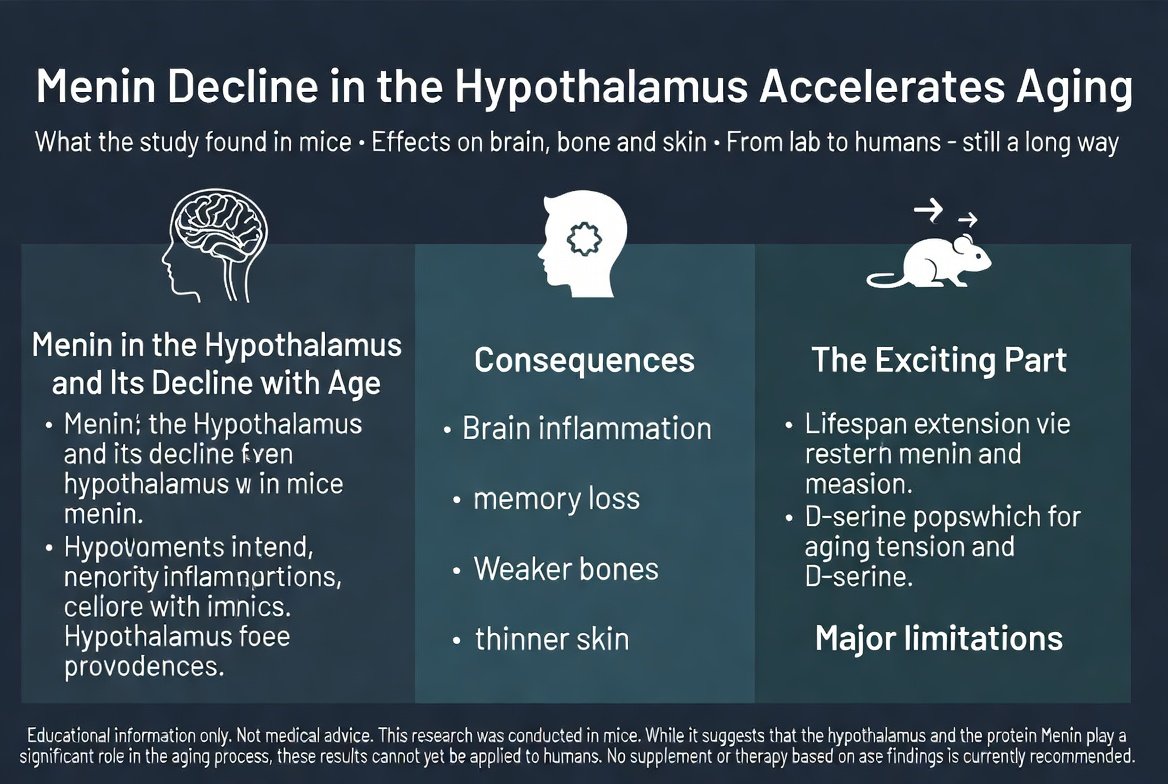
In the first stage, the researchers compared Menin levels in the brains of young mice versus old mice. It was found that Menin concentration decreased significantly with age specifically in SF-1 type neurons in the ventromedial nucleus of the hypothalamus (VMH), and not in microglia or astrocytes. To prove causality, they suppressed Menin in this area in middle-aged mice and saw that the mice developed symptoms of premature aging, including neuroinflammation and poor memory performance. In the opposite direction, restoring Menin to the VMH of old mice improved memory and extended lifespan.
Finding: Behavioral Memory Tests
Memory was measured in standard behavioral tests in mice: the Morris water maze, T-maze, and Y-maze. Old mice, and mice in which Menin was suppressed in the hypothalamus, showed a significant decline in the ability to learn and remember. They struggled to remember the location of an escape platform they had previously found and in working memory tasks, a classic sign of memory impairment.
Finding: Partial Improvement of Memory with D-Serine
This is the central finding. When the old mice received a D-Serine supplement, their performance on memory tests improved. However, it's important to be precise: the rescue was partial. D-Serine administration improved cognitive function, but did not correct the signs of aging in the body's peripheral systems, and its effect was weaker than that of restoring the Menin gene itself. In other words, the supplement bypasses some of the downstream damage, but is not a substitute for fixing the root cause.
The Broader Context of NMDA Modulation
The finding fits into an existing body of knowledge about NMDA receptors and aging. Previous studies have shown that a decline in NMDA receptor function is a central feature of the aging brain, and that systems supplying D-Serine weaken with age. The 2023 study adds a link: it connects the decline in D-Serine to a single regulatory protein in the hypothalamus and the neural circuit that affects the hippocampus.
What About Alzheimer's and Neurodegenerative Diseases?
The connection between neuroinflammation, NMDA receptors, and memory is not unique to normal aging. It is central to several neurodegenerative diseases. In Alzheimer's, for example, there is evidence of dysfunction in the glutamate-NMDA system, and the drug memantine acts precisely on this pathway. Memantine is a non-competitive, low-affinity, voltage-dependent NMDA receptor channel blocker, so it moderates overstimulation without completely blocking normal signaling.
If the decline in Menin indeed contributes to inflammation and the D-Serine deficit, there may be a shared pathway relevant not only to healthy aging but also to memory diseases. This does not mean D-Serine is a cure for Alzheimer's, far from it, but it places the finding in a broader context that interests many researchers.
It's important to qualify: modulation of NMDA receptors is a double-edged sword. Overstimulation of them causes excitotoxicity, a process where neurons are killed by excessive stimulation. This is why in Alzheimer's, a blocker is used, not an enhancer. Hence, any approach that tries to increase NMDA activity must navigate very carefully between memory improvement and the risk of damage.
Should We Start Taking D-Serine?
D-Serine is sold as a dietary supplement and is available. So why not just start? Several weighty reasons:
- The study was done in mice, not humans. This is a qualification that cannot be bypassed. Hundreds of interventions have restored memory in mice and failed in humans. A mouse is not a perfect model for the human brain, certainly not for its aging over decades.
- The rescue in the study was only partial. Even in mice, D-Serine improved memory but did not correct peripheral aging, and was weaker than restoring Menin. That is, even in the animal model, it was not a complete solution.
- The doses and context are completely different. The dose given to a mouse in the lab, relative to its body weight and under controlled conditions, does not simply translate to a human pill. An incorrect dose of a substance that acts on NMDA receptors can be harmful.
- NMDA modulation carries real risks. As noted, overstimulation of NMDA receptors is linked to excitotoxicity and neural damage. The line between a beneficial and harmful dose may be narrow, and is unknown in a healthy human.
- There are no long-term safety data. Taking an amino acid that alters central neural signaling over years is something no one has tested. Possible side effects, interactions with medications, and effects on mood and anxiety are all unknown in this context.
- D-Serine has already been studied in schizophrenia, where it was tested as an add-on to treatment, with mixed results. This shows there is research interest, but also that the path to approval and safe use is long.
The bottom line: This is an exciting mechanistic finding, not a clinical recommendation. Anyone who rushes to buy D-Serine based on a headline about mice is getting ahead of the science by years, and may be taking an unnecessary risk.
What Can We Take from the Study?
- Do not start D-Serine supplementation on your own. The current evidence does not justify it in healthy humans, and the risks of NMDA modulation are real. If you are still interested, this is a conversation for a doctor, not an independent decision.
- Focus on reducing neuroinflammation through proven methods. One of the axes of the study is that the decline in Menin drives inflammation. Chronic neuroinflammation is heavily influenced by lifestyle: an anti-inflammatory diet, regular physical activity, and quality sleep all reduce it, without risk.
- Keep your NMDA receptors healthy naturally. Aerobic exercise increases BDNF levels and strengthens synaptic plasticity, the same mechanism the study tries to restore. This is the safest and most proven intervention for the aging brain.
- Follow the research, not the headline. If you want to know if there is something real here, look for studies that begin in humans. Until then, it's a promise, not a product.
- Feed your brain quality protein. Amino acids, including the precursors of D-Serine, come from a balanced diet. There is no need for a dedicated supplement to provide the brain with the building blocks it needs.
The Broader Perspective
The story of Menin and brain aging joins a larger pattern that has become clear in the last decade: aging is not one opaque block, but a collection of specific deficits, each of which may be repairable. When the right molecule that declines is identified, sometimes a function that seemed lost can be restored.
But the same story also teaches the opposite lesson. Restoring a single molecule in the lab, and certainly only a partial improvement, is not equivalent to treatment in humans. The path from a mouse with improved memory to a human enjoying the same effect goes through safety, dosing, and side-effect studies that take years. In the meantime, the tools that have truly been proven on the human brain—exercise, sleep, diet, and inflammation control—act on exactly the same pathways this study points to.
The message to remember: Behind every deficit of aging lies a mechanism, and behind every mechanism lies an opportunity, but also a temptation to get ahead of the science. Curiosity about Menin and D-Serine is entirely justified. The rush to the pharmacy, less so.
References:
Leng et al., Hypothalamic Menin regulates systemic aging and cognitive decline, PLoS Biology, 2023
PubMed - PMID 36928253



💬 Comments (0)
Be the first to comment on the article.