For an entire decade, the public and scientific consciousness of aging research embraced a clear narrative: Zombie cells are enemy number one. Senescent cells that refuse to die, that secrete a toxic cocktail of inflammatory molecules, that poison the surrounding tissue and cause age-related diseases. The solution seemed simple: eliminate them. Senolytic drugs like dasatinib+quercetin (D+Q), fisetin, and navitoclax (ABT-263) were developed with one goal: to kill zombie cells in the body.
But in recent years, the picture has become much more complex. It turns out that not every zombie cell is an enemy. Some are actually silent heroes of the body, essential for wound healing, embryonic development, and even protection against cancer. A comprehensive review published in May 2026 in the journal Aging (Aging-US), led by researchers from West China Hospital and the Cancer Center of Sichuan University in China, summarizes this paradigm shift and proposes a new approach.
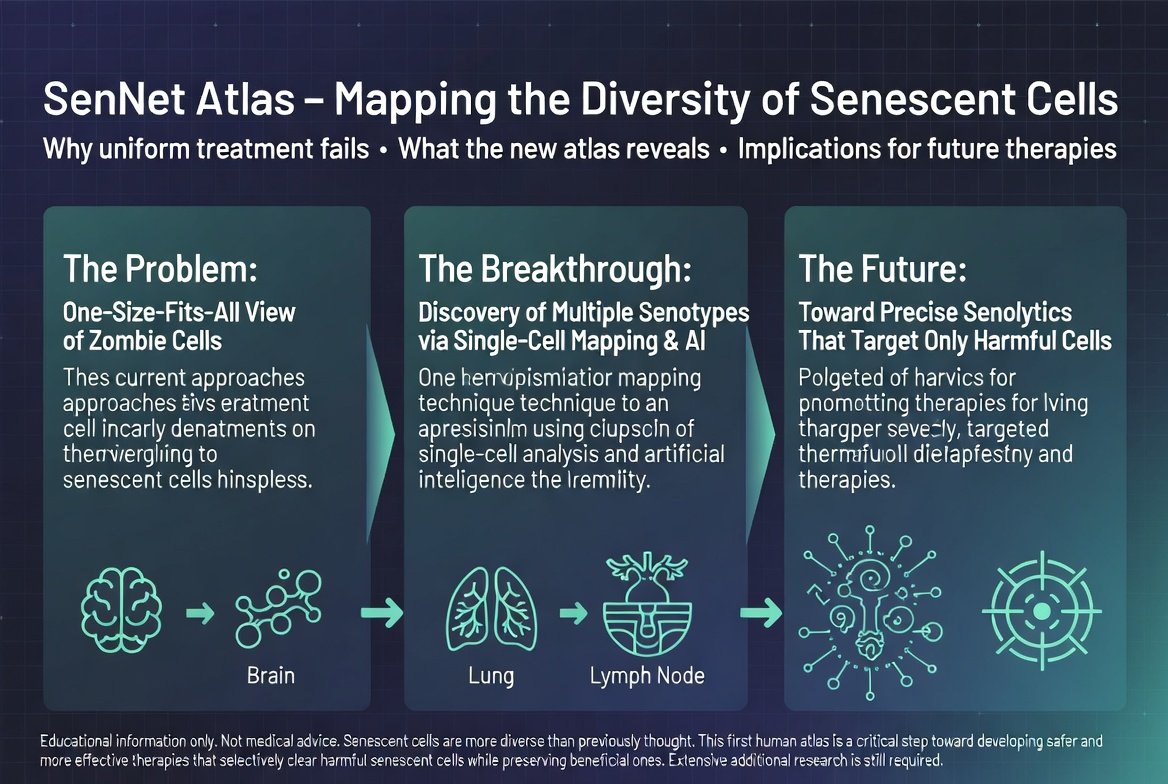
This approach is called Precision Geroprotection or Precision Senolytics. Instead of bombarding the body with a drug that kills everything zombie, the goal is to identify the specific subpopulation of harmful zombies and attack only them, while preserving the beneficial zombies essential for tissue stability and renewal. This is similar to how cancer medicine moved from general chemotherapy to targeted therapy and immunotherapy.
This article delves into one of the most important questions in aging research today: How do you distinguish between good zombies and bad zombies? What biomarkers are being studied to enable this separation? And why is this the future direction of the field?
What is a Zombie Cell, and Why Does It Exist at All?
A zombie cell, officially called a senescent cell, is a cell that has undergone a profound biological change. It has stopped dividing, but it hasn't died. It remains in the tissue, consumes energy, and secretes a wide range of molecules. The phenomenon was first described in 1961 by Leonard Hayflick, who noticed that human cells in culture stop dividing after a limited number of divisions. Only in recent decades have we understood that this is not just a passive process of wear and tear, but an active and regulated genetic program.
- Entry into senescence is triggered by diverse stimuli: DNA damage, oxidative stress, telomere shortening, active oncogenes, or external signals from neighboring cells.
- Key genes: p16INK4a, p21, and p53. These are the 'brakes' that stop cell division and cause it to remain in this special state.
- They secrete SASP: Senescence-Associated Secretory Phenotype, a combination of inflammatory cytokines (IL-6, IL-8, TNF-alpha), tissue-degrading enzymes (MMPs), and growth factors.
- They accumulate with age: The burden of zombie cells increases with aging, although the rate varies greatly between tissues and there is no precise total number across the entire body.
- They are linked to many age-related diseases: Alzheimer's, Parkinson's, type 2 diabetes, osteoarthritis, fibrosis, heart failure, and more.
But why does the body produce such cells at all? Evolutionarily, senescence is a defense mechanism. When a cell accumulates DNA damage, it has two dangerous options: die (apoptosis), or continue dividing with damage, which could turn it into a cancer cell. Senescence is a third way: stop dividing, stay alive to send signals to the environment, and mark itself for removal by the immune system.
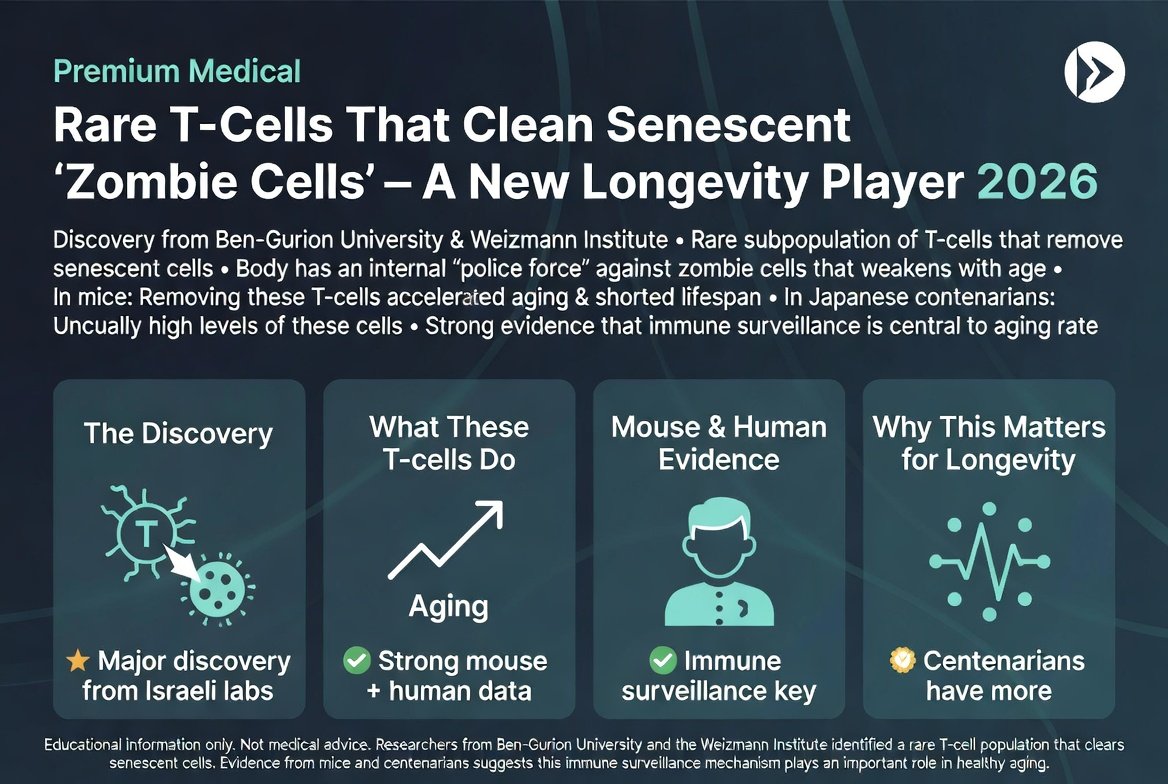
The problem is that with age, the immune system begins to fail in its removal work. The zombies that should be cleared remain, accumulate, and begin to cause more harm than good. This is the moment when beneficial senescence turns harmful.
The Two Faces of Senescence: When Is It Good and When Is It Bad?
One of the key insights of recent years is that cellular senescence is not a uniform phenomenon. There are several physiological roles where zombie cells are essential, not harmful. Understanding these roles is the foundation of the precision senolytics approach.
1. Wound Healing
When injured, cells at the wound edges temporarily enter senescence. They secrete SASP, but in this context, SASP serves as a recruitment signal for immune cells and stem cells that arrive at the injury site and activate tissue repair mechanisms. After the wound closes, the temporary zombie cells are supposed to be cleared. It is important to clarify a point that recent research has actually reversed: In aged skin, where chronic zombies have accumulated, studies in mice showed that senolytic treatment actually accelerates wound healing and does not impair it. That is, removing chronic zombies promotes healing, while the temporary zombies that appear during the injury itself play a beneficial role.
2. Embryonic Development
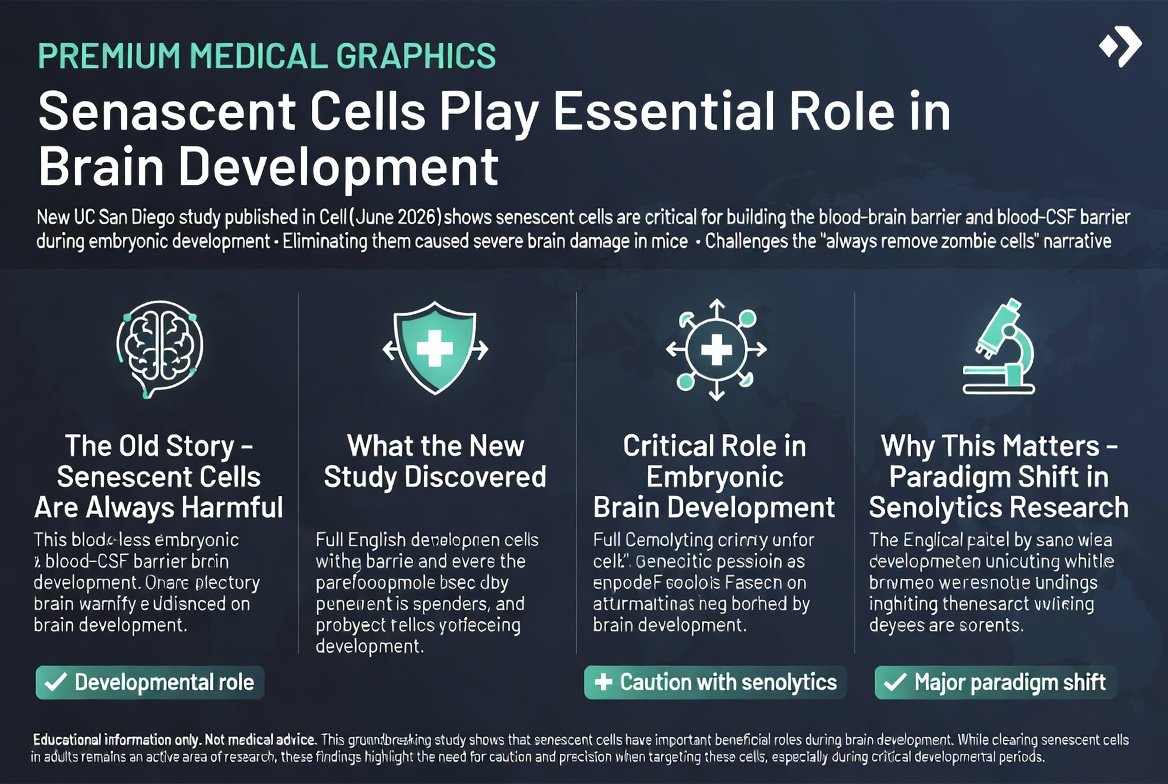
In early stages of development, cells in the embryo enter programmed senescence. Developmental senescence helps in the proper shaping of organs and structures, and in the controlled removal of temporary tissues as part of the normal developmental process. This is one reason why human studies on senolytics are careful to exclude pregnant women, out of caution.
3. Protection Against Cancer
Senescence is one of the important defenses against cancer. When a cell receives an active oncogene (like RAS or MYC), it can automatically enter senescence, which prevents it from dividing and growing into a tumor. These zombies, called OIS (Oncogene-Induced Senescence), are a kind of evolutionary 'imprisonment' of cells that could have become cancerous. This is the reason for a theoretical concern: broad senolytics that also eliminate OIS zombies could, in theory, weaken one of the body's cancer-suppression mechanisms. It is important to note that this is a conceptual concern arising from the biology of OIS, not a finding established in humans. In fact, some evidence points in the opposite direction: in mice, removing zombie cells with senolytics actually reduced the development of radiation-induced cancer, presumably by reducing the chronic SASP inflammation that promotes tumors.
4. Immune System Regulation and Tissue Repair
Temporary and controlled senescence also plays a role in regulating immune responses and repairing tissues after acute inflammation. After a heart attack, stroke, or acute inflammation, local zombie cells can play a bidirectional role: in the initial phase, they may contribute to repair, and only if they are not cleared in time do they become a source of chronic inflammation. Therefore, timing is critical in any intervention approach.
The 'bad' zombies, on the other hand, are those that remain in the tissue for months or years after their original role has ended. They continue to secrete SASP, cause chronic inflammation, and infect neighboring healthy cells in a process called paracrine senescence. These are the zombies that need to be eliminated.
The Connection to Precision Senolytics: How to Distinguish Between the Two
If good and bad zombies look similar, how do you tell them apart? This is one of the central questions of research today, and it is far from being solved.
Marker Profile: p16 vs. p21
Researchers are examining whether marker profiles, such as expression levels of p16INK4a versus p21, can help distinguish between subtypes of zombie cells. The hypothesis is that different markers may characterize chronic-pathological senescence versus temporary-physiological senescence. However, the picture is complex and not clear-cut: some studies have actually found that cells with high p21 expression are the problematic ones in certain contexts. Therefore, the simple dichotomy of 'p16 = bad zombie, p21 = good zombie' is an oversimplification that has not been resolved, and research is still trying to crack which marker signatures truly differentiate between subtypes.
Distinctive SASP Profile
The SASP is not uniform: the composition of molecules a zombie cell secretes varies according to cell type, the trigger that caused senescence, and the tissue context. Analyzing the SASP profile—which pro-inflammatory cytokines (like IL-6, IL-8, TNF-alpha) and which tissue-degrading enzymes (MMPs) are secreted—is being studied as a possible tool for characterizing harmful versus beneficial zombies.
Surface Markers as Targets for Targeting
One of the promising directions is identifying proteins on the surface of the zombie cell that can serve as a 'flag' for identification and targeting. Beta-2-Microglobulin (B2M) is an example of a surface protein identified as a general marker of senescence. As early as 2021, an Antibody-Drug Conjugate targeting such a surface protein was presented as a proof-of-concept to selectively eliminate zombie cells. It is important to clarify: B2M is a general senescence marker, not a specific marker that distinguishes between 'bad' and 'good' zombies. Approaches of this type, as well as additional antibodies and CAR-T cells targeting senescence markers, are being studied to make targeting more selective.
Senomorphic Approaches: Don't Kill, Restrain
Another approach is Senomorphics: instead of killing the zombie cell, its inflammatory SASP is suppressed. This neutralizes the damage the cell causes without eliminating it, thereby preserving beneficial functions and reducing the risk of harming essential zombies.
What Is Already Known, and What Is Still a Hypothesis
It is important to separate what is established in research from what is still a hypothesis or research direction:
- Established: Zombie cells are heterogeneous, and some have beneficial physiological roles (wound healing, embryonic development, cancer suppression via OIS). This is solid documentation in the literature.
- Established: The efficiency of removal by the immune system declines with age, leading to zombie accumulation.
- Established: First-generation senolytics (D+Q, fisetin, ABT-263) target zombie cells broadly and non-selectively.
- Established: In aging mice, senolytics actually showed improvement in wound and bone healing, and zombie removal reduced radiation-induced cancer. That is, the picture is not 'senolytics are always harmful'.
- Established (important negative finding): A randomized controlled clinical trial from 2025 examining fisetin for knee osteoarthritis found no significant benefit at the dose and strategy tested, although no safety issues were observed. This is a reminder that promising results in mice do not always translate to humans.
- Hypothesis / Research Direction: That it will be possible to precisely map zombie subpopulations in each tissue and selectively target only the harmful ones. This is the vision of precision senolytics, but it is still in the research stages.
- Theoretical concern only: That broad senolytics will weaken cancer suppression by harming OIS zombies. There is no study showing a defined numerical increase in cancer risk in humans as a result of senolytics.
What About Other Age-Related Diseases?
The principle of heterogeneity, distinguishing between harmful and beneficial zombies, is relevant in principle to a variety of age-related diseases. In each, the question arises whether it will be possible to distinguish between cell subpopulations and target only the harmful ones, but these are research directions, not approved treatments:
- Type 2 Diabetes: Pancreatic beta cells can enter senescence. Distinguishing between subtypes may, in the future, allow for more targeted treatment.
- Pulmonary Fibrosis (IPF): Zombie fibroblasts are involved in the disease, and identifying the harmful population is an active research direction.
- Heart Disease: Zombies have different roles in different tissues of the cardiovascular system, reinforcing the need for a discerning approach.
- Alzheimer's and Neurodegenerative Diseases: Microglial cells and other brain cells can enter senescence, and their role is not uniform. This is an intense research area.
- Sarcopenia and Kidney Diseases: Here too, the distinction between harmful zombies and cells in temporary senescence essential for repair arises.
In each of these conditions, the old approach of 'kill all zombies' may be flawed, and the direction of discerning and precise senolytics is the more promising one. But it must be emphasized: these are research directions, not existing treatment protocols.
Should We Start Taking Senolytics?
This question becomes more complex with each new study. The excitement in the field is real, but there are important reasons for caution.
No Senolytic Drugs Approved for Treating Aging
As of today, there is no senolytic approved for general treatment of aging. Dasatinib is approved for specific types of leukemia, quercetin is a dietary supplement, and fisetin is in clinical trials. Using any of these for anti-aging is off-label, without the required level of clinical validation.
The Safety Profile Is Still Unclear
The heterogeneous biology of zombie cells raises a theoretical concern that imprecise senolytics could also harm beneficial zombies, for example, OIS zombies that help suppress cancer. However, there is currently no proven number for such a risk in humans, and some animal evidence points to benefit instead. The main point: the long-term safety profile of senolytics for anti-aging in humans has simply not been sufficiently studied yet.
Open Questions on Precision
The biomarkers meant to distinguish between good and bad zombies are still under development. p16, p21, B2M, SASP profiles—all are being studied, but their accuracy in the clinical setting has not yet been proven, and simple dichotomies are turning out to be complex. There is a risk of inaccurate diagnoses.
The Risk of 'Commercial Anti-Aging'
Already today, there are private companies selling expensive 'senolytic treatments', most without clinical validation. They offer high-dose fisetin, or 'cocktails' of unapproved drugs. The risk is not only financial; there is also a health risk here. Until precise approved drugs exist, beware of attractive promises.
Populations Requiring Special Caution
Even when precise drugs arrive, certain populations will require special caution: pregnant women or those trying to conceive, patients with active cancer, people with open wounds, patients with active autoimmune diseases, and the elderly with severely weakened immune systems. For these, the risk may outweigh the benefit.
What Can You Take from the Research?
- Don't rush to take general senolytics now. Even if fisetin or quercetin are available, their safety and efficacy profile for anti-aging in humans is not yet established. The clinical trial of fisetin for osteoarthritis showed no significant benefit, and this is a reminder for caution.
- Start with evidence-based lifestyle interventions. Regular physical activity, quality sleep of 7-9 hours, and stress management support the function of systems that naturally remove damaged cells, including autophagy and immune activity.
- Eat a Mediterranean diet rich in polyphenols. Strawberries, apples, onions, and dark chocolate contain natural fisetin and quercetin in safe food doses. The effect is subtle, but as part of a healthy dietary pattern, it is supportive.
- If you have an advanced age-related disease, ask your doctor about participating in a clinical trial. Controlled trials are the safest and most responsible way to access innovative treatments, under medical supervision.
- Beware of commercial 'anti-aging' services. Most wellness companies selling expensive 'reversible aging treatments' have no clinical validation. Ask for evidence, controlled publications, and regulatory approval before you pay.
- Follow research from leading institutions. The senescence field is advancing rapidly, and real breakthroughs are published in peer-reviewed scientific journals, not in advertisements.
The Broader Perspective
The story of good and bad zombie cells is much more than an article about new drugs. It marks the maturation of an entire field. In the last decade, senescence research was like an enthusiastic child discovering something new every day. Now it is growing up, becoming complex, asking harder questions, and seeking precise solutions.
Think about the history of chemotherapy. In the past, the approach was simple: kill all rapidly dividing cells. This included cancer cells as well as hair cells, intestinal cells, and bone marrow cells, and the side effects were severe. Only later, with the development of immunotherapy and targeted therapy, were we able to attack cancer more effectively with less collateral damage.
Senolytics are at a similar point. The first generation, D+Q and fisetin, is the broad approach: non-discriminating, hitting zombie cells broadly. The future direction, precision senolytics with antibodies and CAR-T cells targeting senescence markers, and senomorphic approaches that restrain SASP, aims to be more targeted, with less harm to beneficial zombies.
This also opens a door, in the future, to more personalized medicine. In the vision of the field, a person could one day characterize their zombie profile and receive an intervention tailored to them. But it is important to emphasize that this is a research vision, not an existing clinical reality.
It is also important to remember the deep biological aspect. Senescence is not just 'aging'; it is a complex biological phenomenon with essential roles. A body with no zombies at all is not necessarily a healthier body, as some zombies are necessary for wound healing, development, and cancer suppression. The goal is not to erase senescence, but to tune it.
This is also a reminder of scientific humility. Expectations for senolytics were very high, and some estimated that such treatments could, in future combinations, extend healthspan, but these were speculative forecasts. As research progressed, it became clear that the biology is more complex than the initial hypothesis. This is not a failure; it is scientific progress: identifying complexity is the path to real solutions.
And finally, let's return to the human point. Healthy aging does not rely on a single drug or a magic treatment. It combines a healthy lifestyle, evidence-based interventions at the right time, and a cautious approach to new technologies. Precision senolytics, if and when they arrive and are proven, will be a tool in the toolbox, but not the only solution. Movement, nutrition, sleep, and social connections remain the foundation of any healthy aging strategy.
Good and bad zombie cells teach us that in biology, as in life, simple classifications always turn out to be more complex. And sometimes, the way to solve a problem is not to eliminate the cause, but to understand it deeply, distinguish between the useful and the harmful, and act with gentleness and precision. This is the medicine of the 21st century, and with precision senolytics, it is beginning to reach the field of aging as well.
Source:
Deng J, Sun R, Bai Z, Fang L, Zhao X, Yang D. "Cellular senescence: from pathogenic mechanisms to precision anti-aging interventions." Aging (Aging-US), Vol. 18, May 4, 2026. DOI: 10.18632/aging.206375

💬 Comments (0)
Be the first to comment on the article.