Women live longer. In every country in the world, and in every recorded historical period. The average difference is about 5 years, but behind this dry number lies a fascinating biological phenomenon: the immune system of men and women ages differently. A new study published in the journal Nature Aging, from the Barcelona Supercomputing Center (BSC-CNS), reveals these differences in cellular detail never seen before, and its major surprise shatters a common intuition.
What is Immunosenescence?
Immunosenescence is the change in immune system function with age. It is the process that explains why older people get sicker with influenza, recover more slowly from infections, and develop more cancer. At the same time, a low-grade chronic systemic inflammation sometimes develops, a phenomenon termed inflammaging. Aging of the immune system is one of the key factors affecting healthy lifespan.
How the Study Was Conducted
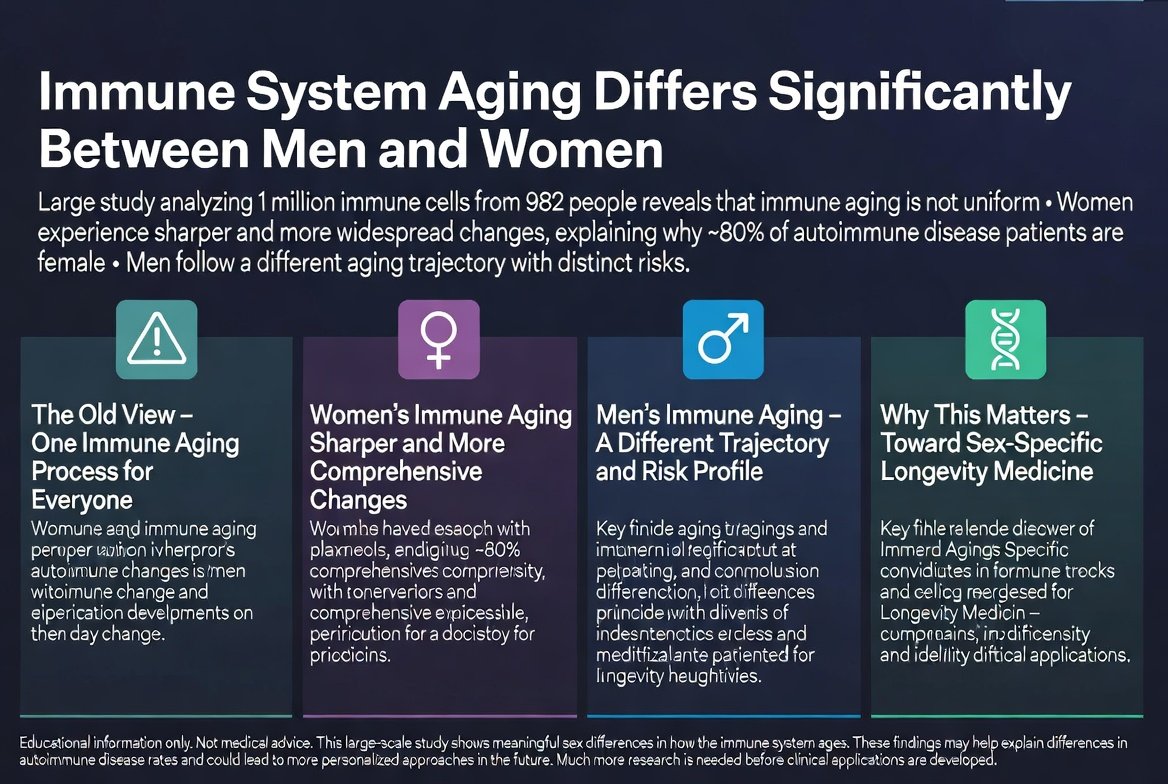
The research team led by Maria Sopena-Rios, Aida Ripoll-Cladellas, and Marta Melé from BSC-CNS performed one of the largest analyses of its kind on immune aging. The researchers analyzed single-cell RNA sequencing (scRNA-seq) of peripheral blood cells from approximately 982 donors across adulthood, examining over one million individual blood cells and the expression of about 20,000 genes. The method allows seeing which subpopulations of immune cells increase or decrease with age, and how men and women differ.
The Surprising Finding: Women's Immune System Changes More
Contrary to what might be expected, the study found that women's immune system undergoes more pronounced changes with age than men's. Immune aging leads to cellular changes and changes in gene expression in both sexes, but in women, the "remodeling" of the immune system is more significant. Both sexes age, but they age differently:
- Women: More pronounced cellular changes, including expansion of CD8+ memory-effector cytotoxic T cells, an increase in inflammatory monocytes, and age-related changes in CD4+ central memory T cells linked to autoimmunity. This is one possible reason why women constitute about 80% of patients with autoimmune diseases (lupus, rheumatoid arthritis, thyroid disorders, etc.).
- Men: Fewer overall cellular changes, but in some men, an age-dependent expansion of a B cell population was found, linked to a precursor, asymptomatic state of chronic lymphocytic leukemia (CLL). This finding may help explain the higher incidence of blood cancers in older men.
Most of these changes are mainly evident in older age, as adulthood progresses.
Two Sexes, Two Risks
This picture aligns with long-standing clinical observations but provides them with a cellular basis. In general, women develop a stronger immune response, which improves resistance to infections and sometimes vaccine efficacy. At the same time, this same immune strength is also associated with a higher risk of autoimmune diseases. Men, on the other hand, tend to be more vulnerable to severe infections, and according to the study, carry a different cellular risk towards pre-cancerous blood cell populations.
It is important to clarify: This is a descriptive study based on RNA sequencing of blood cells. It maps which cells and genes change with age in each sex, but it does not directly measure sex hormones, nor does it measure blood inflammatory markers like CRP or IL-6. Full mechanistic explanations, including the role of the X chromosome or hormones, are a broad and separate field of research, not a direct conclusion of this work.
Inflammaging: Background
Chronic systemic inflammation (inflammaging) is considered one of the accelerators of chronic diseases in old age: heart disease, cognitive decline, diabetes, and cancer. The current study found in women an increase in immune cells with an inflammatory nature with age, which aligns with the picture of inflammaging, even if the work itself measures cells and gene expression rather than inflammatory proteins in serum.
Implications for Personalized Medicine
The researchers' main conclusion: Biological sex should be considered a key variable in personalized medicine. When the immune system of women and men ages along different pathways, it is likely that prevention, diagnosis, and treatment approaches should also be considered according to sex, including in the field of vaccines and monitoring for specific risks (autoimmunity on one hand, pre-cancerous blood cell populations on the other).
What Does This Mean for Me?
If you are an older man: It is advisable to adhere to routine medical follow-up, including blood tests, as some of the immune changes in men are related to blood cell populations that require attention. If you are an older woman: Your immune system is relatively active and strong, but its change trajectory is also associated with a higher autoimmune risk, so it is advisable to be aware of the symptoms and consult if they appear. In both cases, this is not just statistics but a step towards anti-aging medicine that takes biological sex into account.



💬 Comments (0)
Be the first to comment on the article.