Every evening, millions of people around the world drink a cup of chamomile tea before bed without knowing exactly what causes the calming effect. The responsible molecule is called apigenin, a yellowish flavonoid found in high concentrations in chamomile flowers, as well as in parsley, celery, artichoke, and citrus peels. For decades, apigenin was considered a folk sleep supplement, nice but not serious. In 2026, the picture changed.
The reason for the change is a surprising discovery: Apigenin not only calms the brain, it also inhibits an enzyme called CD38, one of the 3 largest consumers of NAD in the human body. NAD is a key molecule in aging, its levels drop by 50% between ages 40 and 60, and one of the reasons for this decline is precisely the increase in CD38 activity with age. Suddenly, the old flavonoid from tea became a dual candidate: for both sleep and longevity. Let's examine what is actually proven.
What is Apigenin?
Apigenin (Apigenin, formula C15H10O5) is a flavone, a subgroup of flavonoids, which are plant antioxidants. Here is the summary:
- The main source in supplements is German chamomile extract (Matricaria chamomilla), in which apigenin is the leading active component.
- It is poorly soluble in water, so the bioavailability of apigenin from regular tea is relatively low, and a concentrated supplement is more effective.
- It has been studied in 3 different directions: as a calming and sleep-inducing agent, as a CD38 inhibitor for NAD preservation, and as a general antioxidant and anti-inflammatory.
- It is considered relatively safe, with a long history of human consumption through food and tea.
Our rating for apigenin is 🟡 Yellow: there is real evidence, some even in humans, but it is still far from conclusive, especially regarding longevity.
The Connection to GABA: Why It Induces Sleep
The calming mechanism of apigenin is well-established neurologically. Apigenin binds to the benzodiazepine site on the GABA-A receptor, the same site to which sedative drugs like Valium (diazepam) and Xanax bind. The critical difference: apigenin is a partial agonist, meaning it activates the receptor with much milder intensity than a prescription drug.
GABA is the main inhibitory neurotransmitter in the brain, the 'brake' of the nervous system. When apigenin enhances GABA activity, the result is calming, anxiety reduction, and shortening of the time it takes to fall asleep, without the heavy sedative effect or risk of addiction associated with benzodiazepines. This is the biochemical reason a cup of chamomile causes drowsiness. The classic study identifying this binding was published as early as 1995 in the journal Planta Medica, and has since been identified in several animal studies showing anti-anxiety and calming effects.
The Connection to CD38 and NAD: The Longevity Mechanism
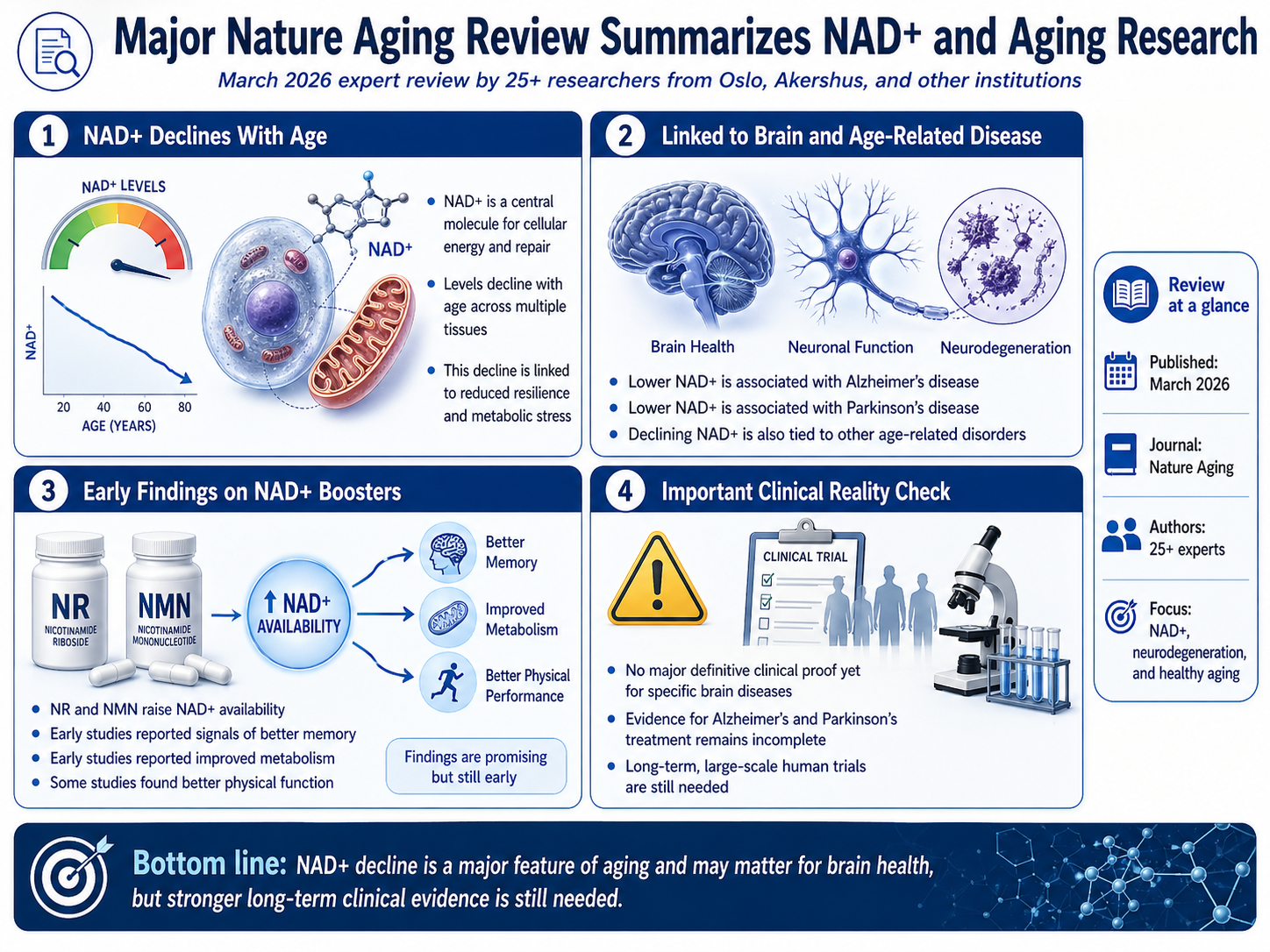
Here enters the more interesting side for the longevity community. NAD (Nicotinamide Adenine Dinucleotide) is an essential coenzyme that every cell in the body uses for energy production and DNA repair. With age, NAD levels decline, and this is one of the reasons for the decline in mitochondrial function.
Why does NAD decline? One of the main reasons is an enzyme called CD38, which consumes NAD at an increasing rate as we age. CD38 is one of the largest consumers of NAD in the body, and its activity increases with aging and chronic inflammation. This is where apigenin comes into play: it is one of the most potent natural inhibitors of CD38 identified to date. If less NAD is consumed, more NAD remains available for cells. This is the complementary opposite to supplements like NMN and NR that try to raise NAD by adding raw material, while apigenin tries to stop the leak.
Current Evidence
Study 1: Apigenin as a CD38 Inhibitor, Diabetes Journal 2013
The landmark study on this topic was published by the research group of Eduardo Chini and colleagues (including David Sinclair) in the journal Diabetes of the American Diabetes Association in 2013. The researchers showed that apigenin inhibits the NAD-ase activity of CD38 with an IC50 value of 10.3 micromoles per liter, and the ADP-ribosyl-cyclase activity with an IC50 of 12.8 micromoles per liter. In simple terms: a relatively low concentration of apigenin is sufficient to block half of the enzyme's activity.
More importantly, in a mouse model on a high-fat diet, administration of apigenin increased NAD levels in tissues, reduced protein acetylation (a sign of increased sirtuin activity), and improved the metabolic profile. This is the strongest mechanistic evidence for the claim that apigenin can preserve NAD in a living organism.
Study 2: Chamomile for Generalized Anxiety, Randomized Controlled Trial
On the sleep and anxiety side, a randomized double-blind placebo-controlled trial tested a standardized chamomile extract standardized to 1.2% apigenin in patients with Generalized Anxiety Disorder (GAD). 57 patients were divided into a chamomile group versus a placebo group for 8 weeks, and the chamomile group showed a statistically significant reduction in anxiety symptoms (p=0.047) compared to placebo. A follow-up long-term study from 2016 confirmed that chamomile treatment is safe over time and reduces anxiety symptoms, although it did not significantly prevent relapse.
Study 3: Sleep and Meta-Analyses
Meta-analyses of chamomile studies indicate a moderate but measurable improvement in sleep quality and sleep onset time. The effect on clinical insomnia severity is less clear and requires further research. That is: apigenin is not a sleeping pill, but it slightly shortens sleep onset time and improves the subjective feeling of sleep quality in some people.
What About Brain and Kidney Protection?
Beyond sleep and NAD, apigenin has also been studied in other contexts. A 2020 study showed that inhibition of CD38 by apigenin improved the NAD to NADH ratio and the activity of the longevity enzyme Sirt3 in kidney cells of diabetic rats, and reduced oxidative damage. Other studies are examining apigenin as a potential anti-neuroinflammatory and neuroprotective agent, but all of these are still in animal models and cell cultures, not in humans. The potential is interesting, the human evidence is still lacking.
Should You Start Taking Apigenin?
Here is the sobering side. Most of the evidence for NAD and longevity comes from cells and mice, not from humans. The gap between a concentration of 10 micromoles in a test tube and what reaches the brain after swallowing a pill is significant, and the bioavailability of apigenin is limited. Additionally:
- There is no long-term human study showing that apigenin extends lifespan or slows aging in humans. All claims in this direction are inferences from mechanism, not proof.
- Possible interactions: Due to its binding to the benzodiazepine site, combining it with sedative drugs, alcohol, or sleep medications requires caution.
- Effect on liver enzymes: Apigenin may affect CYP enzymes in the liver and therefore the breakdown of certain medications. Those taking regular prescription drugs should consult a doctor.
- The cost is relatively low: An apigenin supplement costs about 50 to 90 NIS per month, much less than NMN, making it a low-financial-risk experiment.
The bottom line: As a mild sleep and calming aid, apigenin is a reasonable bet with a good safety profile. As a longevity agent, it is still a cellular promise not yet proven in humans.
What to Take Away from the Research?
- If you have trouble falling asleep, a dose of 50 mg of apigenin about 30 to 60 minutes before bed is a reasonable and relatively safe starting point. Strong chamomile tea is a milder alternative. Purchase apigenin on iHerb.
- If your goal is NAD and longevity, understand that apigenin is a complementary supplement, not a replacement. It tries to stop NAD leakage, while quality sleep, intermittent fasting, and strength training raise NAD in more proven ways.
- Do not combine with sedative drugs without consultation. The binding to the GABA-A receptor means there is potential for interaction with benzodiazepines, sleep medications, and alcohol.
- Give it 2 to 4 weeks. The effect on sleep quality is cumulative and subtle, not dramatic like a sleeping pill.
- Test yourself. If after a month there is no improvement in falling asleep or feeling calm, there is no reason to continue.
Not sure if apigenin is right for your goals? Try our personal supplement finder that matches supplements based on age, gender, and goals.
The Broader Perspective
Apigenin is an excellent example of a principle that recurs repeatedly in the field of longevity: an old, simple molecule to which new science reveals an additional layer. The flavonoid that gave grandma's tea its calming effect now turns out to be a CD38 inhibitor, a player in the NAD story. This is exciting, but it is also a reminder that a promising mechanism in a test tube is not equivalent to proven benefit in humans.
If you are looking for a mild aid for sleep and calmness, apigenin is a logical, cheap, and relatively safe choice. If you expect it to turn back your biological clock, it is wise to temper expectations. Good sleep is itself one of the most powerful tools for longevity, and if apigenin helps you sleep, it may be contributing to your longevity through the back door, not through CD38.
References:
Escande C, et al. Flavonoid Apigenin Is an Inhibitor of the NAD+ase CD38. Diabetes. 2013;62(4):1084-1093. doi:10.2337/db12-1139
Mao JJ, et al. Long-term chamomile (Matricaria chamomilla L.) treatment for generalized anxiety disorder: A randomized clinical trial. Phytomedicine. 2016
CD38 inhibition by apigenin restores the NAD+/NADH ratio and Sirt3 activity in renal tubular cells in diabetic rats. 2020

💬 Comments (0)
Be the first to comment on the article.