In 1882, a giant tortoise sent as a gift to the governor of the island from the Seychelles arrived on St Helena, in the middle of the Atlantic Ocean. He was already fully grown, and by tortoise standards he was not young at all. Since then 144 years have passed: governors came and went, empires fell apart, and the tortoise, Jonathan, kept grazing quietly in the grounds of Plantation House. He is estimated to be 194 years old and to have hatched around 1832, which makes him the oldest living land animal in the world.
The temptation to tell a simple story here is enormous: "Here is the gene of eternal life, and now all we have to do is copy it." But the scientific paper published in October 2026 in the journal Science Advances tells a more interesting and more complex story. It does not point to a single magic gene. It points to a set of changes in genes for DNA repair, insulin regulation and energy production, and to a phenomenon that may be even more surprising: certain regions in the "on-off switches" of his DNA appear remarkably stable. Let us examine what exactly was found, what it means, and above all what the genome shows versus what it still does not prove about human aging.
What are Jonathan's genome and epigenome, and why are they interesting?
To understand the study you need a few basic concepts. Here is what is worth knowing:
- Jonathan is an Aldabra giant tortoise (Aldabrachelys gigantea), a species originating in the Seychelles islands. According to the paper, the usual life expectancy of Aldabra tortoises is estimated at about 65 to 90 years, meaning Jonathan has lived more than twice the upper limit of the accepted range, about a hundred years beyond it.
- The genome is the complete genetic instruction book. The researchers compared Jonathan's genes with those of other tortoises and with humans, in order to locate variants unique to him.
- Positive selection is a statistical sign that, over the course of evolution, changes in amino acids accumulated in a gene at a higher rate than expected, which hints that those changes conferred an advantage.
- The epigenome is the layer of chemical marks on and around the DNA that determines which genes are active and which are silent. DNA methylation is one of the central marks.
- Methylation entropy is a measure of the "disorder" in the methylation pattern. As age increases, the pattern becomes noisier, so regions that "stayed orderly" are especially interesting.
The study was carried out by an American nonprofit for longevity research called Kallel, led by senior author Stephen Clark, together with other researchers, among them Justin Gerlach of the Peterhouse college at the University of Cambridge and Steve Horvath, who is known from the world of epigenetic aging clocks. According to the Cambridge announcement, this is the first time the epigenome of a giant tortoise has been examined.
How can genes and the epigenome explain a life of nearly two centuries?
To understand why the researchers focused on certain categories of genes, it is worth looking at the biological problem. Every cell in the body constantly absorbs DNA damage, from radiation, from oxidation, and from copying errors. A cell that does not repair this damage accumulates mutations, and some of them lead to cancer or to impaired function. A creature that lives 194 years has to cope with this damage over a very long time. So it is no wonder that longevity studies in animals return again and again to the same gene families.
The paradox of a large body and a long life
In cancer biology there is a long-standing puzzle sometimes called "Peto's paradox." In theory, the more cells an animal has and the more years it lives, the more opportunities there are for a single cell to accumulate mutations and start a tumor. But in practice large, long-lived animals do not get cancer at a rate that fits their size. The prevailing conclusion is that they evolved additional defenses: more efficient DNA repair, rapid elimination of damaged cells, and greater sensitivity to mechanisms that halt cell division. When researchers find in a giant tortoise precisely genes related to DNA repair, tumor suppression and immune function, they are in effect seeing a possible solution to that same problem.
DNA repair: a wide toolbox
Among the genes that underwent positive selection in Jonathan were, according to the paper, 12 DNA repair genes: POLE2, BARD1, RHNO1, XAB2, RAD23A, RAD51B, XRCC5, DDB2, RFC1, SIRT4, POLQ and FANCL. What matters is not the names but the fact that they cover different types of repair. Some are involved in repairing double-strand breaks in the DNA, the most dangerous damage (for example RAD51B, BARD1, XRCC5 and POLQ), others in detecting damage from UV radiation (DDB2) and in handling cross-links between strands (FANCL). When changes are found in so many parts of the system, it hints at a repair system that underwent wide "tuning" rather than a single point change.
To see why this diversity matters, imagine DNA repair as a maintenance crew in a giant building. Some workers specialize in replacing a single damaged "tile," others fix walls that have snapped in two, and others handle faults that arise when the building works under load. If the crew is weak in only one area, defects pile up there, even if all the other areas are fine. In Jonathan the changes are scattered across several "departments," which fits what is seen in other long-lived animals. However, this is also exactly where the weak point lies: the study identifies changes in the gene sequences, but did not test whether repair in practice is faster or more accurate in Jonathan's cells.
Insulin, mitochondria and telomeres
The analysis also identified genes related to insulin regulation (SOCS2, NOX4, APPL1 and APPL2) and to mitochondrial function, including ALDH2, a gene that handles toxic by-products of metabolism. In addition, a change was found in the POT1 gene, part of the "shelterin" complex that protects the ends of chromosomes, the telomeres. The insulin pathway and the energy pathways are among the most studied in longevity, so their presence on the list is not surprising, but it is consistent with the general picture.
The broader context is that in many animal models, such as worms, flies and mice, reduced signaling of insulin and of the growth factor IGF-1 is associated with extended lifespan. Therefore, changes in insulin-pathway genes in a long-lived tortoise are an interesting hint, but no more than that. They may lower the signaling, they may strengthen it, and they may be unrelated to lifespan altogether. What the authors present is a fit with the existing picture, not a demonstration of the direction of the effect.
As for the mitochondria, which produce most of the cell's energy and at the same time also free radicals, the literature shows that long-lived animals tend to produce fewer such radicals. That is the background to why the finding about the respiratory chain, which the authors emphasize in the discussion, seemed significant to them.
The epigenome: what stays stable when everything changes
Here comes the part that many commentators missed. The press release stresses that Jonathan's epigenome "remained similar" to that of young tortoises in DNA repair and metabolism regions. But the paper itself emphasizes that Jonathan does show significant changes in methylation and in methylation entropy compared with four other Aldabra tortoises, whose ages ranged from a 5-year-old youngster to older adults. In other words, he is not "epigenetically young." He shows signs of age like everyone else, and within that, specific regions stayed orderly.
What the researchers found is that the low-entropy regions in Jonathan, that is, regions where the pattern remained "clean," are mainly promoters of respiratory-chain genes in the mitochondria and of RNA-processing genes. This is a pattern reminiscent of earlier findings in humans aged 100 and over, in which such regions were found mainly near DNA repair genes. The interesting difference is the enrichment in respiratory-chain genes, which the authors write they are not aware of in humans.
Three methylation "signatures" of aging
To understand why methylation entropy matters, it helps to know what age looks like in the methylation pattern. The authors describe three processes that occur in parallel throughout life. The first is a general decline in the level of methylation in the genome, linked to genomic instability. The second is an increase in methylation in certain regions, called PRC2 targets, linked to loss of stem-cell flexibility. The third is an increase in entropy, that is, in noise, which causes genes to be expressed less precisely.
The central idea is that maintaining order requires investing energy. If a certain region in the genome stays "clean" even after decades or centuries, the body is probably investing resources in it, and so it is probably important. This is exactly why the researchers looked for these regions in Jonathan, and they found them in respiratory-chain genes. In terms of logic it is an interesting closed loop: mitochondria supply energy for maintenance, and maintenance protects the genes of the mitochondria. But again, this is logic that fits the data, not logic that has been proven in an experiment.
The proposed model: a loop between energy and repair
Based on the findings, the authors proposed a model: efficient mitochondria supply ATP, and this energy enables efficient DNA repair and epigenome maintenance, which in turn keep the genes of the mitochondria and of repair "quiet." This is a positive loop that slows the accumulation of noise. It is important to stress: this is a hypothetical model that the authors themselves present as something requiring validation, not a finding tested in an experiment.
The current evidence
Study 1: Jonathan's genome and epigenome, 2026
The central study, by Benjamin Vaisvil and colleagues, was published in Science Advances in October 2026. Jonathan himself is a "sample" of a single individual, which is important to remember in any interpretation. The researchers sequenced his genome and compared it with other Aldabra tortoises, with Lonesome George and with humans. The main results:
- 770 genes in Jonathan's genome showed signs of positive selection (P<0.05), compared with long-lived and short-lived species. The genes clustered in DNA repair, insulin regulation, mitochondrial function and telomere function, and in pathways of development, metabolism and immunity.
- 287 genes carried variants unique to Jonathan, out of a set of genes chosen in advance because of their link to longevity, based on the Lonesome George study. Among them 22 genes were also under positive selection, including the DNA repair genes POLQ and POLE2 and the telomere gene POT1.
- Jonathan shares with Lonesome George variants in genes such as ALDH2 and XRCC5, and both were found in him under positive selection.
- The HAS2 gene, which produces hyaluronic acid, was also found under positive selection. The authors link it to cancer resistance in the naked mole-rat and in genetically engineered mice.
- In the methylation analysis, Jonathan's low-entropy regions were enriched in promoters of mitochondrial respiratory-chain genes and of RNA metabolism.
It is also worth understanding the difference between the genetic and the epigenetic finding in this study. The genetic finding concerns the DNA sequence itself, which does not change (almost) during life, and so it points to what Jonathan was born with. The epigenetic finding concerns what happened to him during his life, and so it points to a process. The combination of the two is what interests the researchers: not only "what equipment he received," but also "how he maintained it" over nearly two centuries.
The meaning: Jonathan's genome contains a large number of changes in genes already known to be linked to aging, but this is a match between lists, not causal proof. According to the preprint version of the paper, the samples were collected from mouth swabs and saliva rather than blood, which limited the sequencing options and in particular prevented testing of gene expression (RNA). That is, it was not tested whether the variants actually affect gene activity.
Study 2: The Lonesome George and Aldabra tortoise genomes, 2019
In 2019 a group from Yale University, the University of Oviedo in Spain and Galapagos organizations published, in Nature Ecology & Evolution, the genome of Lonesome George, the last tortoise of the species Chelonoidis abingdonii, together with the genome of an Aldabra tortoise. The researchers identified there lineage-specific variants in genes for DNA repair, in inflammation mediators and in genes related to cancer, including changes in genes such as XRCC6 and DCLRE1B. This is the study that built the basis for the comparison, and Jonathan's study uses its gene set as a starting point.
The relevance to the new study is twofold. First, it shows that the genetic direction is consistent between two types of giant tortoise. Second, it places Jonathan in context: some of the variants are a trait of giant tortoises in general, and only what is unique to Jonathan might (cautiously) explain why he lives far above their average.
Study 3: The Greenland shark genome, 2026
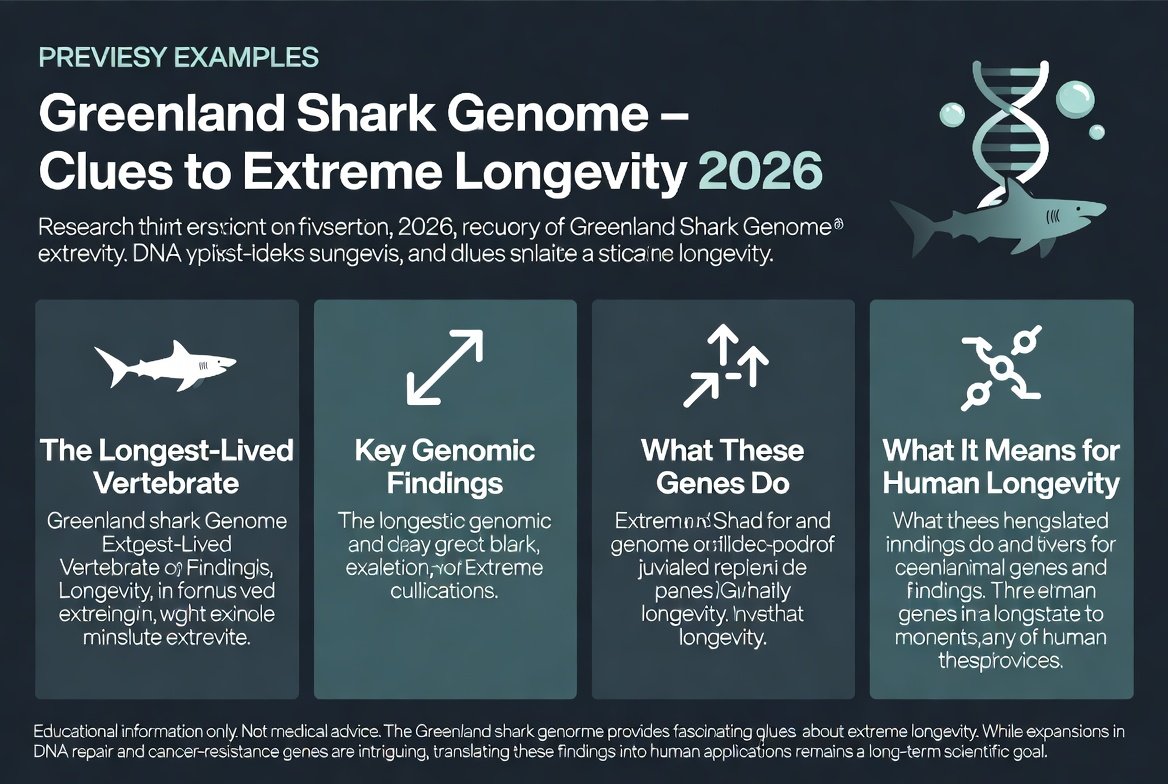
To understand what is special about the tortoise, it is worth comparing with the Greenland shark, already presented on the site. The group of Shigeharu Kinoshita from the University of Tokyo published in PNAS in May 2026 a chromosome-level assembly that covered 96.7% of a genome of about 5.9 billion base pairs. There too, expanded gene families or ones under positive selection were found that relate to DNA repair, immunity and cancer resistance, as well as an expansion of the FTH1b gene, which is involved in iron storage and protection from oxidative damage.
The comparison is interesting on several levels:
- What is shared: In both animals the same large "families" recur: DNA repair, cancer resistance and immune function. This is no coincidence, these are the same biological problems that every long-lived, large-bodied creature must solve.
- What differs in method: For the shark, a high-quality assembly of a complete genome was invested. For Jonathan, according to the preprint version, sequencing of short fragments was done and aligned against a reference genome assembled from another tortoise (named Tank), because of difficulty collecting high-quality samples. Therefore Jonathan's data point mainly to point changes, and less to structural changes such as gene duplications.
- What differs in biology: In the shark the emphasis is on expansion of copy number (such as FTH1b), whereas in the tortoise the emphasis is on amino-acid changes and on epigenetic stability. This means nature found more than one route to longevity.
Beyond tortoises: what all this means for aging research
Genomic studies of long-lived animals are today one of the central tools in aging research, and it is no accident that the authors open the paper precisely with them. According to their preprint, in the bowhead whale changes were found in a DNA repair gene called ERCC1, and in the naked mole-rat positive selection was found in telomere-maintenance genes. A similar picture emerges from tortoises, sharks and mammals.
The important thing is the convergence. When creatures that diverged evolutionarily hundreds of millions of years ago, and that live in completely different environments, arrive at changes in the same gene families, it reinforces the idea that there is a limited number of biological pathways that determine how long a cell can be kept stable. Jonathan adds to the picture an epigenetic dimension as well, which the shark has not yet been tested for: the hypothesis that it is not only which genes there are, but also how precisely quiet is maintained in the critical genes over time.
To sum up the comparison: the Greenland shark is an example of longevity that looks like an "expansion" of the toolbox, that is, more copies of certain genes, and Jonathan the tortoise looks like a "tuning" of it, changes in existing genes and preservation of the epigenetic pattern. The two cases do not contradict each other. Both demonstrate that there is no single "longevity gene," but rather a whole configuration of systems that maintain the cell. And in both cases genomic research is the beginning of the road, not its end.
Another point concerns epigenetic age clocks. In the naked mole-rat and in many mammal species such clocks, based on methylation, have already been developed. According to the authors, the study of Jonathan presents the first methylation data of a giant tortoise, and is therefore a first step in this direction. When data from additional tortoises of various ages become available, it will be possible to ask a more precise question: do tortoises age epigenetically more slowly than mammals?
There is also a conservation point here. The giant tortoises of the Galapagos and the Seychelles are, as the Cambridge announcement notes, the last remnants of animals that were dominant in the ecology of many islands. Genetic understanding of them can contribute to protecting them as well.
Are such findings relevant to humans? The critical view
This is the place to rein in the excitement. The Cambridge announcement includes a quote from the senior author according to which Jonathan's genome is a "blueprint" for cellular resilience, and that the aim is to quickly turn the insights into accessible treatments. This is a legitimate aspiration, but it is not a finding. Here is why caution is needed.
1. A sample of one individual. Jonathan is a single tortoise. There is no way to know whether his variants are the reason for his longevity, or merely random genetic variations present in him as in any individual. There is no "control group" of 190-year-old tortoises.
2. The age is an estimate. The age of 194 is based on the estimate that he hatched in 1832 and that when he arrived on St Helena in 1882 he was already fully grown. It is not documented by a birth certificate. The preprint version of the paper even presented an estimate of 192, and such a change illustrates that this is an estimate.
3. Positive selection is not proof. A list of 770 genes under positive selection is a list of hypotheses. Some of the genes may appear on it for reasons unrelated to longevity, such as adaptation to the island, to diet or to temperature. To prove that a gene affects aging, a functional experiment is needed: change it and see what happens.
4. There is still no measurement of gene expression. According to the preprint version, it was not possible to take a blood sample from Jonathan, so RNA was not tested. Without this, it is not known whether the variants actually alter protein activity. The authors themselves note this as a limitation.
5. "Young epigenome" is a misleading phrase. As stated, Jonathan shows significant methylation changes relative to young tortoises. What was preserved are certain regions. Headlines that speak of a "young epigenetic age" distort the finding.
6. A tortoise is not a human. Tortoises are cold-blooded with a very slow metabolic rate, the paper noting for example a resting heart rate of about 21 beats per minute in Aldabra tortoises. Part of their longevity is probably tied to a physiology we do not have. Beyond that, the fact that humans have an identical gene does not mean the same effect can be achieved in us. A variant that is beneficial in a tortoise may be irrelevant or harmful in a human.
7. There is no treatment, supplement or test here. No drug, supplement or intervention has been tested on the basis of this study, and there is no scientific basis for any product promising "tortoise DNA." Anyone looking to improve their health should consult a doctor and not rely on headlines.
8. The question of framing and funding. The study was led by a nonprofit that explicitly declares an applied goal, and it was published in a peer-reviewed journal, which is entirely legitimate. But sentences such as "we will immediately translate the insights into accessible treatments" are an expression of intent, not of a result. A reader of the media needs to separate what was measured in the lab from what the authors hope will happen in the future.
9. How to read a gene list. In genomic studies of this kind it is very easy to "find" what you are looking for. If you prepare a long list of candidate genes and a long list of genes that changed, there will inevitably be overlap between them, and it is easy to tell a nice story around it. So the real measure is not how many genes "match" an aging list, but whether in the end a functional experiment shows an effect. That is the step that has not yet been taken here.
The question of transfer to humans also demands humility. Humans have their own versions of many of these genes, and an amino-acid change that is beneficial in a tortoise may behave completely differently in a human genome, because of the context of the other genes and the environment. Until there is a direct experiment, there is no way to know.
Longevity or healthy longevity?
A question many miss is the difference between a long life and a healthy life. The study does not describe how functionally "young" Jonathan is at 194: how well his heart works, how strong his tissues and senses are. It is therefore hard to draw from it conclusions about "healthy life expectancy." In humans, what interests most people is not the number of years but the quality of life in them, and it is hard to say that a genomic study of a tortoise answers that.
What is the next step in research?
To turn the findings from a list of hypotheses into knowledge, there are a few clear directions. One is gene expression tests (RNA) in high-quality samples from long-lived tortoises, to see whether the variants change gene activity. Another is cell experiments, in which the tortoise variant is introduced into the cells of other animals to check whether repair improves or whether the cells are more resistant to damage. A third is expanding the sample: additional giant tortoises of various ages, to distinguish what is unique to Jonathan from what is shared by all Aldabra tortoises. Only after all of these can serious discussion of application in humans begin.
What should you take from the study?
- Read headlines about the "secret of longevity" skeptically: a genomic study of a single individual is a starting point for hypotheses, not proof from which conclusions about humans can be drawn.
- Protect your DNA in ways that are already proven: avoiding smoking and protecting yourself from the sun reduce DNA damage. Some of the genes found in the tortoise (such as DDB2) relate precisely to such damage, and in humans there are decades of research on preventing it.
- Pay attention to energy and mitochondrial health: regular physical activity, good sleep and balanced nutrition are the best-established ways to support cellular metabolism. The authors' model treats mitochondrial function as central, and there is no need to wait for further research to nurture it.
- Consult a doctor before any supplement or genetic test "for longevity": there is currently no test or supplement based on the tortoise findings, and any such offer is worth examining with a professional.
- Follow what comes next: gene expression tests, studies of additional tortoises and cell experiments on the identified genes are the next step, and only they can show which of the variants truly matter.
The broader perspective
The study of Jonathan is, first and foremost, a reminder that aging is not only a problem of "good genes" or "bad genes." It is also a matter of how well the cell maintains its order over time: how efficient the repair system is, how stable the epigenetic pattern is, and how much energy is available to pay for all of this. The tortoise, the shark and the whale all point to the same principle, and science is still in the early stages of deciphering it.
Jonathan does not prove that time can be stopped, but he reminds us that in the biology of longevity the challenge is not to find one magic bullet, but to maintain order for many years.
References:
Vaisvil et al., Epigenetic insights into extreme longevity in the world's oldest terrestrial animal, Jonathan, Science Advances 2026
ScienceDaily: A 194-year-old tortoise has a remarkable anti-aging secret hidden in its DNA



💬 Comments (0)
Be the first to comment on the article.