For over a hundred years, aging researchers faced an intractable dilemma: a mouse lives two to three years, a human lives 80. To examine how the immune system ages across the entire lifespan, you have to wait. A lot. Even mouse studies take years, and human studies last decades. This is one of the biggest bottlenecks in aging science, and it had no real solution, until the killifish arrived.
The Nothobranchius furzeri, or in short the African turquoise killifish, is a small fish 5-6 cm in length. It lives in temporary ponds in the African savanna, ponds that evaporate after 4-9 months. Natural selection shaped a fish whose entire life cycle is compressed into a single season. It hatches, matures, reproduces, ages, and dies within less than a year. In recent years, researchers have realized that this model is an invaluable gift.
A new study published in the journal Nature Aging in 2026, led by Prof. Dario Riccardo Valenzano's group at the Leibniz Institute on Aging (Fritz Lipmann Institute, FLI) in Germany, utilizes this model to examine how the immune system ages. What takes decades to study in humans can be tracked within months in killifish. And the central surprise: the signs of immune aging, at the molecular and cellular level, appear evolutionarily conserved, meaning they repeat across different vertebrates.
What is killifish and why has it become an aging model?
This small fish offers a rare combination of features:
- Short lifespan in the wild: Only 4-9 months, compared to a mouse (2-3 years) and a human (80 years).
- A true vertebrate: It has a complete adaptive immune system with T and B cells, a thymus, and kidney marrow, which is the blood-forming organ equivalent to mammalian bone marrow. This is not present in worms or flies, other aging models.
- Well-mapped genetics: Its genome is sequenced and it has about 19,000 genes, many of which are homologous to human genes.
- Easy to raise on a large scale: Hundreds of fish in one aquarium, at relatively low cost.
- Aging signs also seen in humans: Telomere shortening, accumulation of zombie cells, mitochondrial damage, decline in immune function.
This combination makes killifish a vertebrate that ages quickly but is still close enough to humans to learn from. For the first time, immune aging studies can be conducted at the speed of genetics studies rather than human lifespan studies.
The connection to immunosenescence: What is revealed in the fast model
The new study focuses on a process called immunosenescence, the aging of the immune system. This process is a key reason why the elderly get infected easily, respond less to vaccines, and develop cancer and autoimmune diseases. The researchers combined cytometry, single-cell RNA sequencing, proteomics, and functional tests, and identified several aging processes also seen in humans:
1. Chronic Inflammation (Inflammaging)
In older fish, a pronounced systemic inflammatory signature was found, including an increase in acute phase proteins in the blood and signs of metabolic imbalance. This is precisely inflammaging, the creeping chronic inflammation that accompanies aging in humans as well, and is considered a major driver of age-related diseases.
2. DNA Damage and Genomic Instability in Progenitor Cells
One of the key findings: Progenitor and stem cells of the immune system in the kidney marrow accumulate DNA damage (double-strand breaks) and show a decrease in markers of active DNA repair. That is, the cells meant to renew the immune system are precisely the ones that accumulate genetic damage with age. This aligns with the broader phenomenon of cellular aging.
3. Remodeling of the Blood-Forming Organ
In the kidney marrow, the fish's blood-forming organ, structural changes, fibrosis, and a shift in the composition of immune cell populations were observed with age. Concurrently, immune cells from older fish responded much more weakly to bacterial stimulation compared to cells from young fish, a direct functional expression of weakened immune defense.
4. The Connection to the Thymus and the B Cell Repertoire
The thymus is the organ that produces new T cells, and in humans it begins to shrink as early as adolescence, a process called thymic involution. In killifish, a similar age-related thymic shrinkage is described in the literature. Concurrently, the B cell repertoire in young individuals is highly diverse and capable of recognizing almost any pathogen, and with age this diversity narrows. The current study focuses on the kidney marrow as the blood-forming organ, but it fits into a broader picture where all components of the immune system, from the thymus to the antibody repertoire, deteriorate with age in a pattern similar to that of humans.
Current Evidence
Study 1: FLI 2026, Mapping Immune Aging in the Kidney Marrow
Valenzano's group (Morabito et al.) performed a multi-layered mapping of the kidney marrow in young and old killifish, using single-cell sequencing, cytometry, proteomics, and functional tests. The qualitative findings: systemic inflammation, DNA damage and genomic instability in progenitor cells, remodeling of the blood-forming organ, and a weakened immune response. The researchers' conclusion, in Valenzano's words, is that key aspects of immune aging, at the molecular and cellular level, are deeply evolutionarily conserved. That is, what is revealed in the fish may be relevant to humans as well. The study also launched an open data resource called KIAMO for immune aging researchers.
Study 2: Cologne, Fasting, Feeding, and Healthy Aging
Another study by researchers at the Max Planck Institute in Cologne (Ripa et al., Nature Aging 2023) showed that the fasting-feeding cycle is critical for healthy aging in killifish. Young fish undergo normal fluctuations between a fasting state and a feeding state, but older fish enter a kind of "eternal fast" even when they eat. The researchers linked this to the activity of a subunit of the AMPK enzyme (Prkag1), and its genetic activation improved health and lifespan. This is a study on metabolism and nutrient signaling, and it illustrates how quickly interventions affecting lifespan can be tested in this fish.
Study 3: Microbiome Transplantation, Max Planck Cologne 2017
In a groundbreaking study (Smith et al., eLife 2017, Max Planck Institute Cologne), researchers transferred gut microbiota from young killifish to middle-aged killifish. The result was dramatic: the fish that received "young" bacteria lived significantly longer (by about 37% in the study), remained more active in old age, and maintained a diverse microbiome. This was the first proof that gut microbiota transplantation in a vertebrate could extend lifespan in the context of normal aging, paving the way for human FMT (fecal microbiota transplantation) studies.
Broader Context: Senolytics and the Fast Model
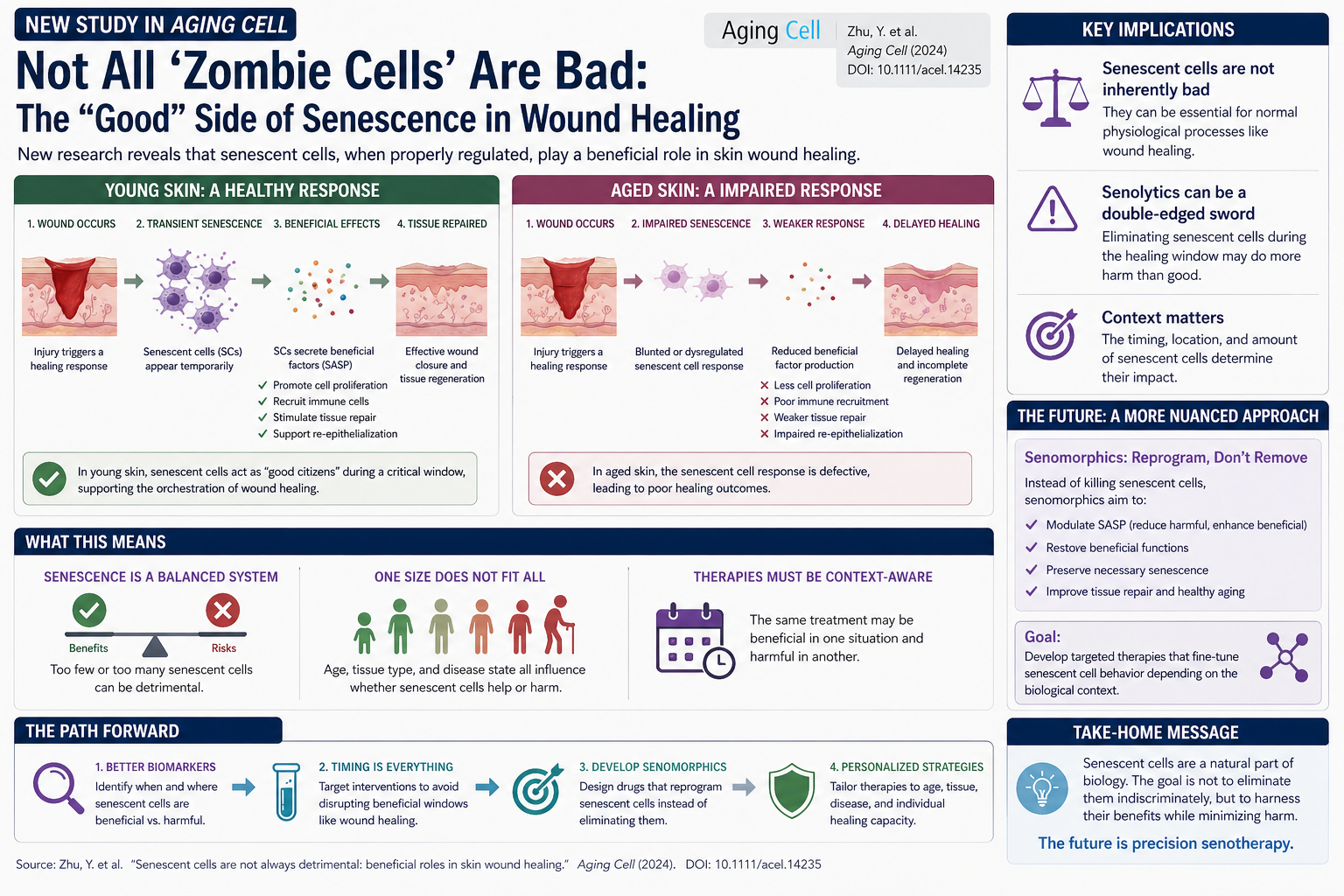
In these fish, as in humans, senescent immune cells ("zombie cells") accumulate that no longer divide but also do not die, secreting inflammatory substances (SASP) that damage tissues. Thanks to the short lifespan, killifish is a suitable model for the rapid testing of anti-aging interventions, including senolytics, drugs that clear zombie cells. It is important to note that the effect of specific senolytics on lifespan in killifish is still under investigation, and not every claim circulating online is backed by controlled data.
What about other aging models?
It is important to understand where killifish fits into the landscape of models:
- C. elegans worm: Lives 2-3 weeks. An excellent model for basic gene pathways (IGF-1, mTOR), but it has no adaptive immune system. Not relevant for immunosenescence.
- Fruit fly Drosophila: Lives 2-3 months. Only an innate immune system. Again, not suitable for studying T and B cells.
- Mice: A vertebrate with a complete immune system, but a longitudinal study takes 2-3 years. Also expensive.
- Monkeys: Similar to humans, but studies take 20-30 years and cost millions of dollars. Ethical issues.
- Killifish: A vertebrate with a complete immune system, longitudinal study takes months, low cost, no significant ethical issues.
This model closes a gap that was open for almost a hundred years. It enables studies that were previously impossible.
Can the findings be translated to humans?
This question troubles every researcher working with animal models. Not everything that works in a mouse works in a human. The advantages and limitations of the killifish model:
- Advantage: It is a vertebrate with a complete adaptive immune system (T and B cells, thymus, kidney marrow) and immune aging signs that appear evolutionarily conserved.
- Limitation: It has a small and simpler brain, different cardiovascular physiology, and lacks complex bones like humans.
- Advantage: Its epigenetic clock works on the same principles (CpG methylation).
- Limitation: It does not deal with specific human pathogens like CMV or EBV.
- Advantage: CRISPR experiments and pharmacological interventions can be performed in killifish in the same way as in mice.
Researchers propose a hybrid approach: Find the intervention in killifish, validate it in mice, then move to humans. This significantly shortens the early screening stages.
What to take from the research?
Even if you are not a scientist, there are several practical insights based on what is being discovered in killifish and immune aging research in general:
- Protect your thymus early. It begins to shrink as early as adolescence. Try to minimize things that accelerate its involution: chronic stress, visceral obesity, lack of sleep.
- Keep T cells healthy: Regular physical activity and maintaining a healthy weight are linked in the literature to better immune function with age.
- Microbiome diversity is vital: Studies in killifish show that a young and diverse microbiome contributes to health. Eat a variety of fermented foods, fiber, and different vegetables.
- Check your flu and COVID vaccines: Older adults respond less to vaccines due to immunosenescence. High-dose or adjuvanted versions of the vaccine sometimes provide a better response; consult your doctor.
- Follow senolytic research: There are currently early clinical trials of fisetin and D+Q. It is still too early to draw conclusions for humans, but it is a field worth following.
- Avoid chronic inflammatory stimuli: Gum disease, obesity, smoking, and poor sleep all fuel the chronic inflammation that accelerates immune aging.
What else comes from the model
Killifish research opens a new era. In addition to discoveries about the immune system, the model is already revealing new insights into:
- Brain aging: Killifish develop neurodegenerative changes within months, a fast model for drug testing.
- Heart aging: Structural changes in the fish heart parallel changes seen in other vertebrates.
- Epigenetic clock: Horvath-like methylation clocks have been described in fish.
- Regenerating organs: Killifish lose regenerative ability with age, a model for stem cell research.
The Broader Perspective
The history of aging science is full of models that changed the game. Long-lived mutants in C. elegans in the 1980s and 1990s (e.g., the age-1 mutation in the IGF-1-like pathway) led to the discovery of IGF-1 and FOXO pathways, proving that a change in a single gene could extend the worm's lifespan by about 50%. Now, killifish completes the picture: it provides a full vertebrate model on a timescale that enables experiments previously impossible.
Its importance to the field of immunosenescence is particularly great. Immune aging is one of the biggest bottlenecks for health in old age, a major contributor to mortality from infectious diseases, reduced vaccine efficacy, and increased cancer risk. Until now, it was difficult to study it quickly. Now, with killifish, it is possible.
The great lesson from this small fish is that nature solved the same aging problems in similar ways across different vertebrates. Pathways discovered in killifish, if also relevant in mice, are likely to be relevant in humans as well. And this accelerates the pace at which we are approaching an understanding of aging, and its slowing.
References:
Morabito et al., Spontaneous aging-associated inflammation and genome instability in the immune system of turquoise killifish, Nature Aging 2026
Smith et al., Regulation of life span by the gut microbiota in the short-lived African turquoise killifish, eLife 2017


💬 Comments (0)
Be the first to comment on the article.