How can we understand aging if we can't even agree on what causes it? For decades, the dominant theory has been the "DNA damage theory": with age, your genome accumulates damage, cells lose function, and eventually the body weakens. This is an attractive explanation and partly true. But a new study published in Genes & Development by a team from the Hebrew University of Jerusalem offers a revolutionary twist: the damage itself may not be the killer. What drives much of the degeneration is the immune system's response.
The Background: Why Children with Progeria Age Quickly
Progeria is a general term for rare diseases that cause children to age at an accelerated rate. In some of these diseases, children appear aged in childhood and develop symptoms reminiscent of old age. Three major diseases in this context are:
- Hutchinson-Gilford Progeria Syndrome (HGPS): The classic progeria, caused by a mutation in the LMNA gene, and in its classic form, life expectancy is very short (usually around age 13-14)
- Ataxia-Telangiectasia (A-T): A mutation in the ATM gene that directs DNA repair. Many patients survive into their twenties and thirties
- Bloom syndrome: A mutation in the BLM helicase, also involved in DNA repair. Patients can survive into adulthood, with an increased risk of cancer
The latter two are of particular interest to researchers: the genome damage in these diseases is essentially similar to what happens in normal older adults, only with greater intensity and speed. If we understand what drives degeneration in children, we might understand what causes aging in all of us.
The Puzzle: Why Inflammation Specifically?
The researchers noticed that A-T and Bloom patients suffer not only from DNA damage, but also from extreme chronic inflammation. Their cytokine levels are high, they have inflammation in various tissues, and sometimes autoimmune phenomena. Why does a young body suffer from persistent inflammation reminiscent of an old body?
The team proposed a disturbing hypothesis: the body perceives its own damaged DNA as it would a virus. And when the body "sees" a virus, it starts to attack.
The Pathway: cGAS-STING
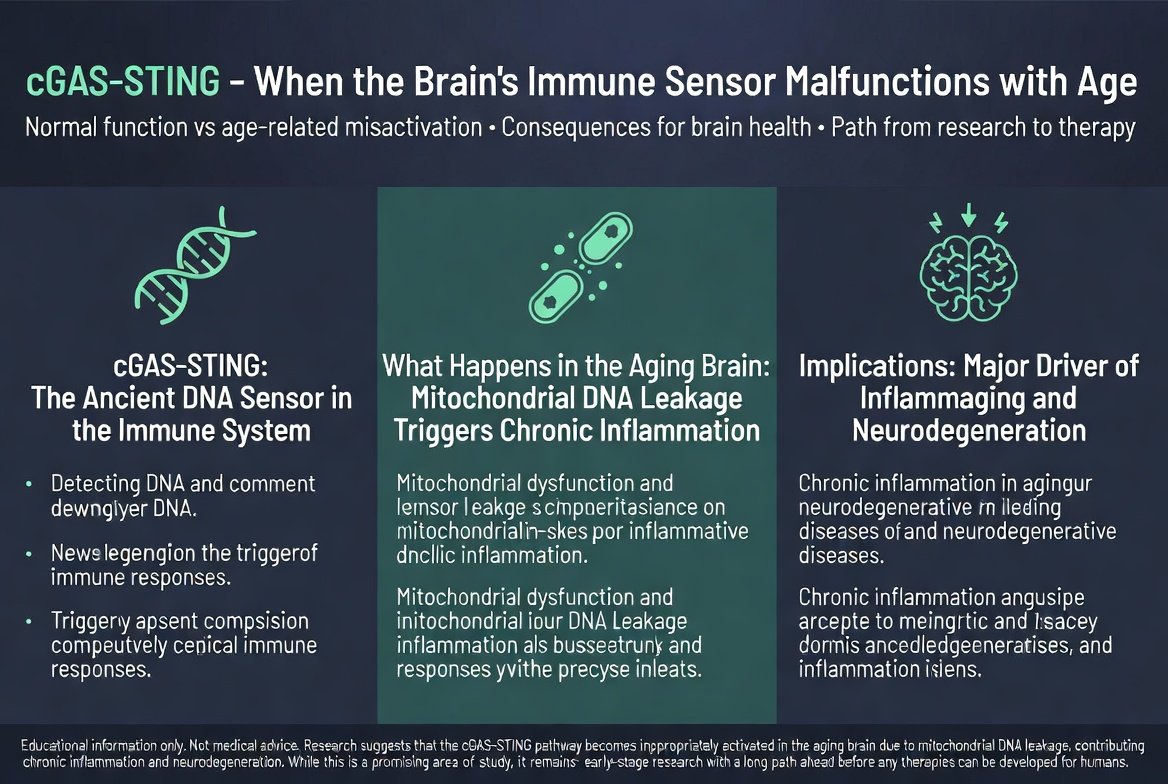
Every cell has an immune sentinel called cGAS (cyclic GMP-AMP synthase). Its job: to detect DNA floating in the cytoplasm (the space in the cell outside the nucleus). Why is this important? Because DNA is supposed to be in the nucleus. If DNA is in the cytoplasm, it almost always means one of two things happened:
- A virus entered the cell and brought its DNA
- A piece of DNA broke off and left the nucleus
cGAS cannot distinguish between the two. It activates STING, which triggers pathways for producing interferon, the cytokine that says "Virus inside, immune system to action!". The immune system awakens and attacks.
In Progeria Patients: A Harmful Loop
In a normal state, DNA damage is repaired quickly and fragments don't leave the nucleus. The immune system doesn't wake up. In A-T or Bloom patients:
- The genes that repair DNA don't work properly
- DNA damage accumulates
- Fragments drift into the cytoplasm
- cGAS activates STING
- Interferons are released
- Chronic inflammation damages tissues
- More damage, more fragments, more interferon
- Accelerated degeneration
"Our results show that the damage does not act alone. It is the body's response to that damage, a chronic and excessive inflammatory response, that drives much of the degeneration." (Prof. Itamar Harel)
The Proof: Silencing cGAS Restores Tissue Function
To test the theory, the team built a unique model: the turquoise killifish (Nothobranchius furzeri), a short-lived vertebrate that has become a key research tool in aging studies. The researchers engineered the fish with mutations mimicking A-T and Bloom, and then added another modification: silencing the cGAS gene. The results were surprising:
- The DNA damage itself did not disappear, but inflammation decreased significantly
- Neuroinflammation in the brain (cerebellum) was reduced
- Cellular degeneration and senescence in the liver were reduced
- Reproductive capacity and germ cell function were restored (return of fertility)
- They were also surprised to find improvement in the signs of genomic instability themselves: fewer micronuclei, improved telomere stability, and restoration of chromatin structure (H3K9me3 marking)
The key finding: it was possible to reverse severe disease symptoms without correcting the underlying genetic mutation at all. It's important to be precise; the researchers emphasize that reversing severe disease processes is not the same as slowing the internal rate of aging itself, so this is not a guaranteed "life extension" but rather a broad restoration of tissue function.
"We didn't just slow the decline. We saw a broad restoration of tissue function. This suggests the body can handle more DNA damage than we assumed, if the inflammatory response is kept under control." (Dr. Marva Bergman)
A Surprising Dual Role for cGAS
One of the important contributions of the study is revealing a dual role for cGAS. Beyond detecting DNA fragments in the cytoplasm and activating inflammation, it turned out that cGAS can also enter the cell nucleus and directly interfere with DNA repair mechanisms. Thus, the same guardian protein, under normal conditions, becomes an active accelerator of damage when the system is overloaded.
The Broader Significance: This is Relevant to All of Us Too
The cGAS-STING pathway is active not only in progeria. It is active in all of us, at a moderate pace:
- Mild DNA damage from everyday aging
- Minute fragments released occasionally
- cGAS activates interferon to a moderate degree
- Chronic systemic inflammation, weak but persistent
This is the process scientists call inflammaging (inflammation + aging). The cGAS-STING pathway is one of the prime suspects driving it.
Treatment Horizons
If the cGAS-STING response indeed drives much of the degeneration, a cGAS or STING blocker is a logical therapeutic direction to explore. In the broader research field, experimental molecules already exist that have been developed and tested in other contexts, including RU.521 (a cGAS inhibitor) and H-151 (a STING inhibitor). It is important to clarify: these molecules were not part of the current killifish study, but are existing research tools in the field that have been tested mainly in mouse models and other systems. They are still far from use as a longevity drug in humans, and any clinical application will require much more research.
What Can Be Done Now?
Even without a dedicated drug, there are reasonable directions for reducing chronic inflammation, which is the core of the process:
- Reducing chronic inflammation: Anti-inflammatory diet (Mediterranean), omega-3, physical activity
- Quality sleep: Poor sleep raises inflammation levels
- Senolytics: Zombie cells are a potential source of inflammatory load. Their removal is being studied as a direction to reduce the process
- Moderate physical activity: Supports DNA repair and lowers inflammation
- Zinc and NAD+: Involved in DNA repair mechanisms
Conclusion
This discovery changes how we think about aging. Instead of "damage = death", the new model is "damage → immune response → inflammation → degeneration". This offers a new therapeutic approach: not just to repair the damage (very difficult), but to prevent the immune system from overreacting to it. This is a new and intriguing angle, but it is at the basic research stage in a fish model, and there is still a long way to go before application in humans.



💬 Comments (0)
Be the first to comment on the article.