Scientists are constantly seeking ways to slow the aging process.
Researchers at Cold Spring Harbor Laboratory have discovered that T cells in the body can be reprogrammed to slow and even reverse aging.
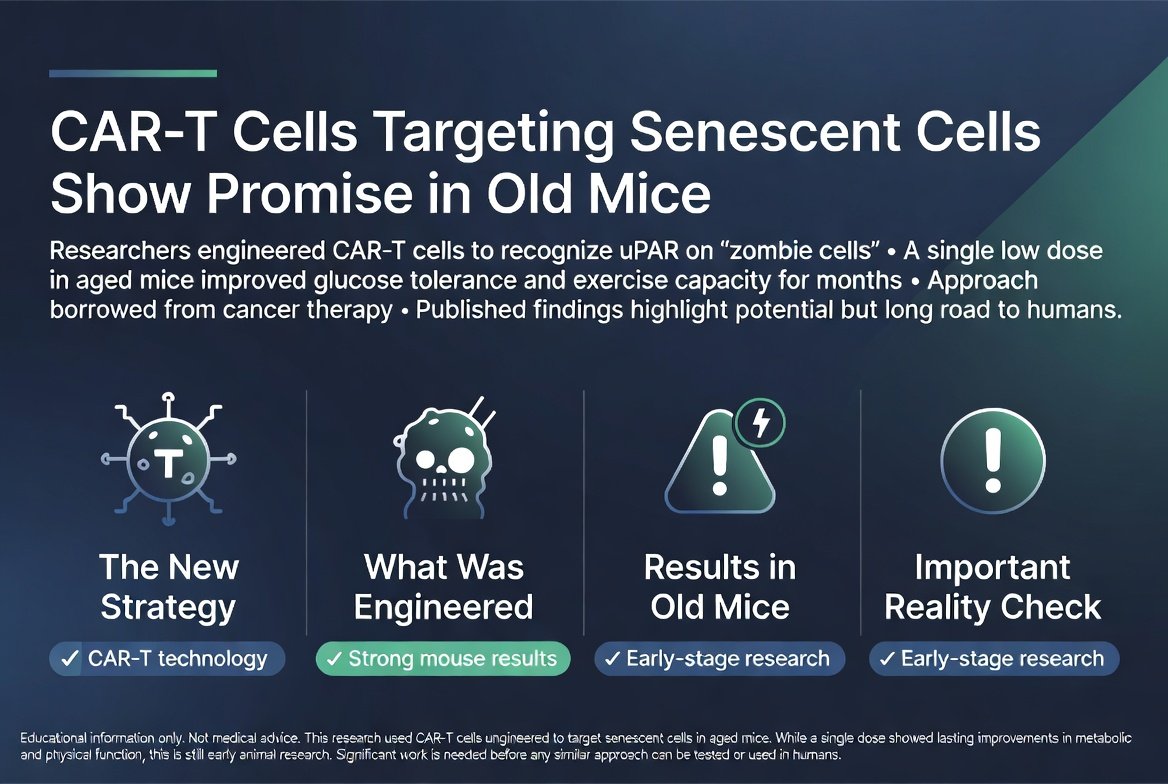
Through experiments on mice, scientists found that T cells can also fight a type of cell that contributes to aging.
Ever since Ponce de León's search for the Fountain of Youth, humans have always sought a way to slow the aging process.
As the number of centenarians—people celebrating their 100th birthday—continues to rise, medical research and innovations are helping people live longer, healthier lives.
However, there are still many new methods and approaches yet to be explored.
A new study from Cold Spring Harbor Laboratory in Cold Spring Harbor, New York, claims that the body's T cells (a type of white blood cell) can be reprogrammed to fight aging.
The work was led by Dr. Corina Amor Vegas, but originated in the lab of Prof. Scott Lowe at Memorial Sloan Kettering Cancer Center in New York (MSK), where the work began and developed in collaboration.
Through experiments on mice, scientists discovered that T cells can repel another type of cell that multiplies as a person ages and causes inflammation,
thereby weakening the effectiveness of the aging immune system over time.
T cells, a type of white blood cell also known as lymphocytes, are an integral part of the immune system.
Their role is vital—detecting and destroying harmful pathogens like viruses and bacteria.
The uniqueness of T cells lies in their "specialization": each T cell has a specific target—identifying and destroying a particular pathogen.
For example; a baby's T cells will "learn" to recognize new viruses it encounters.
Later in life, those same T cells will be ready to fight those viruses again.
T cells are produced in the bone marrow, travel to the thymus gland for development, and finally migrate to tissues and organs in the lymphatic system and the bloodstream.
In recent years, researchers have discovered ways to harness the power of T cells to treat diseases, primarily cancer.
This discovery led to the development of CAR-T cell therapy (Chimeric Antigen Receptor T-cell therapy),
a type of immunotherapy where T cells are taken from the patient, genetically modified in the lab, and returned to the body to fight a specific type of cancer.
But can this therapy also be used to reverse the aging process?
Research on this topic is still in early stages, but initial results are encouraging.
Studies have shown that CAR-T cells can remove senescent and "inflammatory" cells from the body, thereby improving immune system function and other bodily functions.
However, it is important to note that there are still many challenges on the path to making this therapy a clinical reality.
Further research is needed to better understand the long-term effects of this treatment, as well as to develop more effective and safer therapies.
How Do T Cells Change with Age?
"We wondered whether, during the aging process, we could redirect and reactivate T cells to eliminate the damaged cells that accumulate in the body," said Dr. Amor Vegas to Medical News Today.
Dr. Amor Vegas explains that these senescent cells are cells that have accumulated significant damage, ceased to function properly, and instead become inflammatory and harmful to their surroundings.
Changes in T Cells with Age:
- Decreased production: With age, the production of new T cells in the bone marrow declines. As a result, fewer T cells are available to fight infections and diseases.
- Decreased function: Aging T cells are less efficient at identifying and eliminating damaged cells.
- Change in cytokine profile: Aging T cells produce more inflammatory cytokines, which can contribute to the aging process and age-related diseases.
Dr. Amor Vegas's study found that a special treatment can reverse the changes that occur in T cells with age.
This treatment caused aging T cells to eliminate damaged cells more efficiently, similar to T cells from young individuals.
CAR-T cell therapy (Chimeric Antigen Receptor T-cell therapy) is a type of immunotherapy.
In this treatment, T cells are taken from the patient, genetically modified in the lab, and returned to the body.
The engineered CAR-T cells are designed to identify and eliminate specific cells, in this case, damaged or senescent cells.
Results:
The study found that CAR-T cell therapy led to significant health improvements in aged mice:
- Reduced body weight
- Improved metabolism and glucose tolerance
- Increased physical activity
Furthermore, the positive effects were long-lasting, indicating their durability.
Preventive effects:
The study also revealed surprising preventive effects. Treatment in young mice caused them to age more healthily, with a reduced risk of age-related diseases.
Future implications:
These findings are highly promising for the development of new treatments for aging and age-related diseases in humans. Dr. Amor Vegas and her team plan to investigate the potential effects of this treatment on various diseases, such as Alzheimer's, diabetes, and cancer.
Full study: https://www.nature.com/articles/s43587-023-00560-5






💬 Comments (0)
Be the first to comment on the article.