Every year, a new wave of anti-aging promises emerges: a molecule that extends lifespan in mice, a supplement that restores NAD+ to levels of a 20-year-old, a peptide that builds muscle without effort. Most fade away. Meanwhile, the most boring intervention in the world continues to beat them all on every metric: the link between physical activity and longevity is the strongest in longevity science, not due to fashion but due to the consistent accumulation of evidence over decades.
But the flat message 'exercise is good for health' is both true and useless, because it doesn't explain why. The truly interesting question is not whether physical activity slows aging, but exactly how it does so, at the cellular and molecular level. And when you understand the mechanism, you also understand why no pill has yet managed to mimic it.
What is 'Healthy Aging', and Why is Movement Central to It?
Healthy aging is not just about living more years, but living more years with good function: without dementia, without frailty, without dependence on others. Researchers distinguish between two concepts:
- Lifespan, how many years we live.
- Healthspan, how many years we live without chronic disease or disability.
The gap between the two is the major problem of modern medicine: people live longer, but spend their last decade in illness. Physical activity is the rare intervention that primarily extends healthspan, not just the number of years.
The reason movement is so central is that aging is not one process but a collection of processes, what biologists call the hallmarks of aging: DNA damage, zombie cells, declining mitochondria, chronic inflammation, poor intercellular communication. Most drugs target one hallmark. Physical activity targets several at once, and this is precisely the insight that studies from different fields illuminate from various angles.
How Movement Slows Aging: Three Pathways
It is convenient to think of the effect through three systems, but it is important to remember they are intertwined and form one coherent picture. Here is the skeleton of each pathway, before we delve into details:
- First pathway, metabolic-mitochondrial: Physical activity builds and improves mitochondria and enhances sugar and fat utilization.
- Second pathway, immune-inflammatory: Movement reduces low-grade chronic inflammation (inflammaging) that accelerates nearly every age-related disease.
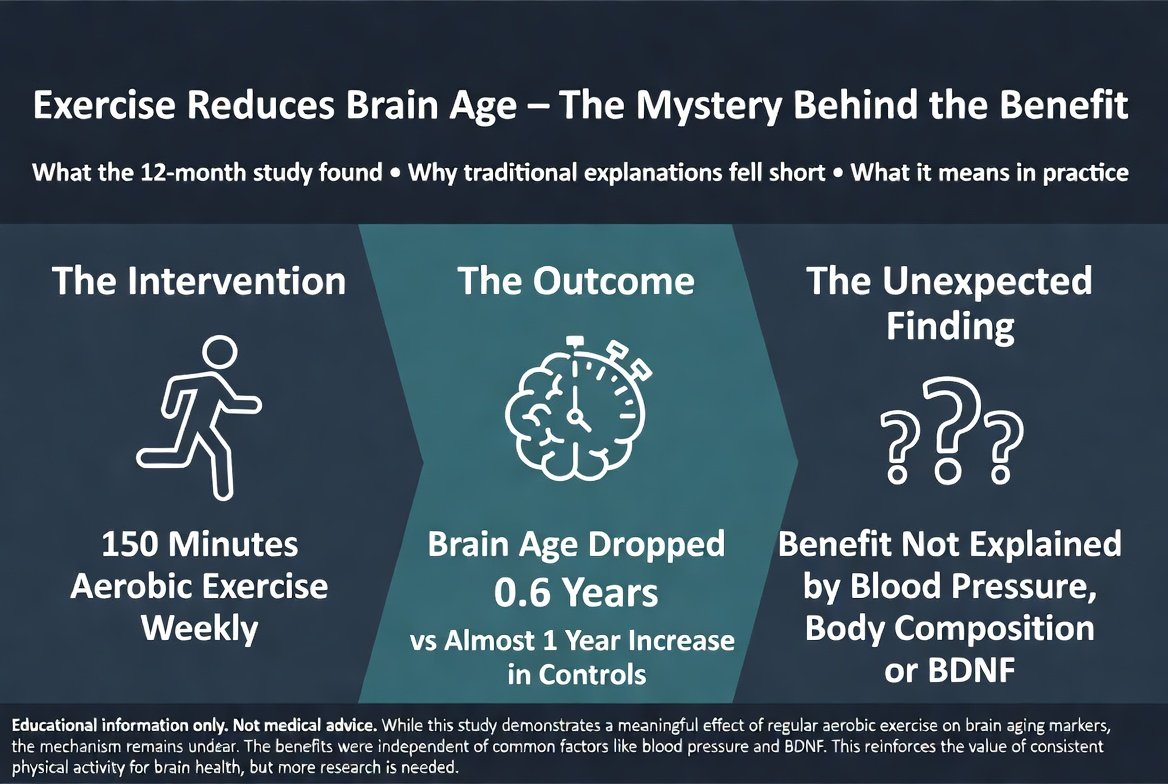
- Third pathway, brain-epigenetic: Exercise protects the brain, and has a modest but measurable effect on epigenetic age measured by DNA clocks.
All three meet at one point: the active muscle is not just a 'movement engine', it is an endocrine organ that secretes signaling molecules (myokines) that communicate with the brain, liver, immune system, and fat. When you move your body, you activate an entire network of signals.
What the Evidence Says
Pathway 1: Mitochondria and Metabolism
One of the most established effects of training is measured inside muscle cells. Regular physical activity increases mitochondrial biogenesis, meaning building new mitochondria and improving the oxidative capacity of existing ones, through activation of the protein PGC-1α. This is one of the most consistent findings in exercise physiology, since the pioneering work of John Holloszy in the 1960s.
Meta-analyses of controlled trials confirm that endurance training increases PGC-1α expression and mitochondrial content and oxidative enzymes in muscle within weeks to months. Researchers distinguish between content and oxidative capacity, which increase significantly, and volumetric density of mitochondria, which in some studies increases less or not at all. The bottom line: more efficient mitochondria mean better sugar and fat utilization, improved insulin sensitivity, and less oxidative stress. This is a partial reversal of one of the classic hallmarks of aging, the mitochondrial decline that causes fatigue and decreased fitness.
Pathway 2: The Immune System and Inflammation
The second pathway concerns inflammaging, the low-grade, silent chronic inflammation that develops with age and accelerates atherosclerosis, diabetes, Alzheimer's, and cancer. Meta-analyses of exercise in older adults consistently point in one direction: regular training lowers inflammatory markers such as CRP, IL-6, and TNF-α compared to a sedentary lifestyle, although the effect size varies between training types and populations.
The mechanism is particularly interesting around IL-6. The same molecule can function both as a marker of chronic inflammation in the blood and as a myokine released from the contracting muscle that triggers anti-inflammatory responses after exercise. Researchers call this the 'IL-6 paradox': the context-dependent role, and it is not about two separate clean versions of the same molecule. Additionally, there is evidence that physical activity helps maintain a more functional immune system in old age, which may contribute to a better response to vaccines and infections, a topic that received special attention since COVID-19.
Pathway 3: Brain, Cognition, and Epigenetic Age
The third pathway concerns the brain. Aerobic training increases the secretion of BDNF (brain-derived neurotrophic factor), a protein that promotes neuronal survival and synaptic connections, primarily in the hippocampus region responsible for memory. In a well-known controlled study by Erickson and colleagues, published in PNAS in 2011 on 120 older adults, a one-year walking program increased hippocampal volume by about 2%, which the researchers described as reversing about one to two years of age-related volume loss, in contrast to the expected shrinkage in the control group.
Another layer concerns epigenetic age, measured by DNA methylation clocks like GrimAge. Observational studies show that more active people tend to have a slightly lower epigenetic age, but it is important to be precise about the magnitude: the effect is modest, sometimes less than a year and at most in the range of about one to two years, and not always statistically significant. Some studies even found that physical fitness does not strongly influence the main aging clocks. That is, physical activity likely leaves a molecular signature of slowed aging, but a moderate one, not a dramatic leap of many years.
What About the Skeleton, Heart, and General Metabolism?
Beyond the cell, the clinical picture is much broader. Physical activity, especially resistance training, is the only tool proven to stop and even reverse sarcopenia, the loss of muscle mass that begins around age 30 and accelerates after 60. Maintaining muscle is not just an aesthetic issue, but it is worth being precise: muscle strength, particularly grip strength, is the strongest and most consistent predictor of mortality in large longitudinal studies (e.g., the PURE study on about 140,000 people), stronger than mere muscle mass.
Simultaneously, weight-bearing exercise (walking, running, weights) stimulates bone and slows osteoporosis, and aerobic training improves heart function and lowers blood pressure. All these contribute to the same picture: movement does not improve one system but orchestrates the strengthening of several systems that decline with age.
Is Physical Activity the Miracle Drug for Longevity?
Here we must pause and add a critical lens, because 'the best medicine' is still not magic. Three important caveats:
- Consistency beats intensity: Most benefit comes from moving from 'zero movement' to 'regular moderate movement'. A person who exercises in extreme bursts and then disappears for months gains less than someone who walks every day. The body responds to habit, not a one-time event.
- More is not always better: Chronic overtraining, without adequate recovery, raises cortisol, impairs sleep and the immune system, and can even accelerate oxidative damage. Extreme endurance athletes are not necessarily the longest-lived.
- It does not negate genetics and disease: Physical activity tilts the odds in your favor, but is not insurance. Active people still get sick, and some for reasons beyond their control.
And yet, after all the caveats, a disturbingly beautiful fact remains: if physical activity were a pill, it would be one of the most sought-after drugs in history. No molecule competes with it in the diversity of effects, and at zero cost.
What to Take from the Research?
- Combine aerobic and strength, don't choose one: Aim for 150 minutes of moderate aerobic activity per week (or 75 minutes vigorous) plus 2-3 resistance training sessions. Aerobic handles mitochondria and heart, strength maintains muscle and bone. The combination covers all pathways.
- Start where you are: If you are sedentary, even 20 minutes of daily walking significantly reduces mortality. The biggest jump in benefit is from 'nothing' to 'something', not from 'a lot' to 'even more'.
- Maintain muscle after age 50: Add resistance training even if you have never lifted a weight. Resistance bands or bodyweight are enough to start. Sarcopenia is one of the biggest threats to independence in old age.
- Plan recovery: 7-9 hours of sleep and rest days are part of the training, not a break from it. Without recovery, the body remains in an inflammatory state.
- Make it a habit, not a project: Choose an activity you can sustain for years, not an extreme 6-week program. Consistency over decades is what moves the biological clock.
The Broader Perspective
The big message is not 'start exercising', you knew that. The message is that we understand more and more why it works: not through one mechanism but through a network of signals traveling from the active muscle to the mitochondria, immune system, and brain simultaneously. This is why the pharmaceutical industry has been searching for years for an 'exercise pill' that mimics the effect, and still fails. It is hard to mimic in one pill something that activates an entire network of molecules simultaneously.
In a world of expensive supplements, biological age tests, and experimental treatments, the reminder inspires humility: the most powerful intervention for longevity is already in your possession, it is free, and available tomorrow morning. The only question is not whether physical activity works, but whether you will get up and do it, again, and again, and again.
Key References:
Erickson KI et al., Exercise training increases size of hippocampus and improves memory, PNAS 2011;108(7):3017-3022 (DOI: 10.1073/pnas.1015950108).
Leong DP et al., Prognostic value of grip strength: findings from the PURE study, The Lancet 2015;386(9990):266-273.
Meta-analyses on mitochondrial biogenesis following exercise, on the effect of exercise on inflammatory markers (CRP, IL-6, TNF-α) in older adults, and on the relationship between physical activity and epigenetic age clocks.
Medical News Today - How exercise aids healthy aging: Evidence from 3 recent studies (news review)

💬 Comments (0)
Be the first to comment on the article.