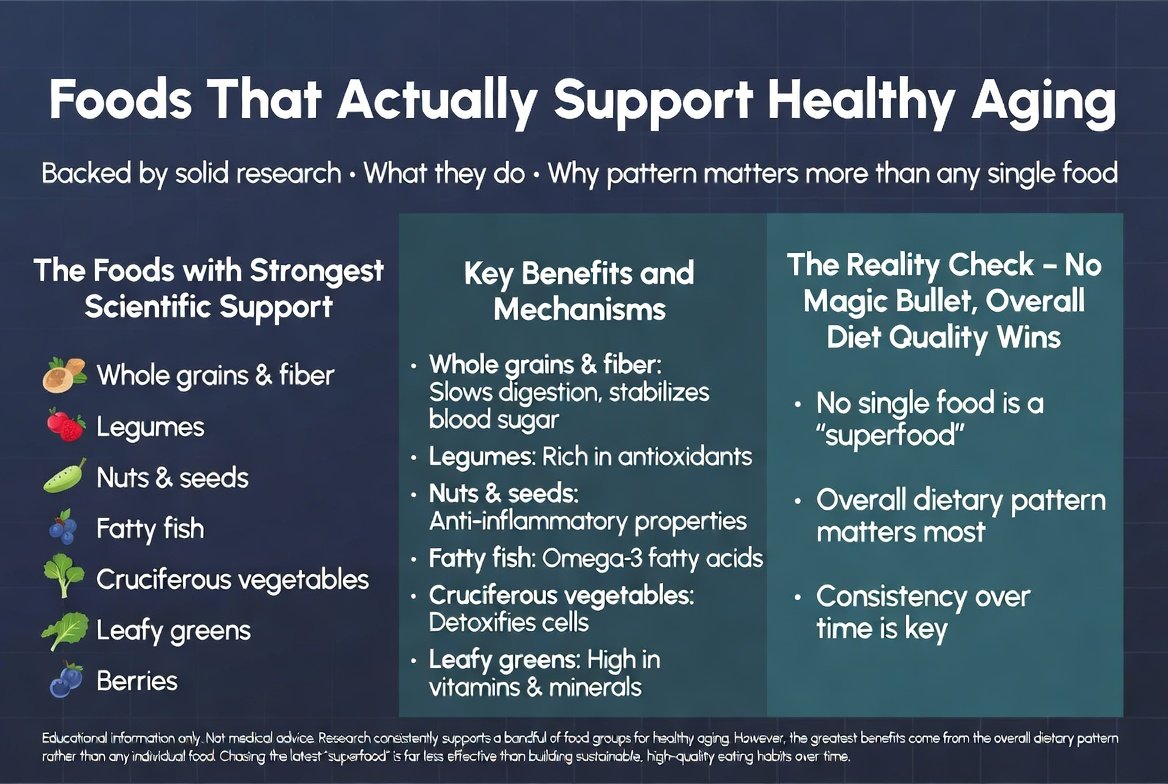
Every year, a new "superfood" appears that is supposed to change our lives: chia seeds, medicinal mushrooms, matcha powder, exotic berries. The problem is that almost none of them have ever been tested in a real randomized controlled trial, the type of study where thousands of people are taken, randomly divided into groups, and followed for years to see who lives longer. When you remove the marketing noise and ask what has truly withstood the toughest scientific test, one eating pattern remains on the table: the Mediterranean diet. This is not a fad diet. It is the eating pattern with the strongest and most consistent body of evidence in the world for longevity and heart health.
What is the Mediterranean Diet?
Unlike diets that define themselves by what is forbidden, the Mediterranean diet is defined by a whole pattern of what you eat abundantly. It is based on the traditional way of eating in regions like Crete, Southern Italy, and Greece in the mid-20th century, and includes:
- Plenty of vegetables and legumes: At the base of every meal, not as a side dish.
- Olive oil as the main source of fat: Instead of butter, margarine, or processed oils.
- Fish and seafood several times a week: A primary source of protein and omega-3.
- Nuts, seeds, and fresh fruit: As a daily snack, not a rare treat.
- Whole grains: Whole wheat bread, whole wheat pasta, bulgur, instead of white flour.
- Very little red meat and processed meat: Red meat becomes an event, not a daily routine.
Dairy products are consumed in moderation, mainly as yogurt and cheese, and processed sugar intake is low. The key point: it is a pattern, not a list of ingredients. No single component is "magic." The power is in the whole mix.
Why a Pattern Beats a Single "Superfood"
The big mistake of the health industry is the fantasy of the single component: if we only find the right antioxidant, the right vitamin, the right polyphenol, we will crack the code. Biological reality works differently. The body does not eat isolated molecules; it eats meals. Components in the diet work in synergy: the fat from olive oil helps absorb antioxidants from vegetables, the fiber from legumes slows sugar absorption, the omega-3 from fish reduces inflammation that supports the action of other components.
This is why almost every trial that tried to isolate a single component and give it as a supplement, for example vitamin E or beta-carotene, failed or even caused harm. The whole pattern is what works, not the pill. And this is exactly why the Mediterranean diet, which never claimed to be a single component, has accumulated the strongest evidence.
The Current Evidence
Study 1: PREDIMED from 2018, the Large Randomized Trial
This is the cornerstone. The Spanish PREDIMED trial recruited 7,447 men and women at high cardiovascular risk and randomly divided them into three groups: a Mediterranean diet supplemented with extra virgin olive oil, a Mediterranean diet supplemented with nuts, and a control group receiving advice on a low-fat diet. This is a randomized controlled trial, the gold standard of medicine, not just an observation.
The results, republished after a rigorous statistical analysis in the New England Journal of Medicine in 2018, were dramatic: about a 30% reduction in major heart events (heart attack, stroke, and death from heart disease) in the Mediterranean groups compared to the control group. The hazard ratio was 0.69 for the olive oil group and 0.72 for the nut group. In simple terms: changing the eating pattern reduced risk almost as much as a medication.
Study 2: The Trichopoulou Study from 2003, Following 22,000 Greeks
In a study also published in the NEJM, researcher Antonia Trichopoulou and colleagues followed 22,043 adults in Greece and examined how closely they adhered to a traditional Mediterranean diet using an adherence scale from 0 to 9. The finding: every 2-point increase in adherence to the pattern was associated with about a 25% reduction in overall mortality (hazard ratio 0.75). This is the link between the degree of adherence to the pattern and survival chances, across an entire population.
Study 3: Meta-Analysis on Overall Mortality, 1.6 Million People
A large systematic review that pooled 29 cohort studies with about 1,676,000 participants found a consistent and dose-dependent relationship: the higher the adherence to the Mediterranean diet, the lower the overall mortality in a linear fashion. Every 2-point increase in the adherence scale was linked to about a 10% reduction in mortality risk. When a result repeats itself in hundreds of thousands of people in different countries, it is a fact, not a coincidence.
Study 4: PREDIMED-Reus on Type 2 Diabetes
Another arm of PREDIMED examined 418 adults without diabetes at high risk. In the group that ate a Mediterranean diet supplemented with extra virgin olive oil, the incidence of type 2 diabetes dropped by about 50% compared to the low-fat diet, and this was without weight loss or calorie restriction. This evidence is especially important because diabetes is one of the most powerful accelerators of metabolic aging.
What About the Brain?
The heart is not the only organ that benefits. In the PREDIMED-NAVARRA arm, the cognitive function of 522 older participants at high vascular risk was tested after about 6.5 years of dietary intervention. The group that ate a Mediterranean diet supplemented with extra virgin olive oil showed better cognitive function, including better performance on verbal and visual memory tests, compared to the low-fat control group.
The biological explanation is logical: vascular health is brain health. The same mechanisms that protect the coronary arteries—less inflammation, less oxidative stress, healthier fat—also protect the tiny blood vessels that nourish brain cells. A diet that benefits the heart also slows age-related cognitive decline.
So Why Doesn't Everyone Eat This Way?
If the evidence is so strong, why is the Mediterranean diet still not the default? Several real obstacles deserve fair mention:
- Extra virgin olive oil is expensive. In the PREDIMED trial, participants were provided with a liter of olive oil per week for free. In the real world, oil quality costs money and affects adherence.
- It requires cooking. A pattern based on fresh ingredients clashes with the culture of fast and processed food.
- There is no single component to sell. You cannot package a whole eating pattern in a capsule, so no one will invest millions in marketing it, unlike supplements.
- The evidence is strong but not perfect. The original PREDIMED trial required republication due to flaws in the randomization process. The corrected analysis maintained the same conclusions, but the history deserves recognition.
Despite everything, no other eating pattern comes close to this strength of evidence. It is still the safest and most evidence-based dietary recommendation that can be given.
What to Take from the Research?
- Replace the fat. Extra virgin olive oil instead of butter and processed oils is the single change with the greatest impact. Use it generously on vegetables, salads, and in cooking.
- Make vegetables and legumes the base of your plate. Lentils, chickpeas, beans, and colorful vegetables should take up at least half the plate at every main meal.
- Eat fish two to three times a week. Salmon, sardines, mackerel, and tuna provide omega-3. If you are not a fish eater, walnuts and flaxseeds are a partial alternative.
- Reduce red and processed meat. There is no need to become vegetarian, but make red meat a weekly event, not a daily one, and minimize sausages and processed meat as much as possible.
- Think pattern, not component. Do not look for the next "superfood." Build a consistent way of eating that you can maintain for years, because long-term adherence is what determines the outcome.
Want to turn these principles into a plan tailored for you? Build personal nutrition principles and start implementing them at your next meal.
The Broader Perspective
The story of the Mediterranean diet is essentially a lesson on how to think about health in general. Longevity is not achieved through shortcuts, not with a single supplement, not with a miracle food, and not with a pill. It is built from consistent patterns repeated thousands of times: what we eat at every meal, how we move every day, how much we sleep every night.
Science says it clearly: the closest thing to a miracle drug for longevity is not a drug, but an eating pattern that people around the Mediterranean practiced for generations without knowing they were extending their lives. It is not sold in a capsule, but it is available in every supermarket. The difference between talking about health and living healthily begins with the next meal.
References:
Estruch R et al. (2018), Primary Prevention of Cardiovascular Disease with a Mediterranean Diet, NEJM
Trichopoulou A et al. (2003), Adherence to a Mediterranean Diet and Survival in a Greek Population, NEJM
Martinez-Lapiscina EH et al. (2013), Mediterranean diet improves cognition: the PREDIMED-NAVARRA randomised trial


💬 Comments (0)
Be the first to comment on the article.