Take a look at the skin on the inner side of your upper arm, the part that almost never sees the sun, and compare it to the back of your hand. Same person, same age, same genetics, yet the difference is dramatic: one side is smooth and even, the other is wrinkled, freckled, and thinner. This difference is the entire story of skin aging in one picture. It stems not from the years that have passed, but from the sun that every patch of skin has absorbed.
Skin researchers distinguish between two types of aging. There is chronological aging, the slow change that happens to all tissues over time, and this is truly inevitable. And there is photometric aging, or photoaging, the cumulative damage from solar radiation, which is responsible for the vast majority of what we identify as 'old' skin: deep wrinkles, age spots, uneven tone, loss of elasticity. The accepted estimate in dermatological literature is that up to 80% of visible facial skin aging is photoaging, meaning it is largely preventable. This guide is a list of habits that make a difference, ordered by their power of impact.
Why This Works: Most Visible Aging is Sun Damage
UV radiation damages the skin in two main ways. UVB burns the upper layers, causing redness and sunburns. UVA penetrates deeper into the dermis, the layer where collagen and elastin reside—the proteins that give skin its firmness and elasticity. Cumulative exposure:
- Breaks down collagen and elastin and activates enzymes that break them down faster than the body can produce new ones, resulting in wrinkles and sagging skin.
- Stimulates uneven melanin production, creating age spots and uneven tone.
- Generates free radicals that damage the DNA of skin cells, increasing both the risk of skin cancer and the rate of aging.
The practical conclusion is simple: If there is one thing to do for your skin, it is to protect it from the sun. Everything else is important, but secondary in comparison.
The Habits, by Order of Impact
1. Sunscreen Every Day, Not Just at the Beach
This is step number one, by a wide margin. A controlled, randomized Australian study published in the Annals of Internal Medicine in 2013 (Hughes et al.) followed 903 adults for 4.5 years. One group was asked to apply broad-spectrum sunscreen every day, the other used it at their discretion. The result: In the group that applied it daily, no worsening of skin aging was measured over 4.5 years, and they showed 24% less skin aging compared to the other group. This is one of the few controlled experiments proving causality, not just correlation.
How to do it in practice:
- SPF 30 or higher, broad-spectrum (protects against both UVA and UVB), every morning, even in winter and on cloudy days.
- Sufficient amount: Most people apply too little. For the face and neck, you need about a teaspoon.
- Reapply every two to three hours during prolonged exposure, and after swimming or sweating.
- Complementary physical protection: A wide-brimmed hat, sunglasses, and covering clothing are sometimes more effective than sunscreen.
2. Don't Smoke (And Don't Sit in a Smoky Room)
Smoking is the second most important factor in skin aging, and the evidence is impressive. A study on identical twins where one smoked and the other did not showed a visible difference in skin age: The smoking twin suffered from more wrinkles, yellower and more sagging skin, and deeper furrows around the mouth. Nicotine constricts the tiny blood vessels that nourish the skin, reducing oxygen and nutrients, and chemicals in smoke break down collagen and elastin just like UV radiation. Secondhand smoke also causes damage, though less, through the same mechanism.
3. Sleep: While You Sleep, Your Skin Repairs
Sleep is not 'dead time' for the skin. During the deep hours of sleep, the body increases growth hormone production, repairs DNA damage, and renews skin cells. Chronic sleep deprivation raises cortisol levels, the stress hormone, which breaks down collagen and increases inflammation. People who sleep little often show dull skin, dark circles under the eyes, and slower recovery. The goal: 7-9 hours of quality sleep. This is one of the cheapest and most effective 'anti-aging treatments,' and it is completely free.
4. Gentle Cleansing and Moisturizing, Without Over-Scrubbing
A common mistake is thinking that more cleansing equals healthier skin. The opposite is true. Frequent washing with very hot water, harsh soaps, or daily exfoliation damages the skin's natural lipid barrier, leading to dryness, irritation, and inflammation. The rules of thumb:
- Cleanse at most twice a day, morning and evening, with lukewarm water and a gentle, fragrance-free cleanser.
- Apply moisturizer to still-damp skin, this traps water. Look for ingredients like glycerin, hyaluronic acid, or ceramides.
- Don't overdo exfoliation, once or twice a week is enough.
5. Retinoids: The Most Evidence-Based Active Ingredient
If you're looking for one therapeutic ingredient with the best scientific evidence, it is retinoids, derivatives of vitamin A (retinol in cosmetics, tretinoin by prescription). In a series of classic studies from the 1980s, including a double-blind, controlled study by Weiss and colleagues, it was demonstrated that topical tretinoin significantly improves signs of photoaging, and can even partially reverse some structural damage: it encourages new collagen production, accelerates skin cell renewal, and reduces fine wrinkles and spots.
Practical notes: Retinoids can cause dryness, redness, and peeling at the start of use, so begin with a low concentration, two to three times a week, at night, and increase gradually. They increase sun sensitivity, so daily sunscreen is mandatory. Pregnant women should avoid prescription retinoids and consult a doctor. This is not personal medical advice, but general information.
6. Diet: Less Excess Sugar, Enough Protein, Omega-3
What you eat reaches your skin. Three established principles:
- Reduce sugar and processed carbohydrates in excess: Excess sugar fuels a process called glycation, where sugar molecules bind to collagen and elastin, forming rigid molecules (AGEs) that make skin less elastic.
- Enough protein: Collagen is built from amino acids, and a protein-deficient body struggles to repair and renew tissues.
- Omega-3 and healthy fats: Omega-3 fatty acids (from fatty fish, walnuts, flaxseeds) support the skin's lipid barrier and reduce inflammation.
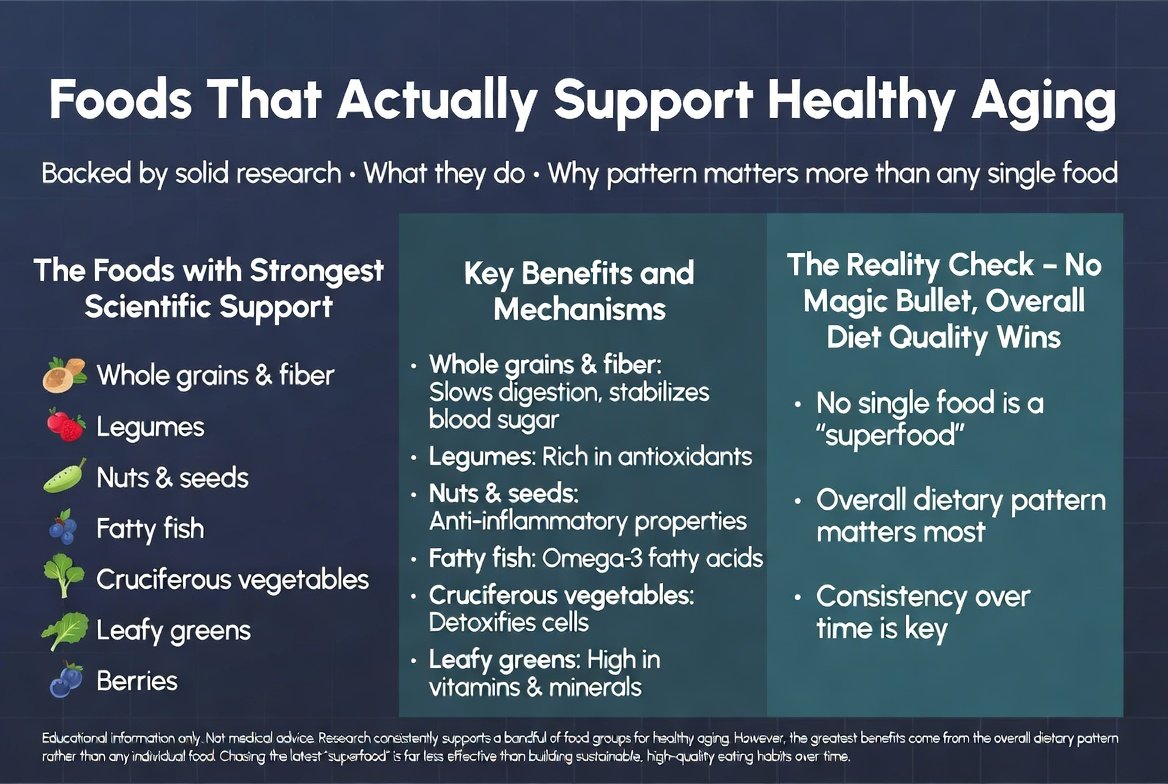
- Color on the plate: Vegetables and fruits rich in antioxidants (vitamin C, carotenoids, polyphenols) help neutralize some free radicals.
You can delve deeper into the topic in the guide Supplements for Skin, but the foundation is always a balanced plate, not pills.
7. Hydration: Drinking from the Inside, Moisture from the Outside
Drinking water won't 'plump' wrinkles; that's a myth. But true dehydration does make skin look dull, dry, and accentuates fine lines. The rule is simple: drink according to thirst throughout the day, and complement the external side with a moisturizer that traps water in the skin. The combination of reasonable drinking and external moisture is better than either alone.
8. Stress Management
Chronic stress is not just a feeling; it has a physical fingerprint on the skin. Sustained cortisol breaks down collagen, damages the skin barrier, and worsens inflammatory conditions like acne, psoriasis, and eczema. Good sleep, physical activity, breathing, and time in nature lower cortisol, and each of these also benefits the skin. This is why healthy lifestyle habits 'show' on the face.
What Ages Skin Faster
If the habits above are the positive levers, here is the negative list—things that accelerate aging and should be minimized:
- Sun without protection: The number one factor, by a margin. Tanning beds are included here and are especially dangerous.
- Smoking: Reduces blood flow and breaks down collagen.
- Excess sugar and ultra-processed food: Through glycation and inflammation.
- Chronic sleep deprivation: Less repair, more cortisol.
- Excessive alcohol: Dehydrates, dilates blood vessels, and worsens redness.
- Aggressive cleansing and exfoliation: Damages the skin barrier.
- Air pollution: Tiny particles generate free radicals, another reason to wash your face in the evening.
When to See a Doctor or Dermatologist
This guide deals with lifestyle habits, not treating medical conditions. There are signs that require professional evaluation and should not be ignored or 'treated at home':
- A mole that changes in size, color, shape, or borders, or a new mole after age 30, remember the ABCDE rule (Asymmetry, irregular Borders, uneven Color, Diameter over 6 mm, Evolution over time).
- A lesion that bleeds, itches, flakes, or doesn't heal within a few weeks.
- A new spot or lump that grows, stands out, or looks different from the rest of the skin.
- A persistent rash, redness, or irritation that doesn't improve, or severe acne that leaves scars.
- Any skin change that worries you, it's better to check and relax than to wait.
Periodic skin checks by a dermatologist, especially for those with fair skin, a history of sunburns, or a family history of skin cancer, are a smart part of a health routine.
In Summary: Consistency Beats Miracle Products
The great news from skin science is that most of what ages it is not fate. Daily sun protection alone does more than any expensive cream, rare serum, or aesthetic treatment. Following it are the simple daily decisions: don't smoke, sleep enough, cleanse gently, add a retinoid if desired, eat well, and manage stress.
There is no magic here and no single product that changes everything. There is a routine that repeats every day, and just like in all other aspects of longevity, the small habits you consistently maintain determine the outcome over decades. Your skin in twenty years is built from the choices you make this week.
Want more practical guides for health and longevity? Go to More Practical Guides.
References:
Hughes MCB et al. - Sunscreen and Prevention of Skin Aging: A Randomized Trial, Annals of Internal Medicine 2013
Weiss JS et al. - Topical tretinoin improves photoaged skin: A double-blind vehicle-controlled study, JAMA 1988
Okada HC et al. - Facial changes caused by smoking: a comparison between smoking and nonsmoking identical twins, 2013


💬 Comments (0)
Be the first to comment on the article.