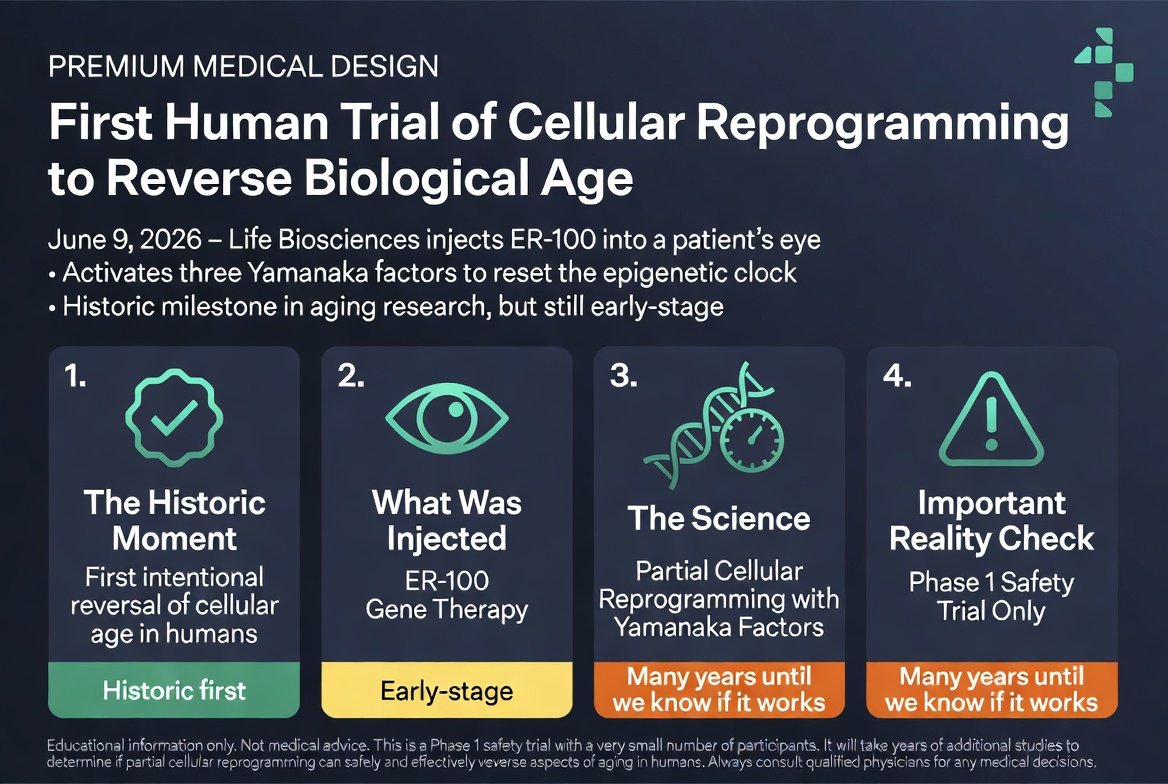
If you ever wondered what the "next step" of anti-aging looks like, the answer came in 2026: the most powerful method we have ever identified for reversing cellular aging—partial reprogramming—is being tested in humans for the first time. The company Life Biosciences, co-founded by Harvard aging researcher David Sinclair, received FDA approval and began a first-of-its-kind clinical trial. This is not speculation. It is happening.
The Story of Yamanaka Factors
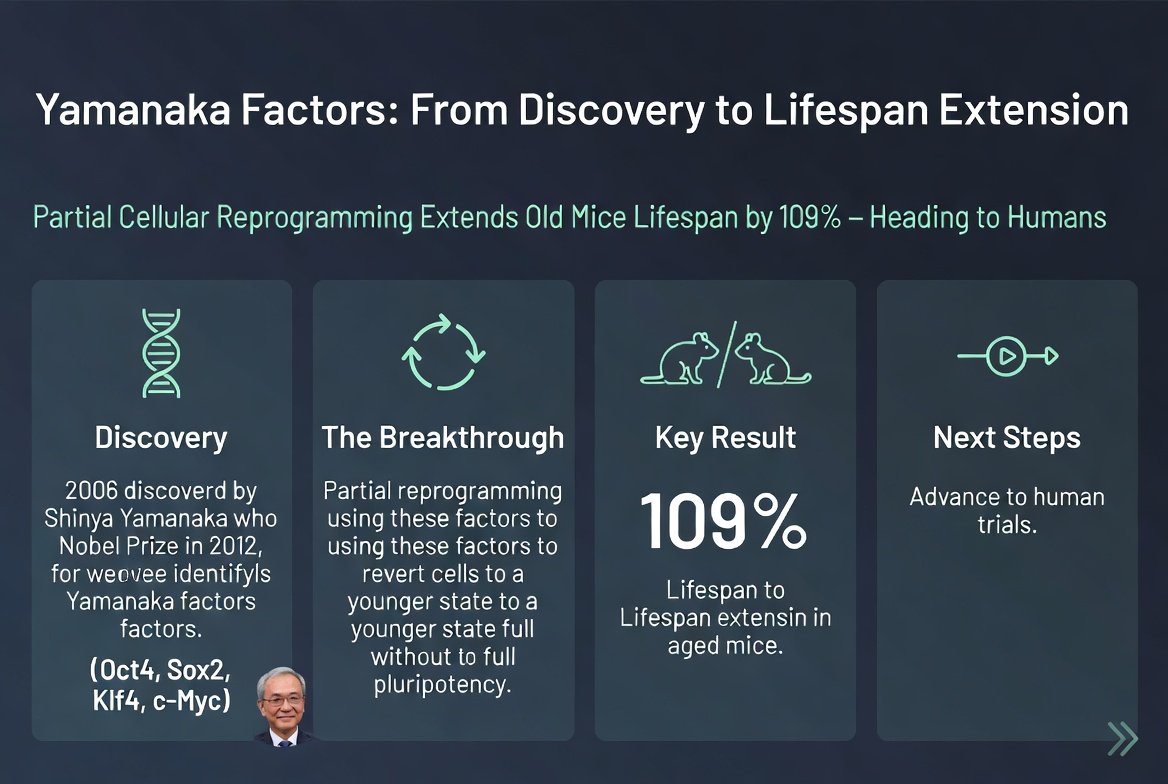
In 2006, Japanese researcher Shinya Yamanaka attempted a task considered impossible: reverting a mature cell to a stem cell state. He searched for the genes that make cells stem-like, and over time narrowed the list to just 4 genes: OCT4, SOX2, KLF4, MYC. When he introduced these four genes into a mature cell—they reversed it, creating induced pluripotent stem cells (iPSCs).
The discovery earned him the Nobel Prize in 2012 (along with British researcher John Gurdon). But there was a problem: the cell reverts fully to a stem cell. If you activate the genes in a skin cell, the cell becomes a stem cell—not a younger skin cell. This is not an anti-aging process—it is an "erasure" process.
The Shortcut: Partial Reprogramming
In 2016, a team in the lab of Juan Carlos Izpisua Belmonte at the Salk Institute (led by Alejandro Ocampo) made a critical change: they activated the Yamanaka factors only briefly and cyclically, then turned them off. Instead of full erasure—a short, repeated dose.
The result was astonishing: the cells did not revert to stem cells. They remained skin cells or muscle cells. But—they aged backward. In a mouse model of progeria (accelerated aging syndrome), the approach extended lifespan and improved multiple aging markers, without tumor formation. This was the first proof that partial reprogramming inside a living body could reverse the aging clock.
The next step came in 2020: a team led by Yuancheng Lu and David Sinclair from Harvard published a groundbreaking study in Nature showing that activating three Yamanaka factors (OSK, without MYC) in retinal ganglion cells of mice restored vision: it rejuvenated DNA methylation patterns, promoted axon regeneration after injury, and reversed vision loss in a glaucoma model and in old mice. This study made the eye the first target for the human trial.
Life Biosciences: From Lab to Clinic
Based on the research by Lu and Sinclair, Life Biosciences was founded, with Sinclair as a co-founder, and developed the experimental drug ER-100—the first clinical candidate from the "Partial Epigenetic Reprogramming" platform, based on the three factors OCT4, SOX2, and KLF4.
In January 2026, Life Biosciences announced FDA clearance of its IND application—the first time a cell rejuvenation therapy based on partial epigenetic reprogramming has reached a human trial. In June 2026, it was reported that the first patient in the trial had already received the drug. (It is important to clarify: Altos Labs, another company in the reprogramming field founded in 2022 with funding from Jeff Bezos and other billionaires, employing Belmonte and Yamanaka, is a separate entity and is not running this trial.)
The First Clinical Trial: What Does It Focus On?
The first trial will not be a general "anti-aging drug." To get FDA approval for such a novel technology in humans, a specific indication with urgent medical need must be chosen. The researchers chose optic nerve diseases (NCT07290244):
- How: Direct injection into the eye (intravitreal) of an AAV vector (viral delivery) carrying the Yamanaka factors without MYC—which poses a cancer risk.
- Why the eye: The trial includes patients with open-angle glaucoma (OAG) and non-arteritic anterior ischemic optic neuropathy (NAION)—conditions involving gradual death of retinal ganglion cells, for which there is currently no treatment that restores dead cells.
- Why specifically the eye: It is a closed, accessible, and relatively isolated organ—you can inject into it, monitor the outcome, and contain the treatment in one place.
- How it is controlled: Gene expression is regulated by a drug (doxycycline)—allowing the process to be turned off.
- Trial size: Up to about 18 participants—12 with open-angle glaucoma and 6 with NAION, at four sites in the US (Boston, New York, Los Angeles, and Charleston).
- Timeline: Long-term follow-up of about five years, with most visits in the first six months and then an annual visit.
What We Can Learn from Success (or Failure)
If the trial succeeds, it will prove 3 things that would be revolutionary:
- Humans can tolerate partial reprogramming without developing cancer—the main risk.
- Old cells in humans are capable of rejuvenation—not just in mice.
- The approach is scalable—heart, liver, brain, skin—all tissues could be candidates for a similar approach.
If the trial fails, we will learn the limits of the approach—perhaps variations of factors or more controlled delivery methods will be needed.
Remaining Risks
The team does not hide the concerns:
- Cancer: If cells are pushed too far "backward," they could become stem cells—and stem cells in the eye have the potential for teratoma (a tumor containing different tissues).
- Loss of cell identity: Retinal ganglion cells that undergo high-intensity reprogramming could lose their neural connections, thereby impairing vision instead of improving it.
- Immune response: The AAV viral vector could trigger a local immune response.
The Broader Perspective
If we consider Aubrey de Grey's 7-damage theory we wrote about two weeks ago, partial reprogramming is a direct response to several of them simultaneously—it resets not only epigenetic damage but also improves cellular function and renewal. This is why the scientific community sees it as perhaps the most powerful of all anti-aging approaches identified so far. However, it is important to remember: this is the first human test of the approach, and it is focused primarily on safety. It has not yet been proven that partial reprogramming reverses aging in humans.
If the eye trial succeeds, the next steps are likely within 5-7 years: trials in the heart (after heart attack), muscle (sarcopenia), and brain (Parkinson's, Alzheimer's). If everything goes well—in 15-20 years, we may see partial reprogramming treatments as the standard of care for elderly patients. And after that—who knows? Perhaps also for those who are not sick.
What This Means for You Now
Nothing direct. If you are 50+, the drug will not be available before you are 65. If you are 30, there is a high likelihood you will see revolutionary treatments in your later years. The best thing you can do now is to maintain your body until the treatments arrive: nutrition, physical activity, sleep, and most importantly—avoiding damage that will be hard to repair (smoking, harmful sun exposure to skin, chronic stress).
We are living in a special moment in human history. This is not hyperbole.
References:
Lu, Sinclair et al., Nature 2020 - Reprogramming to recover youthful epigenetic information and restore vision
Life Biosciences - FDA Clearance of IND for ER-100

💬 Comments (0)
Be the first to comment on the article.