Your gut is not just a digestive organ. It contains tens of trillions of bacteria (current estimates stand at about 38 trillion), archaea, and fungi, together forming a microbiome with a comprehensive impact on health. With age, the microbiome changes drastically, and these changes are linked to all major aging-related diseases: diabetes, heart disease, Alzheimer's, cancer. A new review in the San Francisco Chronicle, based on dozens of studies from 2026, provides a clear picture of what changes and what can be done.
What Happens to Your Microbiome with Age?
The studies summarize several consistent trends:
1. Decrease in Diversity
In each individual, there are usually several hundred different bacterial species living in the gut (the MetaHIT study found a median of about 160 species per person). The much larger number often seen in headlines, a thousand species or more, is an estimate at the population level, not for a single individual. With age, diversity decreases, and in unhealthy elderly individuals (frail, ill), it decreases even further. Low diversity = more susceptible to disorders.
2. Decrease in Beneficial Bacteria
Several beneficial species consistently decrease with age:
- Faecalibacterium prausnitzii: A butyrate producer (essential short-chain fatty acid). Its levels decrease in older adults (the magnitude of the decrease varies between studies)
- Lachnospiraceae: An entire family of bacteria that produce anti-inflammatory compounds
- Bacteroidaceae: Vitamin producers
- Roseburia: Improves muscle strength (as reported in another study)
3. Increase in Pro-inflammatory Bacteria
Concurrently, bacteria that cause inflammation or an imbalance increase:
- Potentially pathogenic strains of Enterobacteriaceae (such as certain E. coli)
- Anaerobic bacteria that produce LPS (lipopolysaccharides) causing systemic inflammation
The Story of Akkermansia muciniphila
This is one of the most interesting bacteria in the context of aging. It is an exception:
- In most healthy elderly individuals, its levels increase with age
- In frail elderly individuals or those with metabolic issues, its levels decrease
- It serves as a powerful health marker
Its role: to consume the mucus (gut lining) in a controlled manner, thereby strengthening the gut barrier. When it decreases, the gut barrier becomes "leaky" (leaky gut) and systemic inflammation begins.
Why Is This Important for Health?
Microbiome changes with age are directly linked to:
- Immune function. 70% of the immune system "lives" in the gut
- Systemic inflammation (inflammaging). Certain bacteria cause low-grade but chronic inflammation
- Brain function (gut-brain axis). Bacteria produce neurotransmitters that affect the brain
- Type 2 diabetes. Microbial composition predicts insulin sensitivity
- Muscle strength. Bacteria produce metabolites that affect muscle (see study on Roseburia)
- Vitamin digestion. Bacteria produce B12, K, and folic acid
How to Maintain a Healthy Microbiome?
What to Eat (Prebiotics)
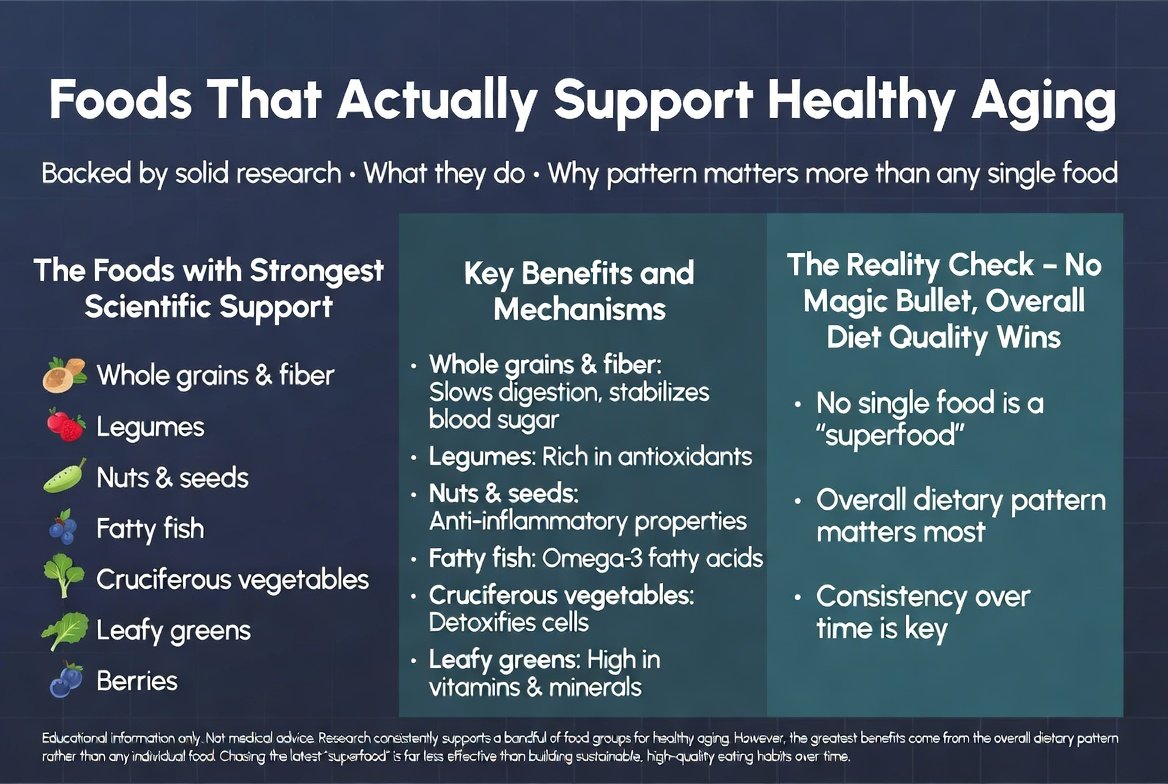
Fermentable fibers are "food" for beneficial bacteria:
- Inulin: Onions, garlic, artichokes, asparagus, unripe bananas
- Beta-glucans: Oats, barley
- Pectin: Apples, citrus fruits
- Resistant starch: Cooled legumes (rice left after cooking), green bananas
Fermented Foods (Probiotics)
- Yogurt with live cultures: Preferably choose a product that indicates live and active cultures
- Kefir: Fermented dairy product with a wide variety of bacterial strains
- Sauerkraut: Lactobacilli
- Kimchi: Wide diversity
- Miso and Tempeh: Fermented soy
- Kombucha: Fermented tea (less commercial bottles, more homemade)
What to Limit
- Antibiotics: Only when necessary. Every course also destroys beneficial bacteria
- Highly processed foods: Artificial sweeteners, emulsifiers, preservatives
- Refined sugar: Feeds harmful bacteria
- Alcohol: In excess, damages the gut barrier
Research-Based Supplements
If you want to add a supplement, here is what has been studied:
- Akkermansia muciniphila: Available as a supplement, but expensive. Promising results in small studies
- Bifidobacterium animalis Probio-M8: Improved muscle performance in a clinical trial
- Lactobacillus rhamnosus GG: A well-established strain studied for years
- Multi-strain probiotics: It is recommended to choose a product with multiple strains and follow the instructions on the package. There is no established universal dosage for all conditions
The Bottom Line
Your microbiome is not just about "digestion." It is part of your overall health in every dimension: from immunity to the brain. The changes that occur with age are real, but not inevitable. A diet rich in fiber, fermented foods, and a wide variety of foods can preserve a youthful microbiome even in old age. No magic is needed. Just consistency.



💬 Comments (0)
Be the first to comment on the article.