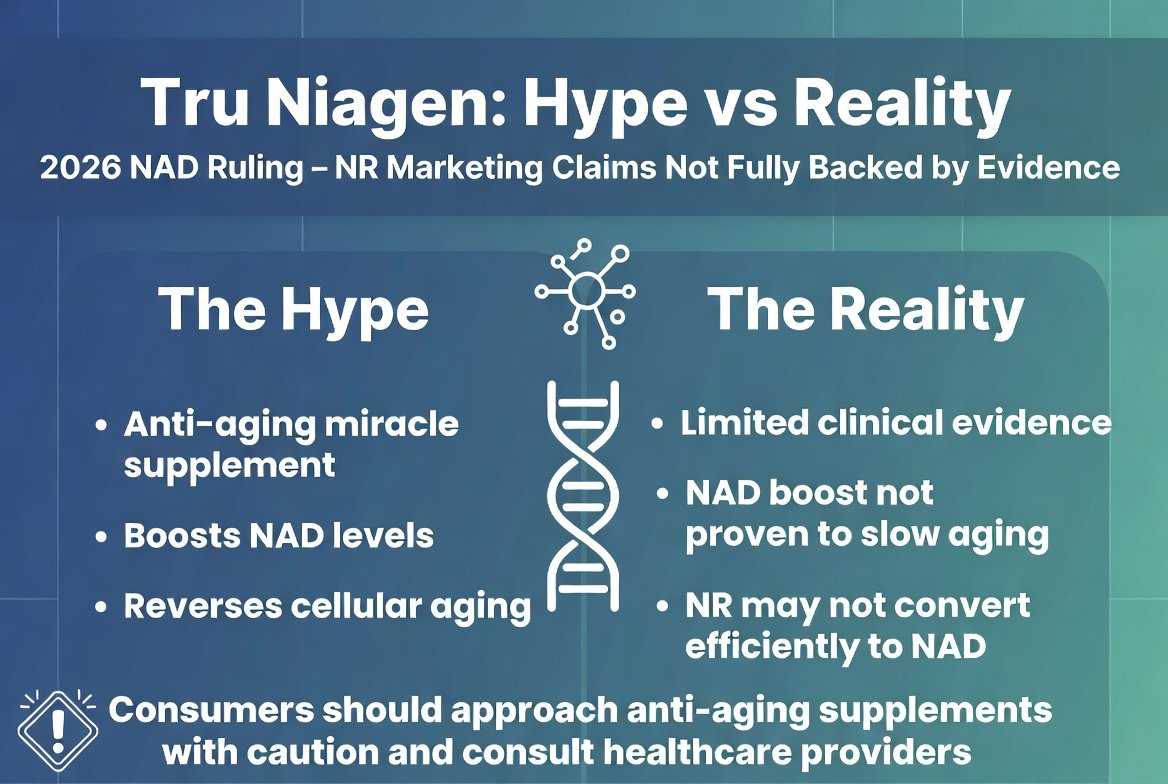
Over the past decade, NAD+ (Nicotinamide Adenine Dinucleotide) has become one of the most studied molecules in the anti-aging world. The story is simple and exciting: NAD+ levels decline significantly with age, and along with them, mitochondrial function, energy production, and DNA repair capacity also decline. Supplements that raise NAD+, primarily NMN (Nicotinamide Mononucleotide) and NR (Nicotinamide Riboside), are sold worldwide at a cost of billions of dollars annually.
But a new study from the School of Medicine at Case Western Reserve University, published in the journal Cancer Letters in 2026 and widely covered (including by Nutrition Insight on April 16, 2026), presents troubling findings: The same NAD+ that helps healthy cells age more slowly may also help cancer cells survive treatments meant to kill them. It is important to state upfront: these findings were obtained in the lab and in mice, not in humans. They are a evidence-based warning, not a clinical proof.
What is NAD+ and Why is it Essential
NAD+ is a coenzyme found in every living cell. Its functions include:
- Energy production, essential for the operation of the electron transport chain in mitochondria.
- DNA repair, the enzyme PARP, which repairs breaks in the DNA strand, consumes large amounts of NAD+.
- Cellular signaling, Sirtuin enzymes (including SIRT1, a key player in the anti-aging field) require NAD+ to function.
- Metabolic regulation, balancing energy production with the disposal of byproducts.
So far, the story is positive. The problem? Cancer cells need NAD+ just as much as healthy cells, and sometimes even more, to survive and divide.
Why Cancer Cells are Hungry for NAD+
Cancer cells are rapidly dividing cells that consume excessive energy and accumulate constant DNA damage due to their division rate. Each of these characteristics requires high NAD+ consumption:
- Rapid cell division = more DNA synthesis = more energy production in mitochondria = more NAD+ consumed.
- High oxidative stress (characteristic of cancer) = more DNA damage = more PARP activity = more NAD+ consumed.
- Survival against treatment: when chemotherapy tries to kill the cell through DNA damage and oxidative stress, a large NAD+ pool allows the cell to repair itself and avoid death.
An enzyme called NAMPT, which is the rate-limiting step in NAD+ synthesis, has been found in many studies to be overexpressed in many cancer types and linked to a worse prognosis. Precisely because of this, NAMPT inhibitors (drugs that block internal NAD+ production and deplete it) have been studied for years as anti-cancer drugs, highlighting how dependent cancer cells are on NAD+ for their survival.
The Evidence: What the New Study Actually Found
The Main Study: Pancreatic Cancer and Chemotherapy Resistance (Cancer Letters, 2026)
A team led by Prof. Jordan Winter from Case Western Reserve examined how NAD+ supplements (NMN, NR, and other forms of vitamin B3) affect pancreatic cancer cells. In both laboratory experiments (cell cultures) and mouse models, the supplements, especially NMN, protected pancreatic cancer cells from three standard chemotherapy drugs: oxaliplatin, 5-fluorouracil (5-FU), and gemcitabine.
The researchers described three mechanisms through which the supplements impaired treatment efficacy:
- Boosting the energy of cancer cells, making the tumors stronger and more resistant.
- Reducing oxidative stress in the tumor, thereby neutralizing one of the key mechanisms by which chemotherapy kills cancer cells.
- Suppressing DNA damage and cell death, blocking the very process that chemotherapy relies on to work.
In other words: the supplement provided cancer cells with exactly the fuel they need to survive doses of drugs that are supposed to be lethal. Prof. Winter called for routine review of supplement use in all cancer patients and for further clinical research on the interaction between NAD+ supplements and oncological treatments.
Another Warning Sign: NR and Breast Cancer in Mice
This is not an isolated finding. A previous study from 2022 (Maric et al.), which developed a bioluminescent sensor to track NR uptake in living mice, found a link between NR and NAD+ metabolism and metastasis: more aggressive breast cancer lines (triple-negative) absorbed more NR, and the supplement was associated with increased metastatic spread, including to the brain, in an immunocompromised mouse model. Like the pancreatic study, this involves mice and a specific model, not humans, but it is another red flag regarding the use of NAD+ supplements in individuals with active cancer or high risk.
Important for Balance: Vitamin B3 is Not Always Harmful
To avoid creating panic, it is important to qualify: Niacinamide (a form of vitamin B3) actually reduced recurrence of non-melanoma skin cancers in the controlled ONTRAC trial (NEJM 2015), where 500 mg twice daily lowered the rate of new tumors by about 23 percent in a high-risk group. That is, the effect depends on the context, the type of cancer, the form of the vitamin, and the dosage, and the specific warning here concerns NAD+ and its booster supplements (NMN/NR) in the setting of an existing tumor under treatment, not all vitamin B3 in all situations.
Why Hasn't This 'Made Headlines' Before?
The connection between NAD+ and cancer has been known to researchers for over two decades. NAMPT inhibitors, such as the molecule FK866 first described as early as 2003, have been studied as anti-cancer drugs precisely because depleting NAD+ harms cancer cells. That is, the dependence of cancer on NAD+ is well known, but the NAD+ supplement industry developed in parallel, based on studies in healthy mice, and sometimes without adequately addressing the implications for cancer patients or at-risk individuals.
Should We Stop Taking NMN?
The answer depends on who you are:
If you are a healthy person without elevated cancer risk
The evidence for a specific danger to you is limited, and most warning studies were done in cancer cells or mice with tumors. If you are healthy, with no family history of cancer and no risk factors, the risk remains theoretical at this stage. However, the proven anti-aging benefit in humans is also still limited.
If you have a family history of cancer
Caution is recommended. Pre-cancerous cells can exist in the body for years before developing into a visible tumor, and in principle, a supplement that raises NAD+ could also support such cells. It is advisable to consult a doctor before regular use.
If you are a cancer survivor or in active treatment
This is the most urgent message of the study: Talk to your oncologist before taking any supplement that raises NAD+, including NMN, NR, high-dose niacin, and intravenous NAD+. According to the preclinical findings, these supplements could impair the effectiveness of chemotherapy and help the tumor survive treatment.
If you are an older adult without known cancer history
Statistically, the likelihood of having pre-cancerous cells that have not yet been diagnosed increases with age. This is a consideration worth taking into account when deciding whether to start a regular NAD+ supplement, and a conversation with a doctor can help weigh it.
What to Do Instead
- Boost your NAD+ naturally. Intermittent fasting and physical activity raise NAD+ and activate AMPK and SIRT1 pathways without a pharmacological dose of a supplement.
- Regular physical activity supports NAD+ metabolism and mitochondrial health through physiological mechanisms, not by external flooding of the molecule.
- If you do take a supplement, carefully consider the dosage and consult a doctor, especially if you have risk factors.
- Adhere to cancer screening tests according to age and gender (e.g., colonoscopy, mammography, skin checks), especially if you take NMN/NR regularly.
- Consult a doctor or oncologist if you are a cancer survivor, in active treatment, or have a risk factor, before starting or continuing an NAD+ supplement.
The Broader Perspective
The NAD+ story is not the only one where a supplement considered safe turned out to be more complex than thought. Vitamin E, once considered a protective antioxidant, was linked in large studies to increased mortality at high doses. Beta-carotene was shown to increase lung cancer risk in smokers. The lesson repeats itself.
The bottom line: 'Natural' or 'sold over the counter' are not equivalent to 'safe for everyone in every situation'. Any biochemical intervention that is not routine in the body requires a personal risk-benefit assessment. NAD+ is a prime example: fascinating biochemistry, interesting potential, but not for everyone and not at every dose. Until we have large, randomized controlled trials in humans documenting both anti-aging benefit and oncological safety, caution is the reasonable approach, especially for cancer patients and survivors.
References:
Nutrition Insight - NAD+ Supplements May Fuel Treatment-Resistant Cancer Cells (16.4.2026)
Cancer Letters - Vitamin B3 derivatives support pancreatic cancer cell survival and chemotherapy resistance (Winter et al., 2026)


💬 Comments (0)
Be the first to comment on the article.